There is nevera dull moment for a robot on Mars.
A fleetingdust devil comes into view -- just right for picture taking. An outcrop of rockis found that yields insight into the planet's past. And then there's need totrudge over and around ever-larger sand fields to reach primetime science.
Thosespunky, full of life rovers -- Spirit and Opportunity-- continue to hit the dusty exploration trail on Mars.
Whirlwind watching
From itsvantage point up in the Columbia Hills at Gusev Crater, Spirit is hard at workand highly productive explained Steve Squyres, the lead scientist for the MarsExploration Rover (MER) project at CornellUniversity in Ithaca, New York.
Spirit hasbeen eyeing an outcrop named Methuselah, and last weekend took several hundredmegabits of Panoramic Camera images of the geology, Squyres said. Those imageshave helped ground controllers to pick a spot on the outcrop to move in forwork with the robot's instrument arm, he said.
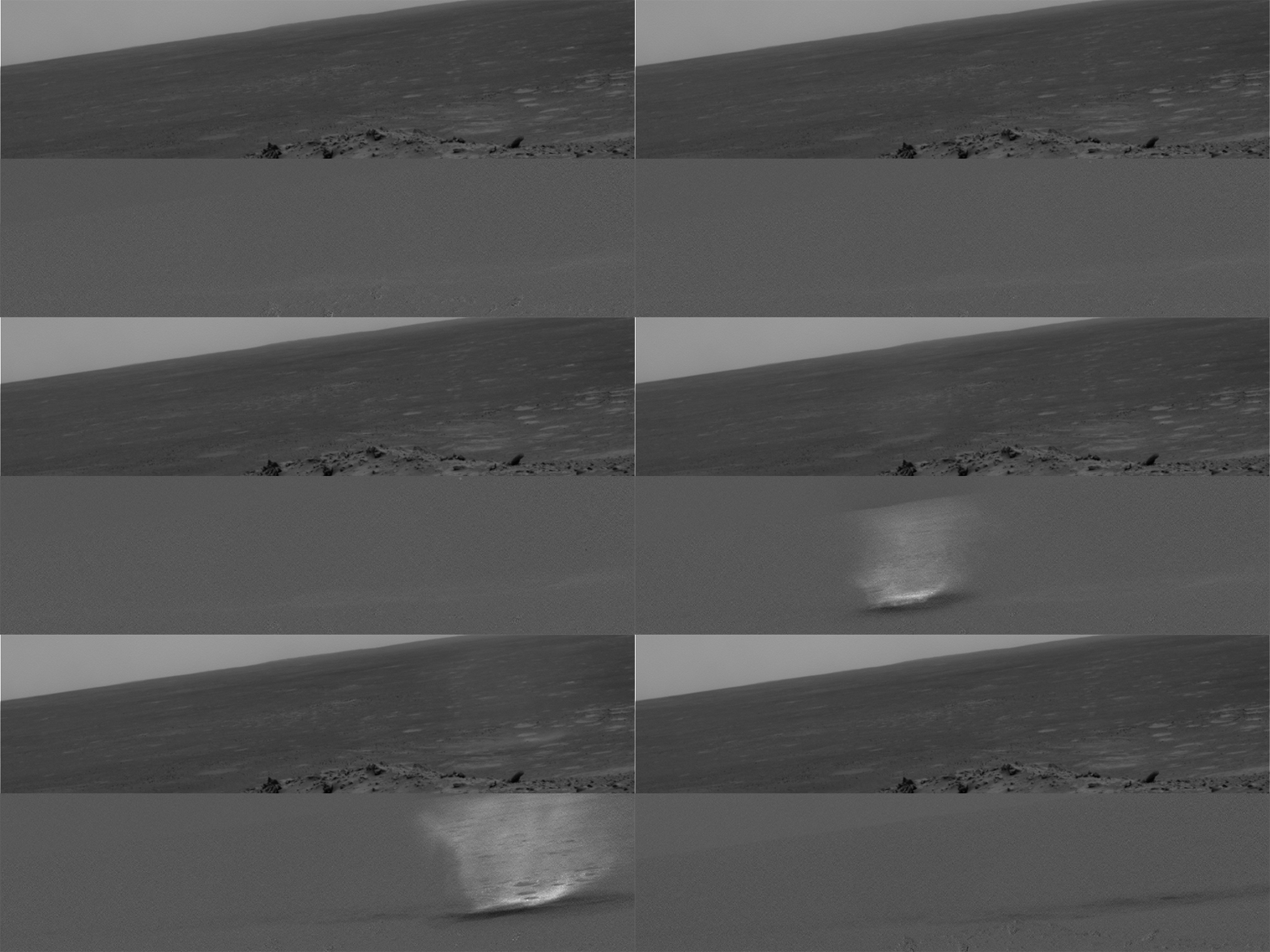
Spirit has also produced "blow by blow" movies of passing dust devils -whirlwinds that hoist dust from the martian surface highinto the air.
"The dustdevil movies are just spectacular," Squyres told SPACE.com. "We've known these things were out there, of course, andwe've seen them at low resolution on several occasions. But to see them upclose and moving like this was a real treat. And they're big!"
The largestdust devil recorded in the movies is more than 328 feet (100 meters) indiameter, Squyres said.
Slipping and digging in
Spirit'spresent position offers both a new view and new science, said MER science teammember, Larry Crumpler, a research curator in volcanology and space sciences atthe New Mexico Museum of Natural History and Science in Albuquerque.
Spirit's climbto that setting wasn't easy.
"Westumbled on this outcrop while driving away from Larry's Lookout a couple ofweeks ago. We were trying to drive up the slope towards the summit, and keptslipping and digging in like trying to drive up a road covered with deep snow.We were digging in...to the hubs. So we started to back down," Crumplerexplained.
"This isone of the more exciting places yet," Crumpler added. "We are about to do somereal field geology here on the side of the Columbia Hills. We are likely to behere for a while."
GivenSpirit's solar panel cleaning, apparently thanks to a passing dust devil, therover has lots of power. That being the case, the urgency to get to the summitof the hills is somewhat less than it was before, Crumpler advised.
"So we willhave time to carefully examine this new site the way you would if you stumbledupon it in the field here on Earth," Crumpler said. "In fact, it is just thissort of low, small outcrop with visible evidence of tilting that one usually getsexcited about -- and learns a lot about the geology from - right here on Earth.This is real field geology on another planet."
Story to tell
"It'sanother new mission," said Ray Arvidson, Chair of Earth andPlanetary Sciences at WashingtonUniversity in St. Louis, Missouriand the deputy principal investigator for the Mars Exploration Rovers.
Arvidsonsaid that for months it was clear that the rocks Spirit had in sight had astory to tell in terms of the origin and modification of the Columbia Hills.They were different than those seen in the plains of Gusev Crater, across whichthe robot had driven from its original landing spot.
Thegeometry of the rocks, their layering, how they conform to the landscape - all areclues that scientists are using to develop multiple hypotheses about theirorigin and the past history of the area.
One view,Arvidson suggested, is that Spirit is perhaps wheeling about a set of coalescedvolcanic cinder cones.
"You needall the observations...pieces of information to put the overall story together,"Arvidson said. Spirit will be hard at work within the area for about a month.The Mars machinery then has to wrap up its survey tasks and start heading southwardto follow the Sun, he explained.
Larger and larger ripples
Thenthere's Opportunity on the other side of Mars,tooling about at Meridiani Planum.
The roverhas started to rumble through what scientists called etched terrain, saidSquyres. "When you look at the etched terrain carefully, you see that there's alot of variability to it. Some of it has a distinct 'mottled' appearance, andseems likely to have a lot of exposed rock. We haven't gotten to any of thatyet...though we will soon," he said.
Squyressaid that other parts of the etched terrain have a distinctive north-south"grain" to the surface texture, but are more uniform in brightness.
"That's whatwe're in now. The 'grain', it turns out, is caused by these big parallelripples that we've been driving through. That wasn't obvious in the orbitalimages, but it's real obvious when you're down on the ground," Squyres noted.
And thoseripples have been getting larger and larger as Opportunityhas driven farther to the south. "We're handling them fine for now, but thelarger they get, the more of a challenge to driving they will pose," Squyressaid.
The next big goal for Opportunity is reachingErebus crater, nestled inside an even larger crater now named Terra Nova. "Sowe're going to pull up to the north side of Erebus, take a good look around,and then decide what to do next," Squyres said.
Beyond Erebus, but far off in the distance, sits another hoped for Opportunity science target: Victoria Crater.
Take home message
Thanks tothe work of Spirit and Opportunity, there's animportant take home message - this time for those blueprinting futureexpeditions of humans to the red planet.
"There's aclear message," Arvidson said. "What we're doing isreconnaissance...understanding the geological evolution and the role of water...helpingto hone in on the sites where you want to do detailed work," he said.
At somepoint in the future, there will be humans on the surface of Mars, Arvidsonsaid.
What'sapparent to Arvidson is that the optimal way to do exploration is with humansand robots acting together. "You can have a dozen of these rovers moving off invarious directions. Astronauts can be directing the robots, with humans thenfield-checking key areas. I look at it as an integrated system," he concluded.