


UPDATE: Story firstposted 11:00 a.m.
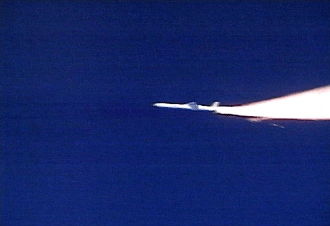
WASHINGTON - NASA officials have confirmedthat the DART rendezvous spacecraft bumped into its target satellite 760kilometers above the Earth during an April 15 mission that ended early when the$110 million experimental spacecraft ran out of fuel faster than expected.
"The DARTspacecraft did make contact with the target satellite during the rendezvousphase of the mission and boosted it into a slightly higher orbit," NASAspokeswoman Kim Newton said April 22.
Newton said neither DART (Demonstration of Autonomous RendezvousTechnology) nor its target satellite, a retired U.S. military spacecraft dubbedMultiple Path Beyond Line of Site Communication (Mublcom) satellite, appeared to have been damaged in theincident.
"There isno evidence that the DART spacecraft or the Mublcomsatellite received any damage at contact," she said.
The DARTprogram was managed by NASA's Marshall Space Flight Center in Huntsville, Ala.The spacecraft itself was built and launched by Orbital Sciences Corp., aDulles, Va.-based NASA contractor.
OrbitalSciences also built Mublcom, a 48-kilogramexperimental communications satellite that was built for the Pentagon's DefenseAdvanced Research Projects Agency and launched in 1999 aboard a Pegasus rocket,the same kind of rocket that carried DART aloft April 15.
DART, wasdesigned to approach within 5 meters of Mublcomwithout any guidance from spacecraft operators on the ground and perform aseries of maneuvers. The entire mission was expected to last less than 24hours.
NASAinitially reported that the self-guided DART spacecraft closed to within about100 meters of Mublcom before DART'sonboard computer detected that it had prematurely exhausted its onboardpropellant. The computer then called off the approach.
In an April16 conference call with reporters, DART Program Manager Jim Snoddysaid that once DART exhausted its fuel, the spacecraft executed apre-programmed plan to back off from the target and place itself in aretirement orbit meant to ensure its eventual re-entry into the Earth'satmosphere. Snoddy said DART accomplished some butnot all of its mission objectives and that NASA would be convening a mishapinvestigation board to determine what caused DART'smission to end early.
NASA hassince revised its understanding of what happened during DART and Mublcom's close encounter.
The firstindication that DART hit Mublcom came from groundcontrollers at Orbital Sciences who detected that the military satellite was ina slightly higher orbit than it was before its encounter with DART, accordingto Newton.
Newton said Marshallofficials first found out late in the day on April 20that Mublcom's orbit appeared to have changed. Shesaid the change of altitude was confirmed by the U.S. Air Force Space Command'sNORAD tracking station.
NASAreceived only a limited amount of telemetry data from DART while the missionwas still in progress. Newtonsaid a further detailed review of DART on-orbit mission data confirmed that thespacecraft made contact with its target.
Newton said after contact, "DART went onto complete its planned retirement phase and is still working, andcommunications from Mublcom show that it is stillfully functional."
DART is in aplanned retirement orbit intended to keep the spacecraft aloft for years tocome. The spacecraft is being tracked by the ground and is expected to re-enterthe atmosphere and burn up sometime within the next 25 years, Newton said.
NASA haspicked Marshallengineer Scott Croomes tolead the DART mishap investigation board.
Croomes,the deputy manager of Marshall'stest laboratory, said during a brief interview April 22 that the rest of theboard members would be announced by NASA headquarters by the end of the day.
"We arejust in the initial stages of getting the team together and we anticipategetting into full swing next week," he said.
Croomessaid the board is required to report back to NASA headquarters within 75 days.
OrbitalSciences President J.R. Thompson, during an April 21 conference call on thecompany's first-quarter earnings, told analysts that DART may have hit Mublcom.
"There issome data to suggest that indeed it got a lot closer [than 100 meters], andperhaps even touched the target," Thompson said. "All other DART systemsperformed as expected."
Thompsonsaid DART's fuel supply was used more quickly thanplanned "due to excessive propulsion system thrusting caused by noisy GPSsystem inputs," a conclusion that would suggest DART'sGPS-based navigation system did not receive clear information once the missionbegan.
NASAoriginally developed the DART mission to test technologies for the OrbitalSpace Plane project, which has been canceled. However, space agency officialshave said they consider autonomous rendezvous capabilities important tomissions as diverse as Mars sample return, satellite servicing and deliveringcargo to the international space station.
NASAproponents of servicing the Hubble Space Telescope robotically frequentlypointed to the DART mission as a confidence-building demonstration of some ofthe approach and rendezvous technologies that would be needed to fix Hubblewithout astronauts.
A NationalAcademy of Sciences panel, in a report issued late last year, said it felt manyof the technologies needed to mount a robotic Hubble repair mission were notready.
NASAAdministrator Mike Griffin said much the same thing April 18 during his firstpress conference, pronouncing the robotic servicing option "off the table."
Peter B. de Seldingcontributed to this report.