





Space Exploration Technologies(SpaceX) announced Friday that it will not attempt the secondlaunch of its Falcon 1rocket before mid-February.
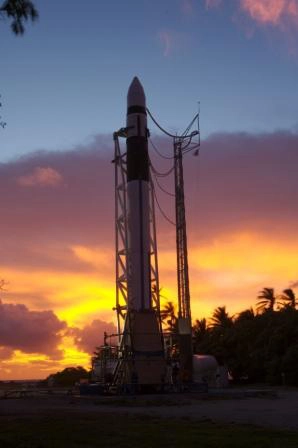
The announcement came the same daythe El Segundo, Calif.-based company was preparing to conduct a static fire testof the rocket in preparation for a plannedJan. 22 launch from the KwajaleinAtoll in the Pacific Ocean [image].
SpaceX CEOElon Musk, in an update posted on the company's website, said the decisionto postpone was due to concerns about the thrust vector control pitch actuatoron the Falcon 1's second stage. The anomaly was discovered during a finalcheckout of the Falcon 1 in preparation for the static fire, a thoroughon-the-pad shakeout of the rocket that culminates with a short four-second mainengine burn.
Since the suspect component does notcome into play during the static fire, SpaceX intends to go ahead and conductthe test between Jan. 20 and Jan. 23. After that, Musk said, the rocket will betaken back to its hangar to permit a thorough investigation of the thrustvector control issue.
SpaceX, which had reserved a two-daywindow for the launch attempt, loses use of the range for a while starting Jan.24 when the U.S. military is expected to begin preparation for an upcomingMinuteman missile test.
Musk said the company is nowplanning for a mid-February launch attempt, but emphasized that it is far fromcertain that the Falcon will actually lift off then.
"As I've mentioned previously, don'thold your breath for this launch," Musk said. "Given the large number ofrobustness improvements and the fact that our vehicle/pad health verificationsystem has increased from about 30 checks to almost 1000, shifts in the launchdate are to be expected. Overall, the SpaceX team is quite happy with thesmooth progress so far."
Gwynne Shotwell, SpaceX's vicepresident of business development, told SPACE.com that the Falcon 1launch's mid-February flight window opens on Feb. 18. The booster will carrytwo experimental payloads - including a low-cost satellite communicationstranceiver and an autonomous flight safety system - will launch aboard theFalcon 1's next flight, Shotwell added.
The upcoming launch is ademonstration flight paid for by the U.S. Defense Advanced Research ProjectsAgency (DARPA), which also paid for the Falcon 1's unsuccessfuldebut last March [image].
SPACE.com Staff Writer TariqMalik contributed to this report.