





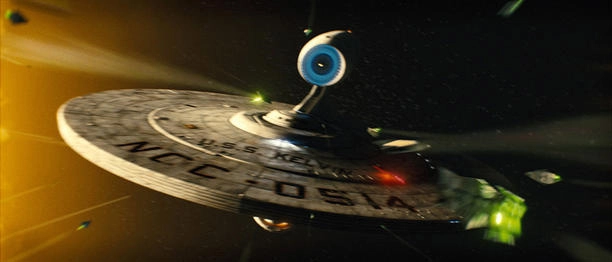
Thenew movie ?Star Trek? may have launched into theaters to reveal the origins ofCapt. James Kirk of the starship Enterprise, but director J. J. Abrams reliedon a veteran planetary scientist to make sure the film?s strange, new worldswere more science than science fiction.
Toadda touch of reality to the planets in ?Star Trek,? Abrams sought advice fromCarolyn Porco, the imaging team leader for the Cassini spacecraft currentlystudying the ringed planet Saturn and its many moons.
?Theywere very sincere about trying to get things as right as possible,? Porco told SPACE.com,adding that it would be impossible to show Saturn?s true face since thesunlight there is 100 times dimmer than it is on Earth. ?With that in mind, Ithink they?ve done a very nice job here while still maintaining all the whizbang and adventure of the Star Trek story.?
Porcojoined the Star Trek team as a science consultant for planetary science andimagery after Abrams saw her presentation on Cassini?s Saturn science at the2007 TED conference in Monterey, Calif. The new ?Star Trek? film, which updatesthe iconic television and film franchise, chronicles the first meeting of theU.S.S. Enterprise?s future Captain Kirk, science officer Spock and other crewas young Starfleet officers.
?It?sveryaction-packed. This is not a very slow-moving cosmic journey,? said Porco.?It?s actually lovely to see the start of a story that all of us have known nowfor 40years.??? ?
?Atfirst blush, it looks incredibly realistic and they did a very excellent jobwith all the planetary scenes,? Porco said, adding that she was excited to seea prominent scene featuring Saturn and its cloud-covered moon Titan.
Aftermonths collaborating with the Trek film?s visual effects supervisor RogerGuyett, Porco said she had only seen still photos of the Saturn and Titan sceneuntil she watched the film.
?Theydid put a scene from Saturn in there that I?m very happy with,? Porco said. Shealso asked for a small addition to the film, but wanted to preserve thesurprise for dedicated viewers who, like herself, plan to sift through the Trekmovie frame-by-frame when the film is released on DVD, Porco added.
Porcoheads the Cassini Imaging Central Laboratory for Operations (CICLOPS) at theSpace Science Institute in Boulder, Colo., where images of from theinternational Cassini probe are received and processed. The center releaseshigh-resolution views of Saturn and its rings via its Web site: http://ciclops.org.
NASAlaunched Cassini in 1997 and the spacecraft arrived in orbit around Saturn in2004. The mission, an international effort by NASA and the European and Italianspace agencies, is in the middle of its first extended phase. Cassini alsocarried the European Space Agency?s Huygens probe, which landed on Titan?sshrouded surface in 2004.
Porco is afrequent commentator on science, astronomy and space exploration and is no strangerto film production. She served as a consultant in the film "Contact,?based on astronomer Carl Sagan?s book, and as a science advisor and ananimation director for ?Cosmic Journey,? a television special that marked the25th anniversary of the Voyager mission to the outer planets.
Porco alsoplayed a prominent role on the Voyager mission and is also an imaging scientiston NASA's New Horizons mission, which is headed toward the distant worldPluto. She has a space rock named after her — Asteroid (7231) Porco — forher contributions to the exploration of the outer solar system.
- New Video - Star Trek's Leonard Nimoy: "I Cried a Lot!", Part 2, Part 3
- New Video - Star Trek: Director J.J. Abrams
- Top 10 Star Trek Technologies
