


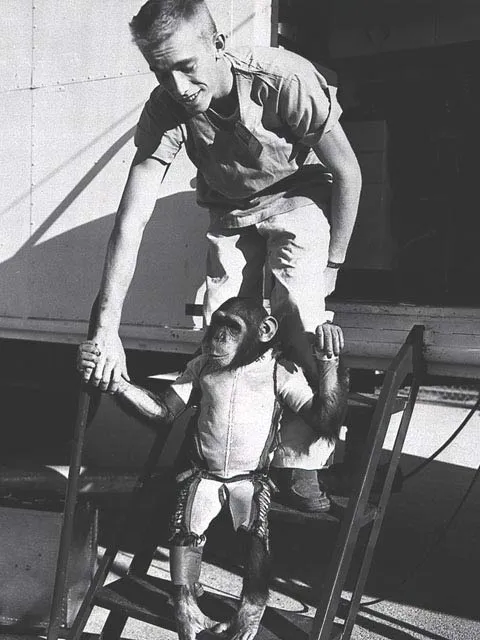
Chimps may represent the forgotten link in the evolution of human spaceflight.
A new documentary and a separate upcoming animated film both hearken to the early days of the U.S. space program, when chimpanzees preceded men into the great unknown of space.
"Most people don't really want to acknowledge the chimpanzee missions as particularly historic," said David Cassidy, director and producer of the documentary "One Small Step: The Story of the Space Chimps."
But when Cassidy dug up footage of the U.S. Air Force's chimp program from the national archives and other sources, he also found press reels celebrating the exploits of the space chimps Ham and Enos. Ham paved the way for the first American to ever fly in space, Alan Shepherd, and Enos flew before just before John Glenn orbited the Earth.
Film footage reveals a time when the infant U.S. space program struggled to successfully launch rockets, let alone humans. That prompted the Air Force to train a group of chimps to test the physical effects of launch and spaceflight.
The documentary includes interviews with Ham's handler, who fondly recalled the chimp as "a sociable little guy" who adored the people around him. By contrast, Enos tended to give humans the cold shoulder.
Cassidy does not skimp on the darker side of the space chimp story. Some scenes that make for hard viewing include decompression sled tests which caused brain damage in chimps and human volunteers alike, as noted in the film by an Air Force physiologist. Chimp training appears to have involved a combination of rewards, such as juice sips, and punishment through electric shocks.
The act of chimp spaceflight was no laughing matter, either. Ham's apparent grin of happiness upon his return to Earth actually signified "the most extreme fear" through his baring of teeth, according to the film's interview with renowned biologist Jane Goodall.
However, Cassidy pointed out that people were just beginning to understand the intelligence and capabilities of chimpanzees in the 1960s.
"Most of the humans involved in the program grew very attached to the chimps and treated them very decently," Cassidy told SPACE.com.
That did not prevent the Air Force from eventually putting its chimp colony up for sale after the first successful human spaceflight missions. Although Ham lived out the rest of his life at the National Zoo in Washington, D.C. and the North Carolina Zoo in Asheboro, N.C., most chimps ended up at a biomedical research facility in Alamogordo, New Mexico.
Twenty one chimps were eventually rescued by Carole Noon, a biological anthropologist who sued the Air Force for custody and founded the Center for Captive Chimpanzee Care in Florida. The center now houses the largest chimp sanctuary in the world with over 135 residents.
Cassidy made the documentary after first hearing Noon's story, because he thought the chimps "need to be treated with a certain level of dignity" after their contributions to the U.S. space program. He pointed to the Russians, who unveiled a monument to Laika the space dog this past April.
"It's kind of fantastical when you think that we treated chimps like humans, trained them, dressed them up in space suits, and shot them up," Cassidy said. "You see how it can inspire an animated film."
That upcoming animated film "Space Chimps" takes a decidedly lighter tone with Ham III, the future grandson of Ham, and a crew of chimponauts blazing new trails for humanity by piloting a spacecraft through an inter-dimensional wormhole. They end up on a planet teeming with alien life and political intrigue — a mission outcome that scientists can only dream of.
A "Space Chimps" video game will also accompany the film's July 18 release, featuring single player and cooperative modes with plenty of simian acrobatics in colorful alien environments.
Perhaps chimps may one day play another role in dangerous space exploration, but they'll face stiff competition from robotic probes. Still, it's worth remembering that one small step into space that threw the doors open for human spaceflight.
"One Small Step: The Story of the Space Chimps" was directed and produced by David Cassidy, and is available at www.spacechimps.com. The "Space Chimps" animated film was produced by Vanguard Animation/Twentieth Century Fox, and will open in theaters on July 18. The "Space Chimps" video game will be released in July on PS2, X360, Wii, and NDS.
- Video: Orbital Animals
- Video: Jane Goodall's Wild Chimpanzees
- Vote for the Best Manned Missions