





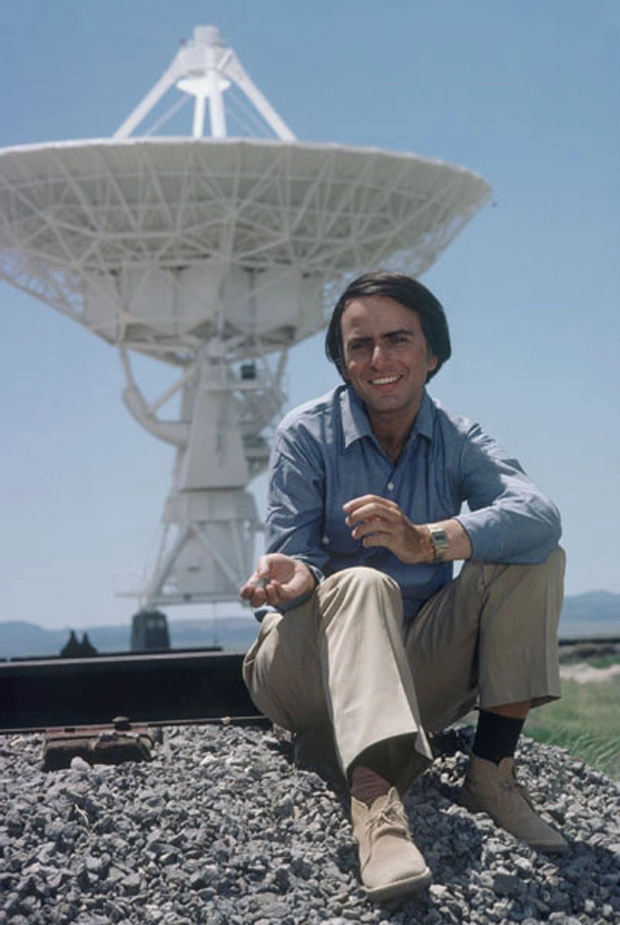
The noted late astronomer Carl Sagan once said that we are, all of us, made of star-stuff.
But instead of just telling us that our atoms in our bodies were created in the furnace of long-dead stars, Sagan worked to show us - in simple terms - using what is likely one of the most easily accessible mediums of all time, television.
In the 13-part series Cosmos that first aired on the Public Broadcasting System (PBS) in 1980, Sagan dutifully explained the history of our planet, the origin of life, the life cycle of stars and a host of other topics that cemented his name in the scientific lexicon.
Sagan himself died in 1996, but Cosmos survived and now - 25 years later - returns to television care of The Science Channel and Cosmos Studios. Digitally remastered and enhanced with fresh computer graphics unheard of at the time of its recording, Cosmos premieres once more tonight at 9 p.m. EDT (check local listings).
"I really think it's a tribute to Carl," said Ann Druyan, Cosmos Studios CEO and Sagan's widow, who co-wrote the science series. "To me, it's a kind of instant scientific literacy."
Much has changed since Cosmos first aired that threatens to cast the series into irrelevance. The Hubble Space Telescope launched into orbit and opened up the distant corners of the universe for observation. Robot missions flew to Mars - two still crawl across its surface and another orbiter is on the way - Saturn, Jupiter and their moons, not to mention comets and asteroids. Imagery from those missions pepper Cosmos' new incarnation.
"I love this chance to cut away from Carl and really show the most visually dazzling concepts," Druyan said, adding that at the time of its original recording, budgeting restriction forced Cosmos to rely heavily on Sagan's in-person narration. "The Hubble didn't even exist then, and we've leaned heavily on Hubble images here."
Despite its age, Cosmos seems to remain eerily poignant, especially in the second hour when Sagan states firmly that "evolution is fact, not a theory."
The simple pronouncement, aired in 1980, hits home a quarter century later when the concept of evolution is again under debate from supporters of intelligent design in U.S. courtrooms and schools.
"It's amazing how much Cosmos speaks to us today," Druyan says.
Cosmos' return to television also brought a new requirement for the show, commercial breaks, which were absent when it first aired on public television but acceptable price for admission to the Cosmos.
Parts 1 and 2 of Cosmos premieres tonight on The Science Channel at 9 p.m. EDT (Check local listings).
