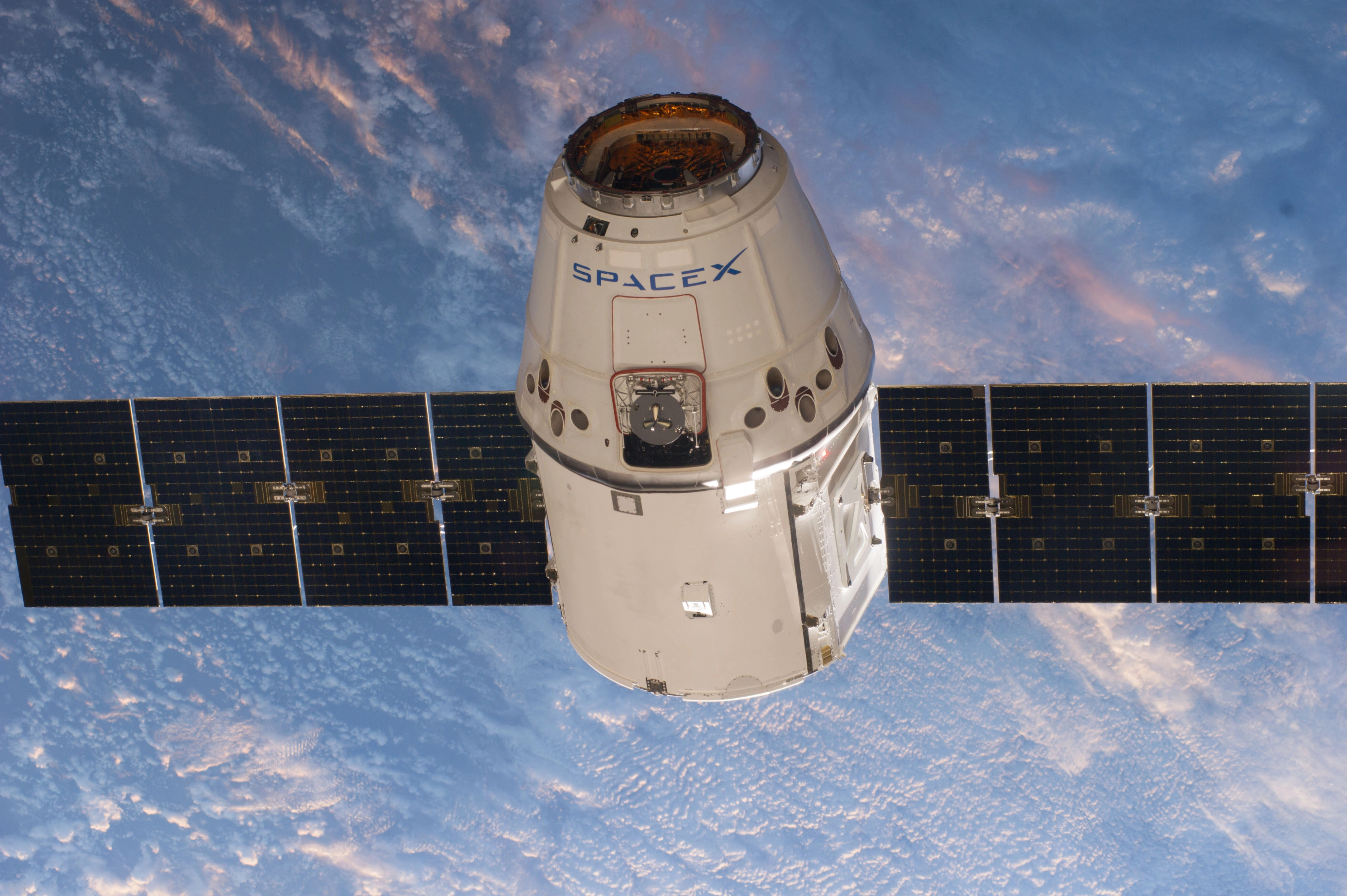
SpaceX's Dragon cargo spacecraft has safely splashed down in the Pacific Ocean off of Baja California, Mexico. The vessel returned to Earth with more than 3,000 lbs. (1,360 kilograms) of cargo and science experiments, including 12 mice.
The crewless spacecraft was released from the International Space Station earlier this morning by NASA astronaut Kate Rubins and Japanese astronaut Takuya Onishi using the station's robotic arm. The spacecraft returned to Earth at 11:47 a.m. EDT (1547 GMT) today (Aug. 26), NASA officials said in a statement.
"Good splashdown of Dragon confirmed, carrying thousands of pounds of @NASA science and research cargo back from the @Space_Station," SpaceX officials tweeted.

Space station astronauts packed the capsule with NASA cargo, equipment and research samples making the journey home. After a successful landing in the Pacific Ocean, the spacecraft was retrieved by SpaceX employees and taken by ship to a port near Los Angeles, where some of the cargo was removed to be sent to NASA.
The Dragon space capsule arrived at the space station July 20 carrying experiments, science equipment, tools and supplies for the space station crew. Dragon also delivered a very important piece of hardware: the first of two international docking adapters (IDAs), which will let future spacecraft dock directly with the U.S. segment of the space station.
Among the science materials that returned to Earth in the capsule are 12 mice kept on the space station for 30 days. Now that the animals have returned, researchers plan to analyze DNA from the mice's organs, as well as DNA of the spacefaring animals' offspring. The results of this study will help researchers better understand the effects of microgravity on DNA expression.
Astronauts on the space station had a busy week preparing the Dragon space capsule for its return to Earth, and their work is far from over.
Thursday (Sept. 1), Rubins and Expedition 48 Commander Jeff Williams will head out on another spacewalk to retract a thermal-control radiator that is no longer operable and to install at least one high-definition camera onto the station's exterior. Retracting the radiator will help protect it from space debris and preserve it as a spare for the station, NASA officials said in a briefing.
Williams, who recently set a new American record for most days in space, will return home Sept. 6 with Russian cosmonauts Oleg Skripochka and Alexey Ovchinin.
Follow Samantha Mathewson @Sam_Ashley13. Follow us @Spacedotcom, Facebook and Google+. Original article on Space.com.