



The Starry Jewels of the Orion Constellation Explained
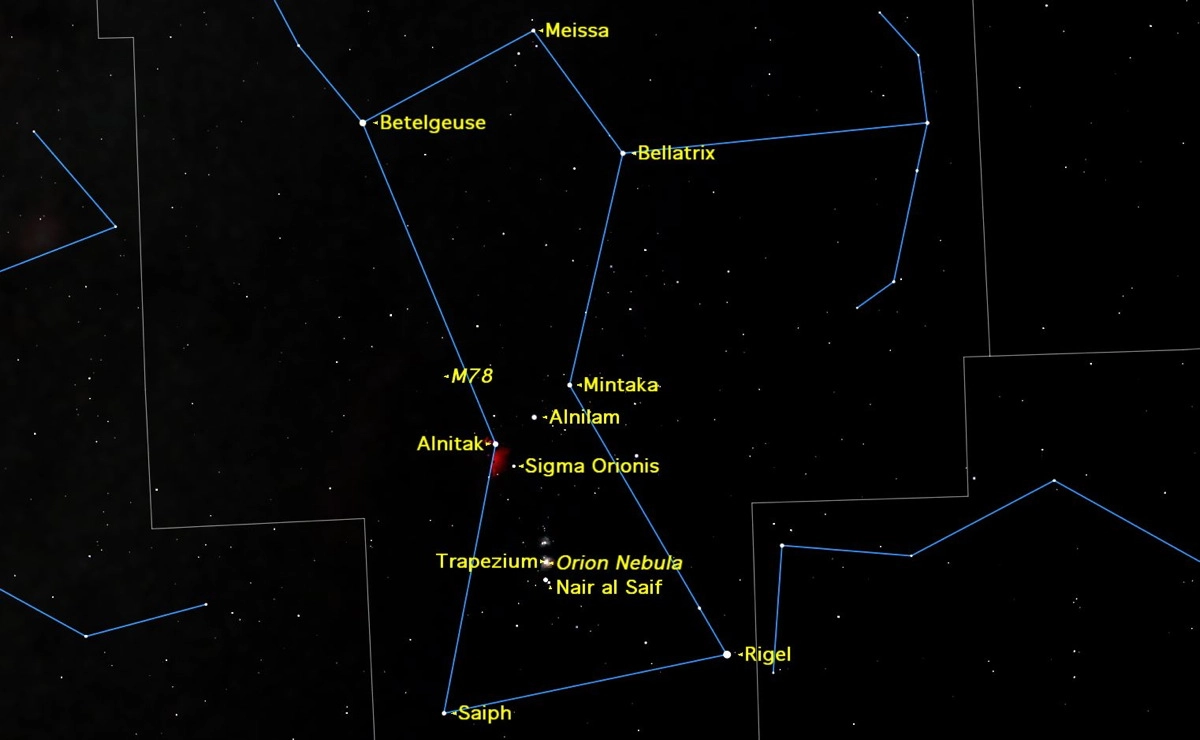
The famed constellation of Orion is one of the most recognizable star patterns in the night sky, and poses a dazzling sight for observers this month, weather permitting. Simply look south around 8 p.m. your local time, and you will see this mighty hunter of the skies.
The ancient poet Manilius' description of the Orion constellation, written more 2,000 years ago, is still an excellent summary of what you can see with your unaided eyes under a dark country sky:
Now near the Twins, behold Orion rise;
His arms extended measure half the skies:
His stride no less. Onward with steady pace
He treads the boundless realms of starry space,
On each broad shoulder a bright star displayed.
And three obliquely grace his hanging blade.
In his vast Head, immersed in boundless spheres,
Three stars less bright, but yet as great, he bears;
But farther off removed, their splendour's lost;
Thus grac'd and armed, he leads the starry Host.
—Manilius (1st c. BCE), translated Thomas Creech (1670)
Four bright stars mark Orion's shoulders (Betelgeuse and Bellatrix) and his knees (Saiph and Rigel). Three stars in a perfect row, canted at a jaunty angle, mark his belt (Alnitak, Alnilam, and Mintaka), from which his sword hangs, again marked by smaller three stars. Above his shoulders, a small cluster of stars, centered on Meissa, mark his head.
If you own a set of small binoculars, say the 7x50 or 10x50 size, take a closer look at Orion. Several of his stars can be seen to be double, such as Mintaka (the right most star in his belt) and Theta (the middle star in his sword). A closer look at Theta shows it to be bathed in haze: this is the famous Orion Nebula.
Most of the stars in Orion are blue-white in color. That is because these are very hot, newly formed stars. In fact the area of Orion is one of the richest star-forming regions in our part of the Galaxy. Long exposure photographs show vast amounts of glowing gas in this area, out of which new stars are being formed.[The Constellations: Night Sky Star Patterns in Maps]
A small telescope will show you that many of these newborn stars are double or multiple. Probably the most amazing star system is the Trapezium, buried in the heart of the Orion Nebula. As its name suggests, this is actually a quadruple star, with one star brighter at magnitude 5.1, two in between at magnitude 6.7, and one fainter at magnitude 7.9. Large telescopes will show at least 4 more tiny stars within this group. Interestingly enough, when William Herschel observed this star two hundred years ago, he didn't see these four extra stars, which has made some astronomers wonder whether they have just started to glow in the past two centuries.
If you have a telescope, check out all the stars shown in our chart. All but three of them are double or multiple stars.
The Orion Nebula, in the center of Orion's sword, is a rewarding sight in every telescope. Try observing it at different magnifications. Low powers will show its huge spreading wings. High powers will resolve its clouds, which Herschel described as looking like clouds breaking up in a mackerel sky. If you have nebula filter, be sure to use it on the Orion Nebula. [Amazing Photos of the Orion Nebula]
The Orion Nebula is actually double, and Charles Messier gave it two different numbers: M42 for the main nebula, and M43 for its smaller section, separated from M42 by a dark gulf called the Fish Mouth. Messier also discovered a smaller nebula which he catalogued as M78.
The leftmost star in the belt is called Alnitak, and is another wide double. Just below it is Sigma Orionis, a remarkable triple star with components of magnitude 4.0, 6.5, and 7.5, easily resolved in binoculars.
Between Alnitak and Sigma is an extremely faint band of nebulosity, so faint that it requires a special filter (hydrogen beta) to become visible. This is where the famous Horsehead Nebula is located. Though a popular target for astrophotographers, this is an extremely challenging object for visual observers. It appears as a faint darker smudge in front of the faint nebulosity, and can only be seen with fully dark-adapted eyes under perfectly dark skies with the special hydrogen beta filter. When conditions are perfectly right, it has been seen with 20x80 binoculars. I personally have seen it with a 127mm refractor.
I have made my descriptions with Orion oriented as seen by observers in the Northern Hemisphere. This constellation is located right on the celestial equator, so everything can be seen equally well in the Southern Hemisphere, but you will need to reverse the directions.
Orion is truly a jewel box of astronomical treats for stargazers of every level of ability.
This article was provided to Space.com by Simulation Curriculum, the leader in space science curriculum solutions and the makers of Starry Night and SkySafari. Follow Starry Night on Twitter @StarryNightEdu. Follow us @Spacedotcom, Facebook and Google+. Original article on Space.com.
