






Late-Rising Moon to Vanish From Evening Sky This Week
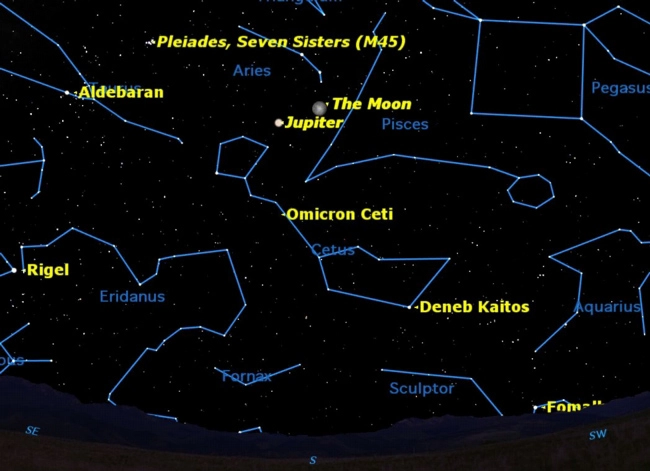
Although the moon is shining brightly tonight (Oct. 12), just a day past full, in a few nights it will disappear from the evening sky, leaving many backyard observers to wonder: Where's the moon?
Though the motions of the moon may seem complicated, there are really just two things going on. First, the Earth is rotating on its axis once every 24 hours. Second, the moon is revolving in its orbit around the Earth once every 29.5 days.
The rotation of the Earth causes the moon (along with the sun, planets, and most of the stars) to appear to rise and set every day. Almost everything in the sky moves in grand arcs from the eastern horizon to the western horizon, taking roughly 12 hours to do so. The only exceptions are stars close to the celestial poles, which circle the poles without ever setting. [Infographic: Phases of the Moon Explained]
The sky map of the moon here shows its position in the evening sky.
The revolution of the moon is much slower, and is somewhat masked by the daily rotation of the Earth. The main effect is that the moon seems to move relative to the background stars by about 12.2 degrees every 24 hours. Tonight the moon appears just to the right (west) of the bright planet Jupiter; by tomorrow night it will have moved so that it appears just to the left (east) of Jupiter.
A secondary result of the moon's motion is that it rises about 50 minutes later each night. Last night, when the moon was full, it rose in the east just about the same time the sun was setting in the west ?the only night in the month when this happens. For example, last night in New York City, the sun set at 6:22 p.m., and the moon rose at 5:52 p.m. Tonight the sun sets at 6:21 and the moon also rises at 6:21. Tomorrow night the sun sets at 6:19 and the moon rises at 6:52.
The pattern is clear: We're just past fall equinox, and as the sun sets slightly earlier each night, the moon is moving eastward through the stars, so it is rising about half an hour later each night. At other times in the month, it rises more than 50 minutes later.
In a week's time, the sun will set at 6:10, but the moon won't rise until midnight, after most people have gone to bed. People will look at the evening sky and ask, "Where's the moon?"
The trick for seeing the moon next week is to look for it not in the evening, but first thing in the morning. It will be a waning crescent (because it has moved a quarter of the way around the Earth) and it will be high in the southern sky.
This may be puzzling to anyone who doesn't understand the two things affecting the apparent motions of the moon: the rotation of the Earth and the revolution of the moon.
This article was provided to SPACE.com by Starry Night Education, the leader in space science curriculum solutions. Follow Starry Night on Twitter @StarryNightEdu.
