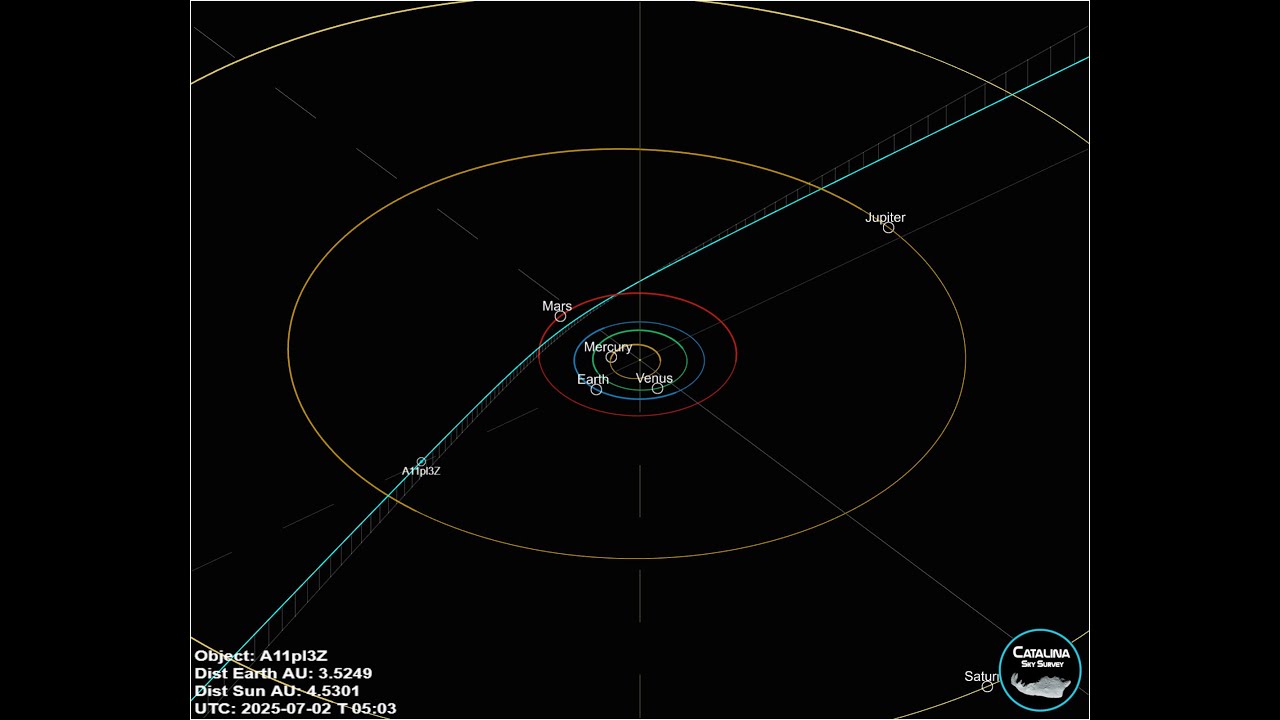
A rare but faint interstellar visitor from beyond our solar system is racing toward the sun — and you can watch it live online today!
Astronomers have identified this cosmic interloper as 3I/ATLAS, making it only the third confirmed object from outside the solar system after 'Oumuamua (2017) and comet 2I/Borisov (2019). The interstellar comet, originally designated C/2025 N1 (ATLAS), was observed on July 1 by the NASA-funded ATLAS (Asteroid Terrestrial-impact Last Alert System) telescope in Rio Hurtado, Chile. It has since been designated 3I/ATLAS by the Minor Planet Center (MPC), with "3I" marking it as the third known interstellar object.
"There are tentative reports of cometary activity," The MPC report states. "With a marginal coma and a short 3" tail".
You can watch comet 3I/ATLAS live online tonight (July 3), thanks to the Virtual Telescope Project, which will livestream views beginning at 6:00 p.m. EDT (2200 GMT). The feed will showcase imagery from telescopes in Manciano, Italy, weather permitting. Tune in via Virtual Telescope's WebTV, YouTube channel or here on Space.com.
Currently, 3I/ATLAS is about 4.5 astronomical units (AU) — or 670 million kilometers (416 million miles) — from the sun according to NASA, and around magnitude 18.8, far too faint for backyard telescopes.

But it's expected to brighten slightly as it approaches perihelion (closest point to the sun) on Oct. 30, when it will pass just 1.4 AU (130 million miles or 210 million km) from the sun inside the orbit of Mars.
The Virtual Telescope Project captured a photo of the interstellar visitor on July 2, using one of its robotic telescopes to track the object's motion across the sky. In the 120-second exposure, the comet appears as a sharp point of light, while the background stars show short trails due to their relative movement.

The object is speeding through the solar system at 68 kilometers per second (152,000 mph) relative to the sun, and it poses no threat to Earth, according to NASA.
After dipping behind the sun in late fall, 3I/ATLAS is expected to reappear in early December, giving astronomers another chance to study this rare visitor from beyond our cosmic neighborhood.