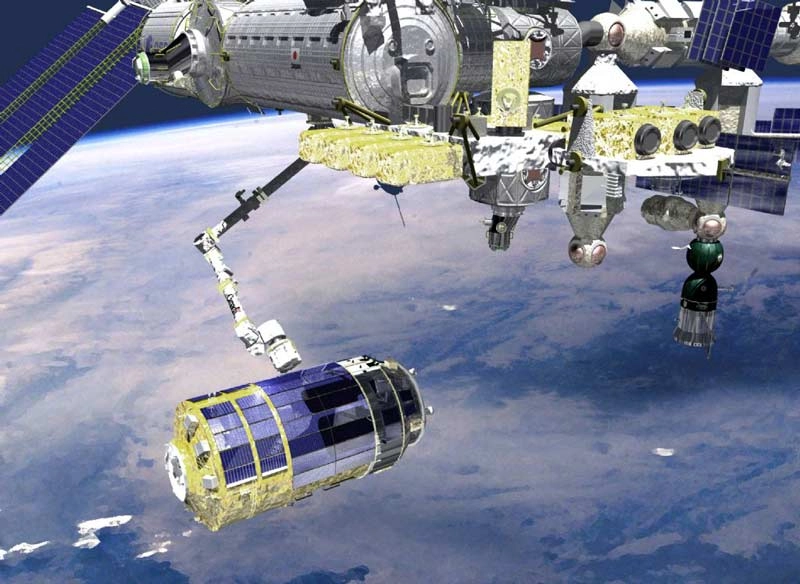
Japan?sfirst unmanned cargo ship is closing in on the International Space Station, wheresix astronauts are eagerly awaiting its arrival.
The cargoship, called the H-2 Transfer Vehicle 1 (HTV-1), is due to arrive at the spacestation today at 3:50 p.m. EDT (1950 GMT) after a week-long shakedown cruise. TheJapan Aerospace Exploration Agency (JAXA) launched the spacecraft last week ona maidenvoyage to deliver tons of supplies for the station?s six-person crew.
?It?s veryexciting,? JAXA spokesperson Naoko Matsuo told SPACE.com. ?[Today?s] maneuveris a very critical mission, so we hope we can show our techniques well.?

The HTV-1is Japan?s first automated spacecraft capable of ferryingvital supplies for use inside and outside the International Space Station.It is the latest spacecraft to join an international fleet of unmanned cargo vehiclesserving the station, which include Russia?s Progress freighters and theAutomated Transfer Vehicles built by the European Space Agency.
But unlikethe other disposable cargo ships, the HTV-1 is not designed to dock at thespace station on its own. Instead, it will fly up below the station to a pointabout 33 feet (10 meters) from the orbiting lab.
From thatpoint, station astronauts Nicole Stott of NASA and Frank de Winne of Europewill have just 99 seconds to grab onto the Japanese spacecraft using the spacestation?s Canadian-built robotic arm. It will be the first time the station armwill be used to grapple a free-flying spacecraft.
?I haveevery confidence that the vehicle is going to be stable and operate as weexpect,? Stott said in an interview before flight. ?And I also have confidencethat if that doesn?t happen, we have been trained to handle it.?
Stott andde Winne have a remote control panel inside the station that they can use to commandthe HTV-1 to retreat away from the station if today?s rendezvous goes awry. Butso far, the spacecraft has performed well during a series of free-flying abortand rendezvous tests.
?We have noproblems,? Matsuo said. ?So everything is going well.?
JAXAlaunched HTV-1 early on Sept. 11 Japan Standard Time using the brand newH-2B rocket, which lifted off from the Tanegashima Space Center in southernJapan. It was still afternoon on Sept. 10 at NASA's station Mission Control Center in Houston at launch time.
JAXA alsobuilt the space station?s $1 billion Kibo laboratory, a massivefacility the size of a tour bus that has two windows, an attached storageroom, robotic arm, small airlock and exterior science platform. The Kibo labwas completed in July after more than a year of space construction.
Station?snew delivery ship
The HTVspacecraft is 33 feet (10 meters) long, 14 feet (4.4 meters) wide and coveredin solar panels attached to its cylindrical hull. It is capable of hauling upto six tons of cargo to the space station, but HTV-1 is carrying about fivetons for its maiden flight, NASA officials said.
Unlike thestation?s European and Russian cargo ships, the vehicle is designed to carrypressurized cargo for use inside the station, as well as unpressurizedcargo for use outside the outpost. The external hardware rides on a giantdrawer that can be plucked from the cargo ship with the station?s robotic arm. HTV-1is carrying two experiments to study Earth?s atmosphere and the spaceenvironment.
Reliablecargo shipments from different spacecraft are vital to continue supporting thespace station?s six-person crew. NASA?s space shuttle fleet is due to retire by2010 or so, and with it will go the shuttle?s ability to haul massive loads tothe orbiting laboratory.
JAXAofficials have said that about $680 million has been spent developing the HTVspacecraft since 1997. The HTV-1 vehicle alone costs about $220 million and isdesigned to be jettisoned to burn up in Earth?s atmosphere after about a monthat the station, they added. Japan plans to build one HTV a year to support thespace station crew.
The stationis currently home to two Americans (Stott is one of them), two Russians, aCanadian and de Winne, a Belgian astronaut representing the European SpaceAgency. The astronauts have been anticipating HTV-1?s arrival with a series of practicesessions to rehearse today?s planned rendezvous and grapple.
?We see ourselvescomplete with for preparations for HTV-1,? Stott radioed Mission ControlWednesday.
- Video - Japan's Spaceship Dreams: Part 1, Part 2
- Video - Inside Japan's New H-2B Rocket
- Video - Maiden Flight of Japan's Space Freighter
