


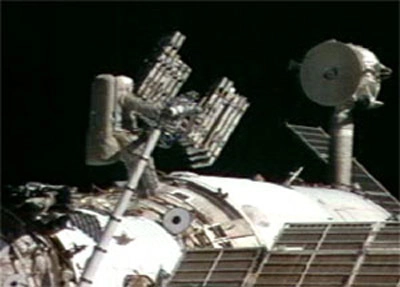
Two Russianspacewalkers will step outside the International Space Station (ISS) for thesecond time Wednesday to finish attaching new micrometeorite shields to their high-flyinglaboratory?s hull.
ISSExpedition 15 commander Fyodor Yurchikhin and flight engineer Oleg Kotov aredue to begin the second spacewalk of their six-month space mission at 10:30a.m. EDT (1430 GMT).
?It?s veryimportant that we continue with our Russian EVAs,? Yurchikhin told reportersbefore a May 30spacewalk, or extravehicular activity (EVA), also aimed at installing newISS shielding.
Yurchikhinand Kotov are both making their second career spacewalks with today?sexcursion, which also comes two days before the planned launch of NASA?s space shuttle Atlantis carryingseven astronauts and new solar arrays bound for the ISS.
Expedition15 flight engineer Sunita Williams will watch over the progress of her twocrewmates from inside the ISS and help choreograph their activities.
Guardingagainst space rocks
Clad intheir Russian-built Orlan spacesuits, Yurchikhinand Kotov are expected to spend just over five hours attaching 12 one-inch(2.5-centimeter) thick metal panels and other equipment to the exterior of thespace station?s Russian segments. The spacewalkers attached five other panels,known as Service Module Debris Panels, on the outpost?s Zvezda service moduleduring their excursion last week.
Each panelweighs between about 15 and 20 pounds (about seven to nine kilograms) andcovers a two-foot by three-foot (0.6 by 0.9 meters) patch of space stationhull, NASA officials said. The shields will help guard the space stationagainst damage from tiny space rocks -- or micrometeorites -- and orbitaldebris from jettisoned rocket stages, satellites and other spacecraft. Thepotential collision with micrometeorites and debris has been one of the toprisks to the space station, NASA has said.
?We?ve beenworking on these for years, actually since prior to the first launch of thespace station,? Kirk Shireman, NASA?s deputy ISS program manager, said of theincreased shielding. ?We actually launched the space station in 1998. Andthrough 2016, if you look at that life, there?s a lot of debris that we?ll flythrough in that time frame and so that?s why it?s our highest risk.?
OutfittingISS
In additionto installing the new station shielding, Yurchikhin and Kotov are expected tothread a 43-foot (13.1-meter) Ethernet cable along the exterior of the ISS andattach a Russian science experiment to the orbital laboratory?s hull.
The Ethernetcable, which will run along handrails mounted to the station?s Russian-builtZarya control module, is part of a computer system upgrade for the ISS. Asecond cable will be installed in a later spacewalk.
Biorisk,a Russian-built experiment to study the effect of weightlessness onmicroorganisms, will also be mounted to the space station?s Pirs dockingcompartment -- the starting point for today?s EVA -- during the spacewalk. Itsthree cylindrical sample containers will be retrieved by future spacewalkers.
?It will bethe first EVAs for both of us and we?re really looking forward to performingthis job,? Kotov told reporters before the two spacewalks. ?We?re verywell-trained and that?s why we?re very sure of our success.?
NASAwill broadcast today?s spacewalk outside the International Space Station liveon NASA TV beginning at 10:00 a.m. EDT (1400 GMT). Click here for SPACE.com?s live spacewalkupdates and NASA TV feed.
- Shields Up! Cosmonauts Install Protective Space Station Panels
- VIDEO: Meet the ISS Expedition 15 Crew
- Complete Space Station Mission Coverage
