Boris Morukov, Veteran Cosmonaut Who Led Mock Mars Mission, Dies at 64
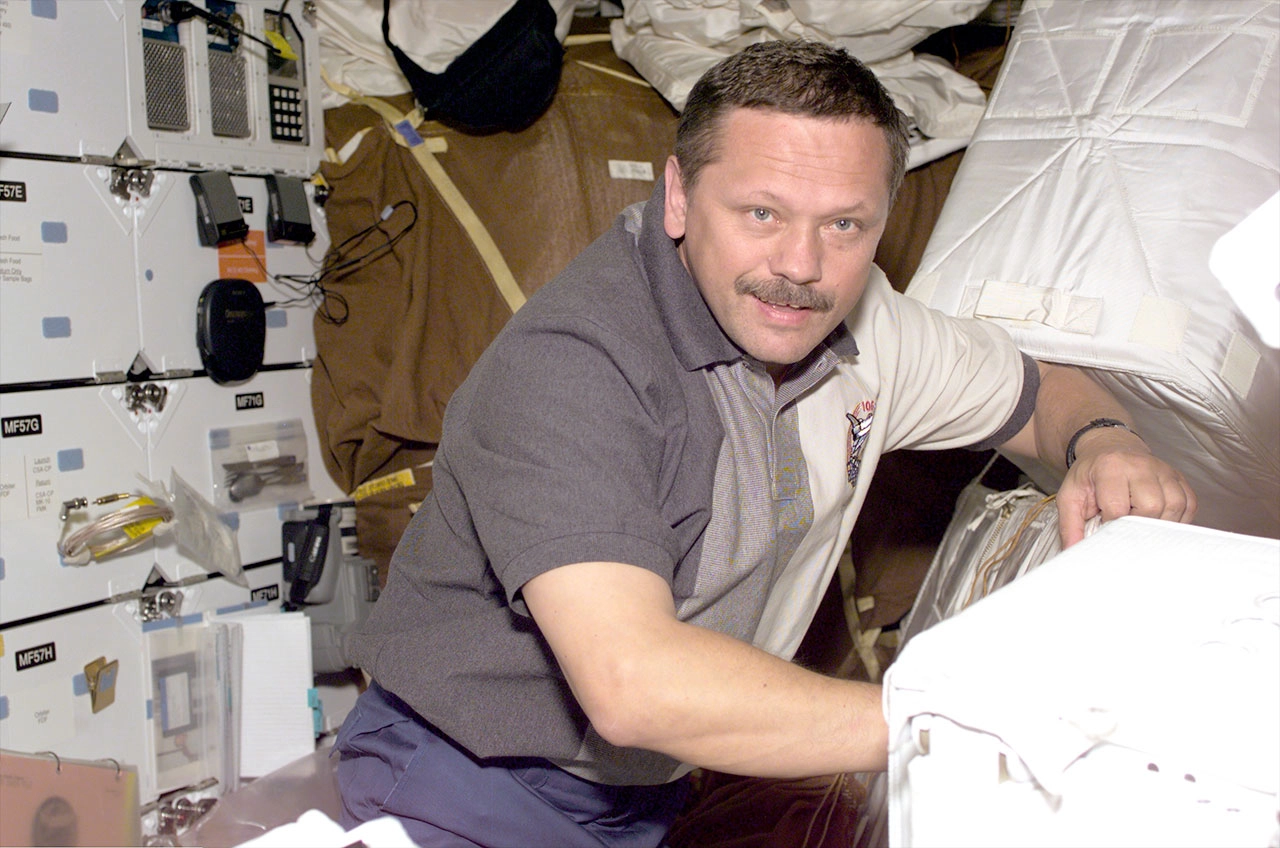
Russian cosmonaut Boris Morukov, a physician who visited the International Space Station and led a 520-day simulated Mars mission, died Thursday (Jan 1). He was 64.
Boris Morukov's death was reported by the Russian Academy of Sciences Institute for Biomedical Problems (IBMP), where he served as the deputy director of science since 2006. A cause of death was not given.
"Morukov will forever remain in our hearts as a talented scientist, brilliant organizer and kind, sympathetic person," IBMP officials said in a statement.
Selected in January 1989 with the fifth group of Russian doctors to train as research cosmonauts, Morukov made his only spaceflight in September 2000 onboard the U.S. space shuttle Atlantis. As an STS-106 mission specialist, Morukov helped to outfit the International Space Station's Russian-built Zvezda service module in preparation for the arrival of the outpost's first expedition crew later that same year.
During the flight, Morukov was tasked with unloading more than 1,300 lbs. (600 kilograms) of supplies that were earlier launched onboard a Russian Progress cargo ship. He also assisted with moving equipment from the shuttle Atlantis to the space station. [Giant Leaps: Biggest Milestones of Human Spaceflight]
As part of that work, Morukov and NASA astronaut Daniel Burbank resorted to using a hammer and chisel to remove some rivets holding a floor bracket in the Russian Zarya functional cargo block (FGB). Finally freeing the panel, the cosmonaut and astronaut were then able to replace a unit controlling the flow of current from one of the module's six batteries.
One of only two flown Russian cosmonauts to never fly on a Russian spacecraft, Morukov logged a total of 11 days, 19 hours and 10 minutes in space. He remained an active cosmonaut for seven years after returning to Earth, retiring from the corps in November 2007.
Boris Vladimirovich Morukov was born on Oct. 1, 1950 in Moscow. He received his doctorate of medicine from the Second Moscow Medical Institute (now Moscow Medical University) in 1973, he received a Ph.D. in space, aviation and naval medicine six years later.
Morokuv joined the IBMP as a researcher in 1978, where he provided medical support for crewed space missions. From 1979 to 1980, he worked as a staff member in the TsUP Mission Control Center, supporting the cosmonauts working onboard the Russian space station Salyut 6.
Morukov's medical research at IBMP primarily focused on the crew members' metabolic changes in the microgravity environment of space. To that end, he organized a series of experiments, including a 370-day study dedicated to the testing of an experimental countermeasure to the negative effects of spaceflight.
"[Morukov] was well known to many of us in the space life sciences community for the breadth of his knowledge and his enthusiasm for understanding the effects of space on human physiology," wrote John Charles, chief of NASA's international science office in its human research program, in a remembrance he posted to Facebook.
"As the senior researcher in metabolism and immunology at IBMP," Charles added, "Boris was directly involved in planning the Russian component of our joint investigations on the upcoming year-long ISS expedition."
From 2007 to 2011, Morukov served as project director for Mars500, which culminated in a full-length simulation of a human mission to Mars. For 520 days, six crew members lived and worked inside an isolated mock spacecraft and Mars landing module located at the IBMP in Moscow.
"A key thing we cannot simulate is the feeling of danger," Morukov told reporters of the Mars500 crew. "They were always aware of us following them from behind the wall."
Morukov was bestowed with the "Leader in Public Medical Service" award in 1989 and the "For Merits to Motherland" medal of the 2nd degree in 1996. He is the author of more than 100 scientific papers and was awarded patents for four inventions.
Follow collectSPACE.com on Facebook and on Twitter at @collectSPACE. Copyright 2015 collectSPACE.com. All rights reserved.