



Russia's Prime Minister Wants Space Agency Overhaul By September
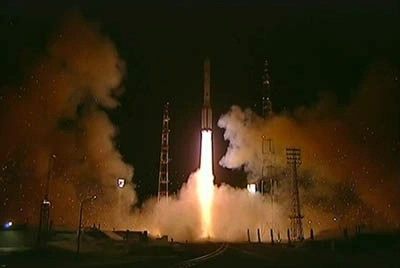
GOUDARGUES, France — The Russian government has given Russia’s space agency, Roscosmos, until mid-September to propose ways to improve quality control in Russia’s space industry, particularly its launcher sector, in the wake of the Aug. 6 failure of a Proton rocket carrying two telecommunications satellites.
Russian Prime Minister Dmitry Medvedev, in Aug. 14 remarks to Russian government and industry officials, said the number of failures in recent years is inexcusable for an industry in which the government continues to invest heavily.
He said government space spending between 2012 and 2015 is scheduled to be 650 billion Russian rubles, or about $20.4 billion.
Medvedev, whose remarks were posted on the Roscosmos web site, said he found it particularly galling that a rocket or satellite failure results in no automatic punishment to the company building the hardware.
“It is possible to produce low-quality products,” Medvedev said, and bear “no financial responsibility” for their failure — “not to mention… disciplinary and other responsibilities. You need to decide who is to blame for the recent series of setbacks, where mistakes were made, and determine the degree of responsibility of all those implicated.”
Medvedev ordered Roscosmos Director-General Vladimir A. Popovkin to propose measures to improve industrial quality control and to reorganize the space agency in a month’s time. [50 Russian Rocket Launch Photos]
“Both of these issues must be worked out at the government level in a month,” Medvedev said. “Then I will hold a meeting with all key business sectors. Other decisions will be taken. Let's start the discussion.”
Medvedev’s statement prompted widespread speculation in Russia that, in addition to a reorganization of Roscosmos, the government had ordered the dismissal of Vladimir Nesterov, general director of Khrunichev Space Center of Moscow, which builds most elements of the Proton rocket.
But as of late Aug. 16 Nesterov had not been dismissed, according to a statement from Khrunichev.
“The general director of Khrunichev can be appointed to his post, or dismissed, only by the Russian Federation President,” Khrunichev said in the statement, which was provided by its U.S. commercial Proton sales arm, International Launch Services (ILS) of Reston, Va. “Since the president has not signed a decree to dismiss him, Mr. Nesterov will continue to act as Khrunichev GD.”
Beyond Nesterov’s status, Khrunichev clearly has been feeling the heat of adverse government commentary since the failed Aug. 6 rocket launch, in which the Proton Breeze-M upper stage shut down prematurely and stranded Indonesia’s Telkom-2 and Russia’s Express-MD-2 telecommunications satellites in useless orbits.
Proton Breeze-M launches have been suspended since the failure. ILS had been planning to launch satellites for Intelsat of Washington and Luxembourg; EchoStar of Englewood, Colo.; Gazprom Space Systems of Moscow; and Satmex of Mexico in the next couple of months.
Responding to what it said were inaccurate reports of its track record, Khrunichev issued two statements on its web site Aug. 14 and 15 that detailed the company’s launch and financial performance since 2008.
In the past five years, Khrunichev said, it has launched 48 Proton rockets, four of which failed. One of these, in December 2010, was caused by a defect in the Block DM upper stage — hardware made not by Khrunichev but by RSC Energia of Korolev, Russia.
That December 2010 launch failure destroyed four Russian Glonass positioning, navigation and timing satellites and ultimately forced the dismissal of the head of Roscosmos and the appointment of Popovkin.
Khrunichev also builds the Russian Rockot small-satellite launcher, which has launched eight times since 2008 and failed once; and the Cosmos-3M vehicle, which has conducted five launches, all successful, since 2008.
Khrunichev has been the focus of a broad consolidation of Russian space-hardware builders in recent years and now controls almost the entire production line for major Proton components.
The company said it has added 17,000 employees as part of the government-ordered industry consolidation, including enterprises that were in bad financial shape and needed immediate restructuring.
Proton production rate has nearly doubled to 12 rockets per year, and the new-generation Angara family of rockets is scheduled to make its inaugural flight in 2013, both for the light-class Angara 1.2 and the heavy-lift Angara-5, both of which will operate from northern Russia’s Plesetsk Cosmodrome.
Khrunichev reported revenue of 43.6 billion rubles in 2011, up 20 percent from 2010. The ILS Proton commercial sales business was responsible for most of the revenue, generating $777 million in 2011, an increase of nearly 22 percent from 2010.
This story was provided by Space News, dedicated to covering all aspects of the space industry.
