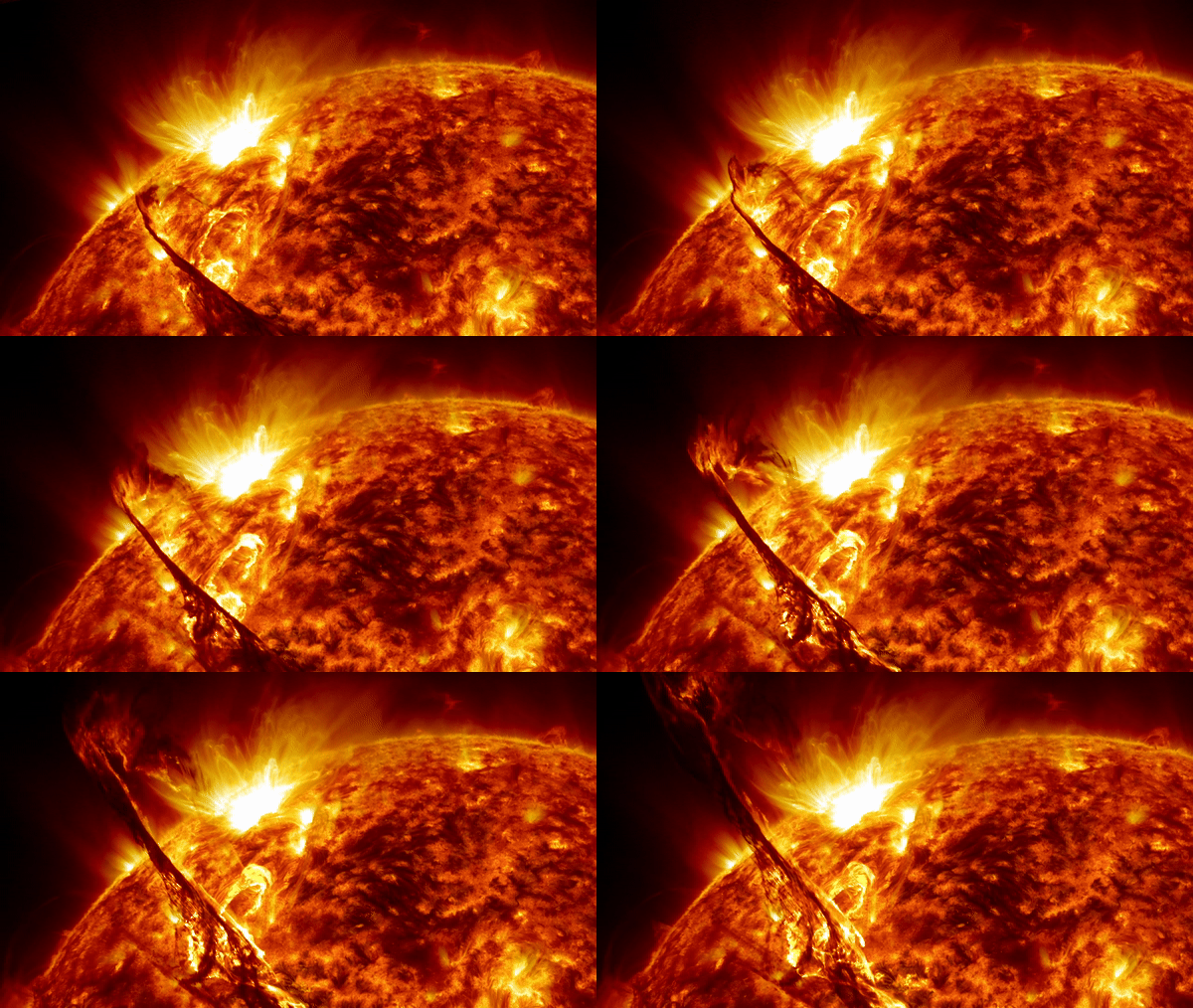
Earth is no stranger to solar storms. Just this year we've been bombarded with storms, some so powerful they've triggered jaw-dropping auroras deep into mid-latitudes.
Modern technology ensures that very little goes unnoticed. A fleet of satellites constantly monitors space weather, while scientists analyze data and study its effects on Earth. Meanwhile, skywatchers turn their gaze and cameras skyward to capture the mesmerizing auroras ignited by geomagnetic storms. But what about solar storms that took place prior to the creation of modern technology? If a solar storm of unprecedented magnitude occurred thousands of years ago how would we know?
Lucky for us ancient trees act as time capsules, silently recording Earth's history. A research team from the University of Arizona led by Irina Panyushkina and Timothy Jull is unlocking these arboreal secrets by carefully analyzing tree rings to reveal evidence of colossal solar storms known as Miyake Events. These space weather events are so rare that only 6 have been detected in the past 14,500 years. The most recent of which occurred around 775-775 CE. But the exact timing of the ca. 660 BCE event had long eluded researchers, until now.
Miyake events represent an extreme type of solar activity first identified in 2012 by Japanese physicist Fusa Miyake.
"If they happened today, they would have cataclysmic effects on communication technology," Panyushkina said in a statement.
Miyake, a collaborator with Panyushkina's team, published research revealing the distinctive signature of these events: sharp increases in radioactive carbon isotopes, specifically carbon-14, found in tree growth rings, according to the statement.
Carbon-14 is a naturally occurring radioactive variant of carbon, it forms in the atmosphere when cosmic radiation interacts with nitrogen. Eventually, this carbon-14 reacts with oxygen to form carbon dioxide. The carbon dioxide then enters the trees via photosynthesis.
"After a few months, carbon-14 will have traveled from the stratosphere to the lower atmosphere, where it is taken up by trees and becomes part of the wood as they grow," Panyushkina said in the statement.

Panyushkina and her team at the University of Arizona carefully dissected individual tree rings from ancient wood samples collected from dead trees buried in riverbanks as well as timbers excavated during archaeological digs. The main component of the wood, the cellulose, is then burned to determine the radiocarbon content.
When a radiocarbon spike is detected, the researchers then compare the tree-ring data to spikes in different isotopes such as beryllium-10 which has been locked away in ice cores retrieved from glaciers and ice sheets, another great natural time capsule. Just like carbon-14, beryllium-10 forms in the atmosphere as a result of a bombardment of solar particles, precipitation such as rain or snow captures the isotope and locks it into an ice sheet.
"If ice cores from both the North Pole and South Pole show a spike in the isotope beryllium-10 for a particular year corresponding to increased radiocarbon in tree-rings, we know there was a solar storm," Panyushkina said in the statement.
Both tree ring and ice data pinpointed the date of an extreme Miyake solar storm whose timing had long eluded researchers to between 664 and 663 BCE.
The study is published in the journal Communications Earth & Environment.
Editor's note: This article was updated on Dec. 2 to correct the date of the most recent Miyake event, which occurred around 775-775 CE.