Two astronauts are scheduled to launch to the International Space Station (ISS) next week, with two empty seats aboard their spacecraft.
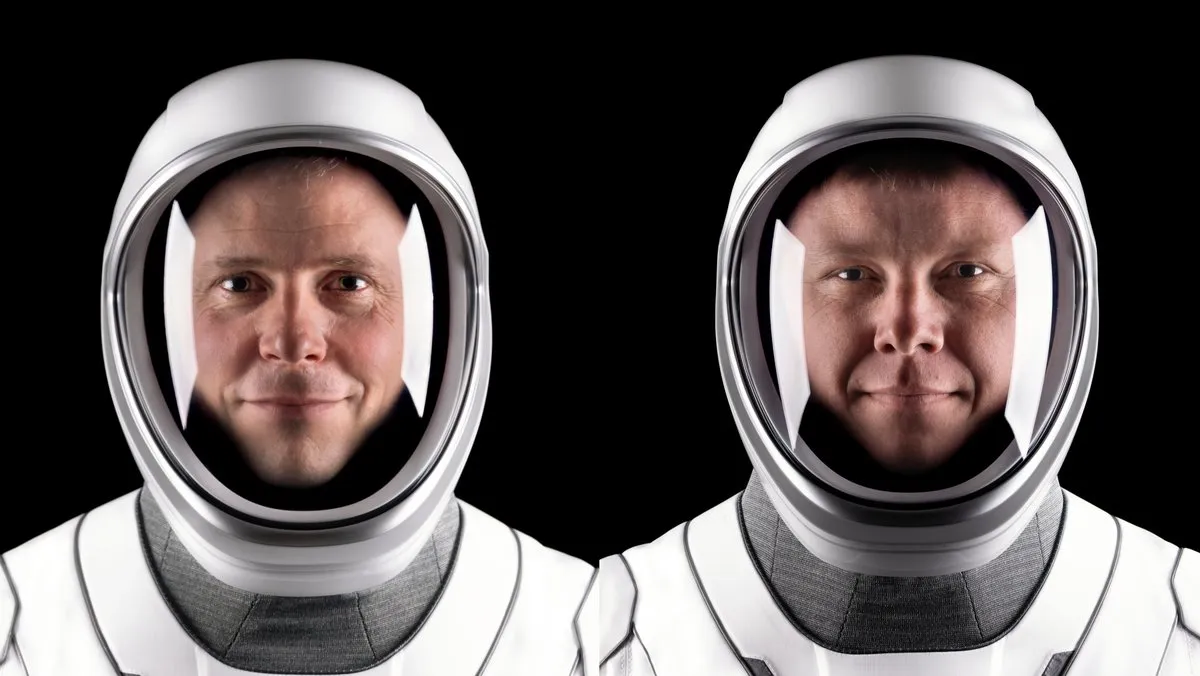
Crew-9, SpaceX's ninth operational commercial crew mission for NASA, will lift off Thursday, Sept. 26, at 2:05 p.m. EDT (1805 GMT). NASA astronaut Nick Hague and Russian cosmonaut Aleksandr Gorbunov will launch aboard SpaceX's Crew Dragon Freedom, which previously flew the Crew-4 mission, as well as the private Axiom-2 and Axiom-3 missions.
It's an atypical launch for a crewed SpaceX mission to the ISS, which customarily ferries four astronauts at a time. Originally, Crew-9 was slated to fly the usual four, but NASA astronauts Zena Cardman and Stephanie Wilson were removed from the flight when NASA made the decision to return Boeing's Starliner spacecraft without its crew, leaving astronauts Butch Wilmore and Suni Williams aboard the ISS in need of a ride home.
Now, Wilmore and Williams will be officially absorbed into ISS Expedition 71, and return to Earth aboard Freedom at the end of the Crew-9 rotation in February 2025. And, once Hague and Gorbunov arrive, Wilmore and Williams will finally have a dedicated spacecraft for their return to Earth.
Related: NASA cuts 2 astronauts from SpaceX Crew-9 mission to make room for Boeing Starliner crew
Nick Hague (NASA)


Nick Hague is a U.S. Space Force (USSF) colonel and Crew-9 commander. The upcoming mission will mark a milestone for the Space Force, as Hague will be the first active USSF Guardian to launch into space.
This will be Hague's third launch, but only his second time to the ISS. His first launch, aboard the Soyuz MS-10 spacecraft in 2018, ended prematurely due to a rocket booster failure, sending Hague and his cosmonaut crewmate Alexey Ovchinin into an abort and ballistic reentry. He launched again five months after that incident, aboard Soyuz MS-12, serving as flight engineer for ISS Expeditions 59 and 60.
Hague graduated from the United States Air Force Academy with a degree in Astronautical Engineering, which he followed with a master's in Aeronautical and Astronautical Engineering from MIT, according to NASA. He was selected as part of the space agency's 2013 astronaut class, and served as the director of test and evaluation as an active-duty colonel for the Space Force from 2020-2022. After that, leading up his assignment to Crew-9, Hague resumed his astronaut duties at NASA, as part of the team working on the Boeing Starliner Program.
Aleksandr Gorbunov (Roscosmos)


This will be Aleksandr Gorbunov's first mission to space. Prior to his cosmonaut selection by the Russian space agency Roscosmos in 2018, Gorbunov supported Progress cargo launches from the Baikonur Cosmodrome, in Kazakhstan, as an engineer for Rocket Space Corp. Energia.
According to NASA, Gorbunov engineering and spacecraft at the Moscow Aviation Institute, and graduated with a specialty in operating and repairing aircraft, helicopters, and aircraft engines from the Intitute's military department. For his upcoming mission to the space station, Gorbunov will serve as Crew-9's flight engineer.
Another first for the Crew-9 mission will be its launchpad. Space Launch Complex-40 (SLC-40) at Cape Canaveral Space Force Station has been undergoing refurbishment to support crewed launches the past several months, and will finally get the chance to do so. SpaceX's usual pad for crewed missions, Launch Complex-39A at NASA's Kennedy Space Center, is currently being equipped to support the upcoming launch of the Europa Clipper probe on a Falcon Heavy rocket.
Hague's and Gorbunov's milestone liftoff from SLC-40 will also mark the second crewed launch ever from Cape Canaveral Space Force Station, following on the heels of the Starliner launch on a United Launch Alliance Atlas V from SLC-41, in June.