





The space shuttle Endeavour fired its thrusters late Friday just hours after linking up with the International Space Station in order to move the outpost clear of a piece of orbital junk.
Endeavour fired its rocket thrusters for about 15 minutes to move the space station about a mile higher above Earth to steer clear of the incoming piece of debris, which was slated to zoom past the docked shuttle and station early Saturday at 5:11 a.m. EDT (0911 GMT). The station typically flies about 220 miles (354 km) above Earth.
Mission Control at NASA's Johnson Space Center in Houston had been tracking the piece of space debris since Thursday, but the space agency was unsure what the object actually is, its size or how close it would ultimately come to the station. But its trajectory, mission managers said, would bring it too close for comfort.
"It meets our criteria to do an avoidance maneuver," said shuttle flight director Paul Dye. "We don't know what it is, but it's big enough that we're concerned about it if it's close enough."
Endeavour fired its thrusters at about 8:27 p.m. EDT (0027 July 18 GMT) to start the station's orbital boost.
NASA and its space station partners usually move the 1 million-pound (453,592 kg) orbiting lab when a piece of space junk is expected to fly within a safety perimeter that extends 15 miles (24 km) to either side of the outpost, which is longer than a football field.
Space debris has been a growing threat for the space station and other satellites in low-earth orbit since the Feb. 10 collision of an outdated Russian satellite and an American communications satellite. The cosmic smash-up created two clouds of debris that increased a risk of collision for the station and linked shuttles by about 6 percent, or about a 1-in-318 chance, NASA officials have said.
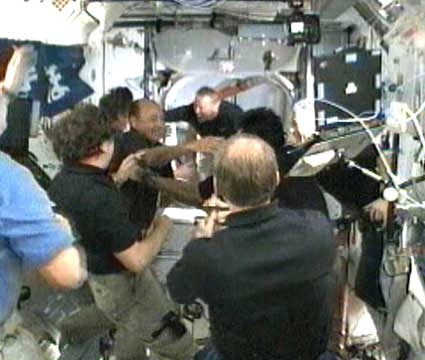
Endeavour is docked at the space station earlier today at 1:47 p.m. EDT (1447 GMT) for a two-week mission to install a new outdoor research porch for the Japanese Kibo laboratory, as well as spare supplies.
On its approach to the station before docking Friday, commander Mark Polansky steered the shuttle through a backflip maneuver to expose its sensitive heat shield tiling for a better view. Astronauts aboard the ISS took hundreds of photographs to be analyzed for signs that Endeavour might have been harmed by falling debris from its external tank during liftoff.
Though it's too early to be sure, mission managers do not think the shuttle has suffered any serious harm.
"The team is actively looking at those photographs," said space shuttle program manager John Shannon. "It did not look like a very big concern at all."
If NASA decides more data is necessary to clear Endeavour for a safe return to Earth, a second more focused inspection of the orbiter using a sensor-tipped pole can be made later during the mission.
SPACE.com is providing continuous coverage of STS-127 with reporter Clara Moskowitz and senior editor Tariq Malik in New York. Click here for mission updates and SPACE.com's live NASA TV video feed.
