
European Rocket Launches 2 New Communications Satellites
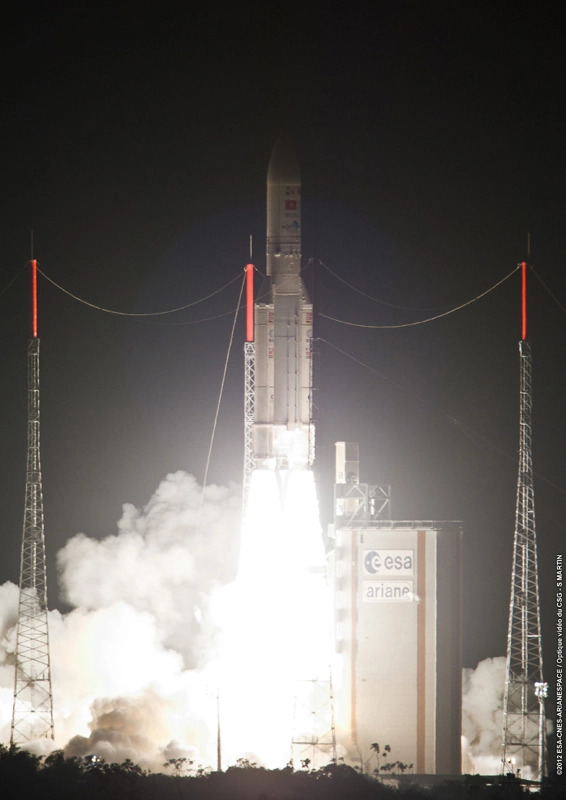
PARIS — Europe’s Ariane 5 rocket on May 15 successfully placed two telecommunications satellites into orbit for Japanese and Vietnamese customers in the second of seven Ariane 5 missions planned for 2012.
The launch, from Europe’s Guiana Space Center in French Guiana, on South America’s northeast coast, cast a rare spotlight on Lockheed Martin’s commercial telecommunications satellite capability, with both customers using the Lockheed Martin Space Systems’ A2100 satellite frame.
Sunnyvale, Calif.-based Lockheed Martin Space Systems reported that both satellites were in good health in orbit after separation from the Ariane 5-ECA rocket’s upper stage.
JCSat-13, owned by Japan’s SkyPerfect JSat Corp., carries 44 Ku-band transponders and two steerable beams for television and telecommunications services. Weighing 4,528 kilograms at launch, it will operate from 124 degrees east longitude. Lockheed Martin said JCSat-13 is expected to complete in-orbit testing by mid-July. [Amazing Rocket Launch Photos]
Vinasat-2 is owned by the Vietnam Posts and Telecommunications Group, a relatively new entrant in the global satellite telecommunications marketplace. It weighed 2,969 kilograms at launch and carries 24 Ku-band transponders.
Vinasat-2 will operate from 131.8 degrees east, next door to the Vinasat-1 spacecraft launched in April 2008. Vinasat-1 filled its capacity of 12 Ku- and eight C-band transponders more quickly than expected, causing the Vietnamese government to order a follow-on spacecraft.
Vinasat-1 was also built by Lockheed Martin, a company whose most regular commercial satellite successes have been in the Japanese market with SkyPerfect JSat.
Lockheed Martin said JCSat-13 and Vinasat-2 are the 100th and 101th Lockheed Martin-built commercial geostationary-orbiting satellites placed into orbit, a milestone that shows how far Lockheed Martin’s attention has drifted away from the commercial satellite market and toward a U.S. government satellite market that has gone through an unprecedented expansion in the past decade.
Building 101 commercial satellites since 1975 means an average delivery rate of nearly three satellites per year — a rhythm that is far greater than Lockheed Martin’s performance over the past decade and illustrates how active the company once was in the market.
U.S. Department of Defense demand for satellites is now leveling off, with few major new starts on satellite infrastructure expected in the near future as U.S. defense authorities manage a tighter budget regime.
Like Boeing Space and Intelligence Systems of El Segundo, Calif., Lockheed Martin has indicated it will be paying more attention to the global commercial satellite business now that the U.S. defense market is no longer growing.
The May 15 launch was the 48th consecutive success for the Ariane 5 vehicle, operated by the Arianespace consortium of Evry, France.
This story was provided by Space News, dedicated to covering all aspects of the space industry.
