





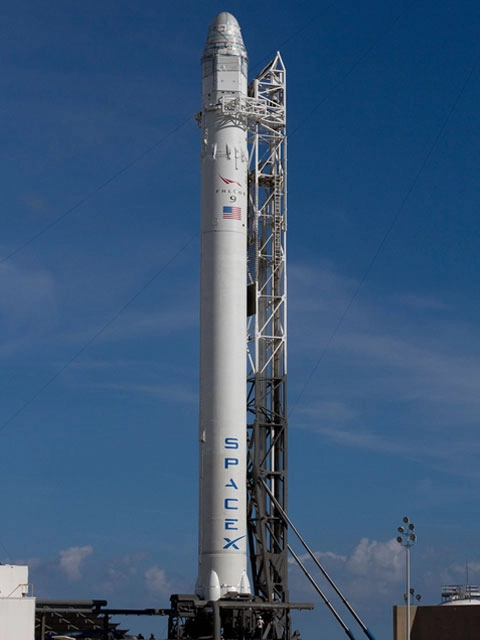
A turning point for private spaceflight looks to be on the horizon.
The commercial rocket builder SpaceX (Space Exploration Technologies of Hawthorne, Calif.) is preparing to launch the first privately built vehicle to the International Space Station this week. If it succeeds, it will be a milestone event in the history of space exploration. However, the firm and NASA warn against placing too much importance on one test flight.
SpaceX's Dragon capsule is due to lift off unmanned atop the company's Falcon 9 booster May 19 from Florida's Cape Canaveral Air Force Station. If all goes well, it will rendezvous with the government-built space lab in orbit, and be berthed there to deliver a haul of food, supplies and science equipment.
The flight is part of NASA's Commercial Orbital Transportation Services (COTS) Program, and if successful, would represent a major validation for the endeavor. The program is aimed at spurring the development of private spacecraft to replace the cargo-carrying capacity of the retired space shuttles.
"This will be one of those historic launches with the first commercial vehicle coming to the ISS to provide supplies," NASA's International Space Station program manager Mike Suffredini said last month during a briefing on the flight. "This is the beginning of a long term effort to have the commercial vehicles supply the ISS, which is a critical need for the program." [How SpaceX's 1st Space Station Flight Works (Photos)]
NASA is paying SpaceX $1.6 billion to fly 12 cargo ferry flights to the station. Before the company can begin making those deliveries, it must demonstrate Dragon's capabilities in the upcoming test flight.
Commercial spaceflight rising
SpaceX isn't the only company benefiting from NASA's need for services. The Dulles, Va.-based Orbital Sciences Corp. has also won a lucrative contract worth $1.9 billion to fly eight robotic delivery missions.
Orbital's Cygnus spacecraft, to fly atop its Antares rocket, is due to make its own inaugural test flight later this year.
"They started a year and a half later than our agreement with SpaceX, and they're also making very good progress," said Alan Lindenmoyer, program manager for COTS.
If Orbital and SpaceX can accomplish what they aim to, they could herald a new era of government-commercial cooperation in space. The COTS program is a departure from NASA's usual way of doing business by designing and building all of its spacecraft in-house.
"We wanted to become a consumer of services rather than a customer of requirements — that would be our more traditional approach," Lindenmoyer said. "We believe that these capabilities are within the grasp of U.S. commercial industry."
Coming soon: private space taxis
Ultimately, COTS itself is in some ways a dress rehearsal for NASA's larger goal of using private spacecraft to carry people, not just cargo, to low-Earth orbit.
Dragon is designed to need only relatively minor modifications to house humans, and Orbital has stated it could upgrade the Cygnus for manned spaceflight as well. And NASA has contracts with additional companies such as Blue Origin, Boeing, Sierra Nevada and United Launch Alliance to develop man-rated vehicles to transport astronauts to the space station.
"I think we're going to see dramatic advancements in spaceflight for the first time in a long time," SpaceX founder Elon Musk told SPACE.com. "Now I think we're seeing the upward trajectory of a new movement, which is commercial spaceflight. And I think that will result in quite rapid improvements in technology, and we've seen some of that already. I think what we're doing is showing that there's a steady march of progress."
These initiatives within NASA come at a time of burgeoning prospects in the field of suborbital space travel. Suborbital spacecraft make short dives up to the edge of space without completing a full orbit around our planet. They are quicker and less expensive, and offer a few minutes of weightlessness and a view of Earth from space.
Another suite of commercial companies are the main players in this new arena. Leading the pack is Virgin Galactic, a company founded by British billionaire Sir Richard Branson to take paying passengers on space joy rides. Virgin is currently testing its SpaceShipTwo space plane, and aims to fly tourists and scientists within the next few years.
Other companies such as Armadillo Aerospace, XCOR Aerospace, and Blue Origin are also developing suborbital spacecraft.
You can follow SPACE.com assistant managing editor Clara Moskowitz on Twitter @ClaraMoskowitz. Follow SPACE.com for the latest in space science and exploration news on Twitter @Spacedotcom and on Facebook.
