





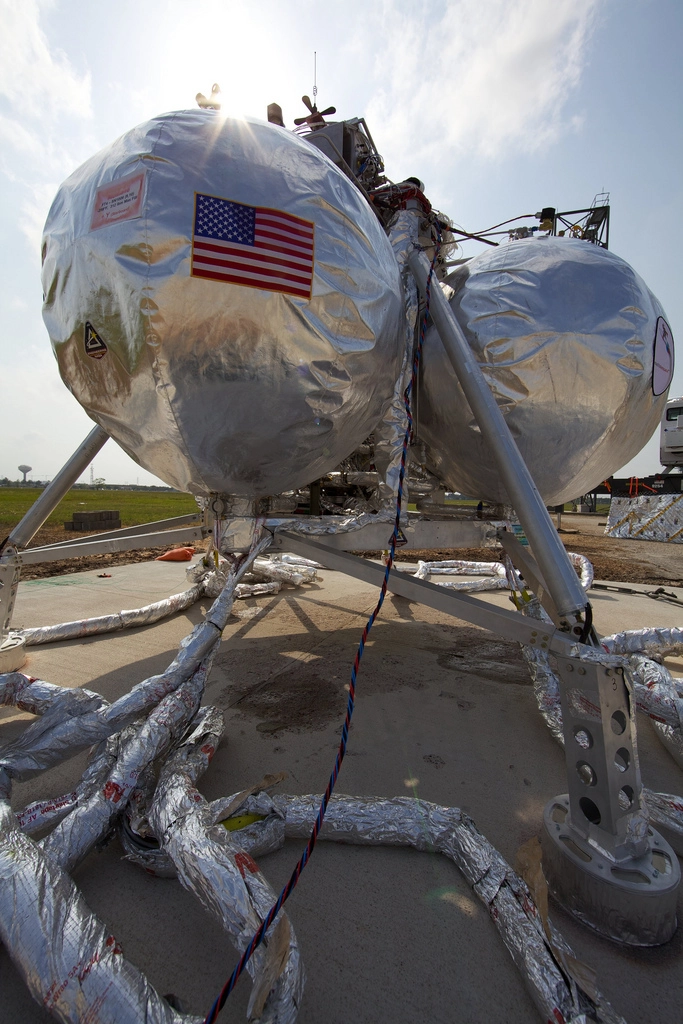
NASA engineers are forging ahead with a project to test a futuristic moon lander, despite a grass fire that broke out during a Wednesday (June 1) test.
The fire started around 2:30 p.m. local time (1530 GMT), during a tethered test of the Morpheus robot lander at the agency's Johnson Space Center in Houston. The Morpheus project is designed to test an amalgam of cutting-edge technologies NASA is developing to take humans to the moon, Mars or beyond.
When the lander lifted off its concrete launch pad, it kicked up some of the concrete, which set off the fire in the dry field around it.
"It's been really dry," NASA spokeswoman Brandi Dean told SPACE.com. "They had done controlled burns around the area to try and prevent grass fires," but the fire sparked anyway.
Because the fire managed to ignite some nearby hay bales, which are hard to put out, NASA called in reinforcements from the Houston fire department and other local firefighters. It took only a few hours to squash the flames.
Despite the fire, Dean said the test went exactly as planned. [Photos: NASA's Project Morpheus Robot Lander ]
"Actually the test went really well and Morpheus itself was fine," she said. "Nobody was hurt. There wasn't any damage at all to the vehicle and the launch pad."
During the test, Morpheus was tethered to a crane above for protection.
"Flew a near perfect hover for the full 30 sec. flight," according to an update on Morpheus' Twitter account, @MorpheusLander.
The unmanned Morpheus vehicle, about the size of an SUV, could carry about 1,100 pounds (500 kg) of cargo to the moon. It utilizes a novel blend of fuels — liquid oxygen and methane — that is cheaper than conventional rocket fuel, and could potentially be harvested from other sites in the solar system.
The lander also incorporates a sensor system to detect hazardous craters or boulders that could complicate a landing on another planet.
Morpheus has already been put through a series of tethered tests, but the team hopes to step it up soon with the first untethered test sometime this summer.
This time, hopefully without flames.
"We'll take some time to look at it and see if there's anything else we should be doing to prevent it in the future," Dean said.
You can follow SPACE.com Senior Writer Clara Moskowitz on Twitter @ClaraMoskowitz. Follow SPACE.com for the latest in space science and exploration news on Twitter @Spacedotcomand on Facebook.
