


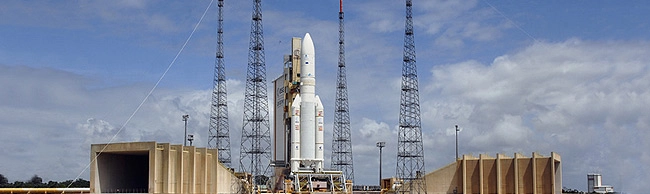
European and Americancommunications satellites shared a ride to space Friday night aboard an Ariane5 rocket, together becoming the heftiest dual payload ever lofted by thepowerful commercial booster.
After a one-day delay dueto unfavorable high-altitude winds, the 32nd flight of Ariane 5 roared off thejungle launch pad at 2229 GMT (6:29 p.m. EDT) from Kourou, French Guiana onSouth America's northeastern coast.
The liquid hydrogen-fueledVulcain 2 main engine and twin solid rocket boosters accelerated the vehicleinto the night sky. Enclosed in the rocket's nose cone were the satellitepassengers -- the ASTRA 1L and Galaxy 17 communications satellites. Thepayloads and associated adapter equipment topped 20,680 pounds, setting a newweight record for the heavy-lift Ariane 5.
The solid motors burned outand jettisoned after a couple of minutes, leaving the cryogenic main stage topush the rocket before finishing its firing 104 miles over the Atlantic. The stage was shed to fall back to Earth.
The ECA upper stage thenbegan its 15-minute propulsive job to inject the payload into a highlyelliptical geosynchronous transfer orbit with an apogee of 22,344 miles,perigee of 154 miles and inclination of 5.9 degrees to the equator.
About 27 minutes afterliftoff, the European ASTRA 1L direct-to-home television satellite was releasedfrom atop the payload stack.
ASTRA 1L will join a dozenspacecraft in a constellation operated by SES ASTRA of Luxembourg. The system relays more than 1,800 television and radio channels to 109 millionhouseholds in Europe. Lockheed Martin built ASTRA 1L using its A2100AX modeldesign. The 9,900-pound craft is equipped with 29 Ku-band and two Ka-Bandtransponders to transmit programming directly to small receiving dishes onhomes.
The spacecraft is headedfor geostationary orbit where it will be located at 19.2 degrees East over theequator to begin a 15-year service life.
"We are very proud andsatisfied that the ASTRA 1L launch has been a success," said FerdinandKayser, president and CEO of SES ASTRA. "ASTRA 1L will allow us to moveour satellite ASTRA 2C from 19.2 degrees East to 28.2 East to fulfill the highcapacity demand from the U.K. and Irish markets. It will also extend thecoverage from the Canary Islands in the West to the Russian border in the Eastand help us to further strengthen our unique in-orbit back-up scheme."
Once ASTRA 1L was deployedfrom the Ariane 5, the barrel-like Sylda payload adapter was jettisoned toexpose Galaxy 17 for its release from the rocket. The successful separation ofGalaxy 17 from the upper stage to complete the launch came 32 minutes into theflight.
Galaxy 17 carries 24 C-bandand 24 Ku-band transponders for beaming video, voice and data transmissionsacross North America and the Caribbean for operator Intelsat. The 9,000-poundsatellite was built by Thales Alenia Space using the Spacebus 3000 B3 design.
The satellite should enterservice in July from the geostationary position at 74 degrees West above theequator, expanding Intelsat's orbiting fleet to 52 satellites.
Intelsat's future plansforesee Galaxy 17 being relocated to the 91-degree slot to join the firm'scable television relay network.
"We believe Galaxy 17will be in demand from customers seeking high-powered C- and Ku-band capacityin North America. The 91-degree W orbital location is ideal for serving themedia community, and is also well positioned to serve the data network andgovernment markets," said Intelsat, Ltd. CEO David McGlade.
Galaxy 17 was the 45thIntelsat satellite to launch aboard an Ariane rocket since 1983.
"About 60 percent ofIntelsat satellites have been launched by Arianespace, and this fall, we willlaunch two more satellites for Intelsat," said Arianespace CEO Jean-YvesLe Gall. "I want to thank Intelsat for the confidence it has had in ourcompany from the very beginning."
A familiar face inattendance to watch Friday's launch was NASA Administrator Mike Griffin. Laterthis year, an Ariane 5 rocket will ferry to orbit the first European-builtAutomated Transfer Vehicle cargo resupply freighter for the International SpaceStation.
"I am very pleased andhonored to welcome tonight a U.S. delegation led by my personal friend, MikeGriffin, the NASA administrator," Le Gall said. "This delegation isvisiting our facility in preparation for the historic ATV launch."
Up next onthe Ariane 5 schedule is another commercial satellite deployment mission. TheAugust launch will carry the American Spaceway 3 broadband communicationssatellite and the Japanese BSAT 3A direct-to-home TV spacecraft. It will be thethird of six Ariane 5s intended to fly in 2007.
- VIDEO: Soyuz Rocket Launches New ISS Crew
- IMAGES: Twenty Great Rocket Launches
- SPACE.com Video Interplayer: Space Station Ready for Orbital Expansion
Copyright 2007 SpaceflightNow.com, all rightsreserved.