


CAPE CANAVERAL, Fla. - NASA's space shuttle Discovery is on track tolaunch Wednesday evening to deliver new solar arrays to the International SpaceStation, mission managers said.
Even the weather appears to be cooperating so far forthe planned launch from NASA's Kennedy Space Center at Cape Canaveral, Fla.on March 11 at 9:20 p.m. EDT (0120 March 12 GMT).
"The weather looks good for launch, I'm very happy to say,"NASA weather officer Kathy Winters said at a briefing here."We have these nice, mild conditions, warm temperatures? so a 90 percentchance of 'go' weather."
The only possible threat to launch from weather could be from a ceilingof clouds that may come in to block launch, Winters said. If that happens,mission managers said they can attempt to launch every day upuntil March 16, after which they would have to stand down to allow aRussian Soyuz craft to make its scheduled flight to the space station.
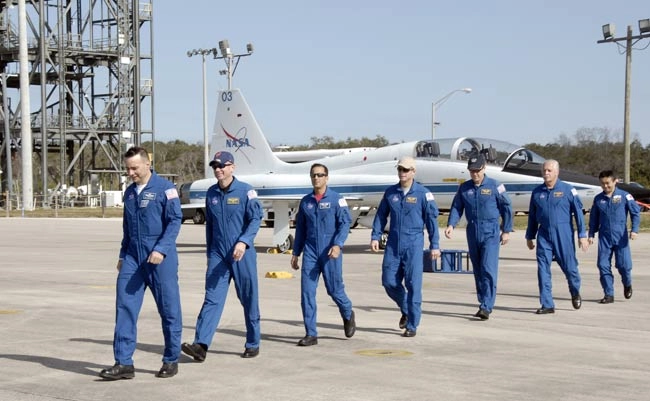
Discovery's seven-man crew, led by commander Lee Archambault, arrivedin Florida yesterday on T-38 jets. They will spend today undergoing medicalexams, checking out their launch suits and reviewing launch plans. This eveningArchambault and shuttle pilot Tony Antonelli are scheduled to practice landingthe space shuttle by flying shuttle training aircraft, which are modifiedGulfstream planes.
Mission managers said Monday that no technical problems currently pose athreat to Discovery's planned launch. They did investigate one minor worryassociated with a controller on the shuttle's Orbital Maneuvering System (OMS)engines, which had had a "hiccup" during last year's May launch ofthe shuttle Discovery's STS-124 flight. Ultimately, they decided it posed avery low risk.
"If this part fails, it's one of two controllers on a single OMSengine," said Mike Moses, chair of Discovery?s mission management team,adding that the controller was part of a tiered system full of backups. ?Soredundancy-wise, we're in really great shape there."
After weeksof delays to Discovery's launch date over fears that fuel control valves inthe shuttle's main engines might be faulty, NASA mission managers said they areconfident the shuttle is in good shape to fly.
"The team is anxious to go," said NASA shuttle launchdirector Mike Leinbach. "We?re fully trained, ready to execute thismission."
Engineers ended up replacing thethree valves on Discovery with a set that had been scanned to be sure theyhad no damage. Last year, a valve on NASA's shuttle Endeavour cracked duringits November 2008 launch. Though the problem didn't affect the shuttle's flight,and Endeavour completed its mission successfully, mission managers wanted to besure a similar occurrence wouldn't endanger Discovery.
The valves monitor the pressure of liquid hydrogen fuel in the shuttle'smain engines during launch, and leak off excess gaseous hydrogen if needed.After extensive tests, engineers found that even if a valve were to crackduring a future shuttle launch, the chances of it causing serious damage areextremely low. Nonetheless, managers decided to replace Discovery's set ofvalves with a new complement that were free of cracks even a fraction of a hairwide.
Discovery is set for a 14-day mission featuring four spacewalks toinstall the new solar array wings on the International Space Station (ISS). Itwill also ferry up Koichi Wakata, a Japanese Space Exploration Agency (JAXA)astronaut who is to become his country's first long-duration ISS crewmember. Heis scheduled to join the station's expedition 18 for about six months as aflight engineer.
"I am expecting that this week will become a historic event for theJapanese human space program," said Kuniaki Shiraki, JAXA ISS programmanager.
SPACE.com is providingcontinuous coverage of STS-119 with reporter Clara Moskowitz at CapeCanaveral and senior editor Tariq Malik in New York. Click here for mission updates and SPACE.com's live NASA TV video feed.
- New Video - Discovery's Mission: Space Station Power Up!
- New Show - NewSpace: The Orbital Industrial Revolution
- Video - Danger at the Pad! Shuttle Escape Training
