Walk in Silence

Tuesday, March 1, 2011: Halfway through the ISS airlock, Discovery shuttle astronaut Al Drew looks at the panorama for a second. This photo was taken by Italian astronaut Paolo Nespoli on the International Space Station on Feb. 28, 2011, during the first of two spacewalks for Discovery's STS-133 mission.

--Tom Chao

The Other One

Wednesday, March 2, 2011: This NASA/ESA Hubble Space Telescope image shows an outer part of the Orion Nebula's little brother, Messier 43, sometimes referred to as De Mairan's Nebula after its discoverer. Only a dark lane of dust separates it from the Orion Nebula (Messier 42).

--Tom Chao

We're Going to Have a Ball Tonight ... Down at the Globe

Thursday, March 3, 2011: This NASA/NOAA GOES-13 satellite image shows the Earth on March 2, 2010 at 8:45 UTC.

--Tom Chao

Horse in the Sky
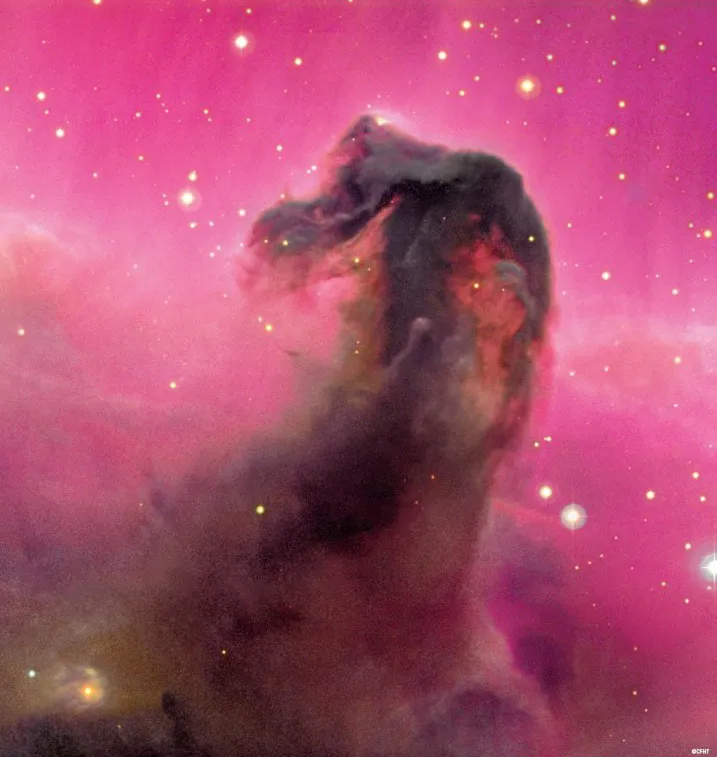
Friday, March 4, 2011: The Canada-France-Hawaii Telescope produced this stunning image of the well-known Horsehead Nebula. It is part of an enormous cloud of molecular gas and dust obscuring background light from nearby emission nebula IC 434, producing the silhouette.

--Tom Chao

Before the Blue Horizon

Monday, March 7, 2011: A thin line of Earth's atmosphere peeks out of the blackness of space, in this photo taken by the STS-133 crew. The image catches the docked Russian Soyuz spacecraft along the right side, while a portion of the International Space Station's Quest airlock and solar array panels sit at the upper right of the photo.

--Tom Chao

Lunar Transit Authority

Tuesday, March 8, 2011: NASA's SDO satellite photographed the moon passing in front of the sun, March 2-4, 2011.

--Tom Chao

The Young Ones

Wednesday, March 9, 2011: ESO's La Silla Observatory in Chile captured this image of many galaxies, as part of the COMBO-17 project (Classifying Objects by Medium-Band Observations in 17 Filters). Some of the most distant flecks of light visible in this photo represent galaxies whose light has been traveling towards us for about nine or ten billion years, revealing what the universe was like when it was much younger.

--Tom Chao

Home at Last

Thursday, March 10, 2011: Space shuttle Discovery's 39th and final flight concluded on March 9, 2011. Here, the "towback" vehicle pulls the spacecraft into Orbiter Processing Facility-2 at NASA's Kennedy Space Center in Florida for a well-deserved rest. NASA will now prepare Discovery for future public display.

--Tom Chao

Home Improvement

Friday, March 11, 2011: Space shuttle Discovery's crew took this image of the International Space Station (ISS) after departing to return to Earth on March 9, 2011. During their STS-133 mission, Discovery's crew added components including the Leonardo Multi Purpose Logistics Module, again changing the appearance of the ISS. Construction of the ISS began in 1998.

--Tom Chao

Before and After the Tsunami

Monday, March 14, 2011: These side-by-side images show the effects of the tsunami on Japan's coastline. Compare the image on the left, taken on September 5, 2010, to the image on the right, taken on March 12, 2011, one day after an 8.9-magnitude earthquake occurred in the Pacific Ocean, and resulting tsunami struck the Japanese island of Honshu.

--Tom Chao

Sendai, Japan in 2003

Tuesday, March 15, 2011: This night view from space shows city lights of Sendai, Japan, in 2003, before the destructive earthquake and tsunami of March 11, 2011. One of the Expedition 6 crew members onboard the International Space Station took this picture, 220 miles above the Earth.

--Tom Chao

Stare into the Sun

Wednesday, March 16, 2011: It was just a few weeks back that the sun was often free of spots. But on March 9, 2011, it had four separate sunspot groups, part of an increase in activity in recent weeks. Sunspots are cool, magnetically active regions on the sun that act like caps on a soda bottle. Sometimes the caps pop off, releasing a torrent of solar energy in the form of light and charged particles. Such a flare was released on March 9. The groups are numbered 1169 (left), 1166 (center), 1164 (upper right) and 1170 (lower right).

--Robert Roy Britt

Irish Lace

Thursday, March 17, 2011: Lacy clouds encircled Ireland a few months ago on December 22, 2010, while a heavy covering of snow lay upon the land. NASA's Terra satellite used its Moderate Resolution Imaging Spectroradiometer (MODIS) instrument to capture this true-color image of the snow. The overnight arrival of 6 in. (15 cm.) of snow at the Dublin airport forced its closure, and severe weather disrupted air, road and rail travel, closed schools and businesses and caused power outages.

--Tom Chao

Pack Your Trunk and Say Goodbye to the Circus

Friday, March 18, 2011: The Elephant's Trunk Nebula sits in star cluster IC 1396, in the constellation of Cepheus. A cloud of high-temperature gas warmed up by newly born stars forms the emission nebula. Hydrogen, the most common element in space, glows intensely in red light when heated by hot, young stars seen inside the "trunk."

--Tom Chao

Too Close for Comfort

Monday, March 21, 2011: Astronaut Paolo Nespoli took this photo of the "supermoon" aboard the International Space Station on March 20, 2011.

--Tom Chao

Young, Gifted and Blue

Tuesday, March 22, 2011: Blue young stars shine in the spiral arms of galaxy NGC 5584, as shown by this Hubble Space Telescope image. Thin, dark dust lanes flow from the yellowish core, filled with older stars. The reddish dots throughout the image are largely background galaxies. Several exposures taken in visible light between January and April 2010 with Hubble's Wide Field Camera 3 combine to make this image.

--Tom Chao

Falling Slowly

Wednesday, March 23, 2011: The Soyuz TMA-01M spacecraft floats down to Earth near the town of Arkalyk, Kazakhstan on Wednesday, March 16, 2011. The vessel carried Expedition 26 Commander Scott Kelly and Flight Engineers Oleg Skripochka and Alexander Kaleri. Russian cosmonauts Skripochka and Kaleri returned after almost six months onboard the International Space Station, where they served as members of the Expedition 25 and 26 crews.

--Tom Chao

How Many Holes It Takes

Thursday, March 24, 2011: Saturn's moon Hyperion possesses many craters, most of which contain an unknown dark material. This 2005 Cassini image shows the strangely-textured surface. Hyperion measures about 150 miles (250 km) across, rotates chaotically and might contain a vast system of caverns.

--Tom Chao

Mountains Come Out of the Sky

Friday, March 25, 2011: Dust in nebula NCG 2174 appears in mountain-like formations, though the structures have no more substance than air. Nearby bright, newly formed stars emanate light and winds that disperse the "mountains." NCG 2174 lies in the constellation Orion.

--Tom Chao

The Latest Fashion

Monday, March 28, 2011: The city of Milan, Italy appears as a cluster of lights in this photograph, with brilliant white lights indicating the historic city center where the Duomo di Milano (Milan Cathedral) stands. The Expedition 26 crew aboard the International Space Station took this picture on February 22, 2011.

--Tom Chao

The Madding Crowd

Tuesday, March 29, 2011: The cramped quarters in globular clusters like Messier 12, shown here, makes them home to binary star systems where two stars tightly orbit each other, and one sucks up matter from its companion, releasing X-rays.

--Tom Chao

Runaway Camel

Wednesday, March 30, 2011: The star Alpha Camelopardalis (center) speeds through the universe at somewhere between 1.5 and 9.4 million miles per hour (680 and 4,200 kilometers per second). Considered a runaway star by astronomers, it creates a bow shock, seen as the red swath in the image.

--Tom Chao

Ultra Vivid Scene

Thursday, March 31, 2011: Magnetic field lines arc high above the surface of the sun in this image obtained Feb. 23-27, 2011, by the Solar Dynamics Laboratory. In extreme ultraviolet light the multitude of lines are revealed because charged particles are spinning along them.

--Tom Chao

Image of the Day: March 2011

Date: 01 April 2011 Time: 12:01 AM ET
MORE ALBUMS
Go