





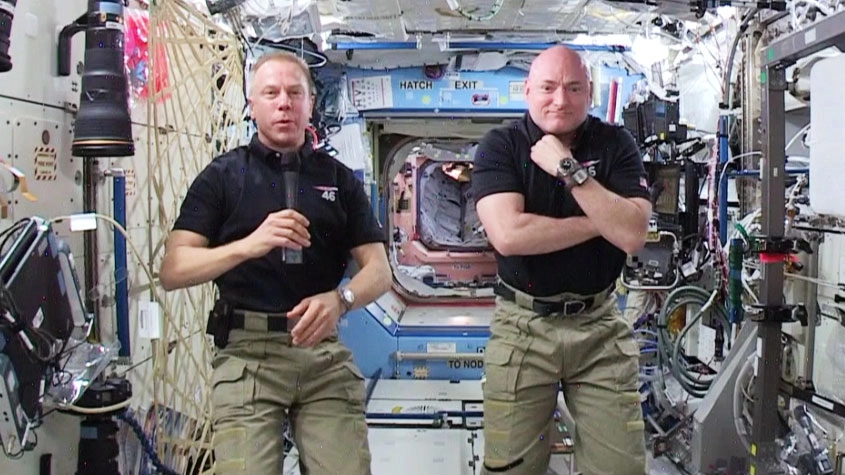
"Super Tuesday," when several U.S. states hold their primary presidential elections, won't be so super for astronaut Scott Kelly. Or, rather, it will be "super" for a different reason; instead of casting a vote, he'll be busy making his way back down to Earth after a yearlong stay on the International Space Station.
Both of the U.S. astronauts on board the station are slated to vote tomorrow (March 1) when their home base of Houston, Texas, casts its votes, but NASA representatives said Kelly will not be able to participate.
"Scott confirmed he will not be voting as he will be in the process of landing," NASA spokesman Dan Huot told Space.com.
Kelly's crewmate, Tim Kopra, will be able to vote thanks to a 1997 Texas bill setting out a technical process for spacebound voters.
"They send it back to Mission Control," NASA spokesman Jay Bolden of Johnson Space Center told Space.com in 2012 during the last presidential election cycle. "It's a secure ballot that is then sent directly to the voting authorities." Kopra will receive an email with specific credentials, which he will use to access the ballot.
When they get home, Kelly and Kornienko will go through extensive testing to see how a year in space affects the human body. Kelly will also be compared with his twin brother, Mark Kelly, a retired astronaut, in a comprehensive genetic study.
Kopra, British astronaut Tim Peake and Russian cosmonaut Yuri Malenchenko will remain on board the space station. They will be joined by U.S. astronaut Jeff Williams and Russian cosmonauts Alexey Ovchinin and Oleg Skripochka on March 18.
Email Sarah Lewin at slewin@space.com or follow her @SarahExplains. Follow us @Spacedotcom, Facebook and Google+. Original article on Space.com.
