Have you ever wished you knew more about the stars overhead? It’s easier than you think. All you need to do is lie back on a warm summer evening and look straight up.
To catch a great view of the summer stars, it helps if you can find a spot free from light pollution on a night when the moon isn't in the sky. The first thing you will notice is that some stars are brighter than others.
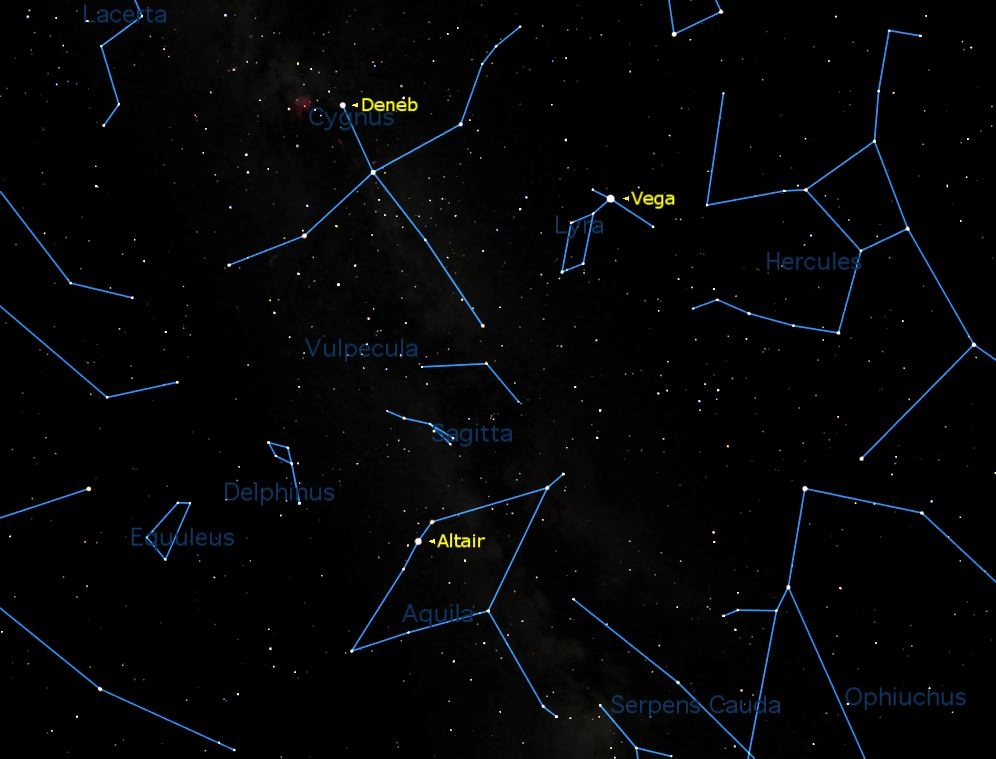
The brightest stars are said to be "of first magnitude" and there are three that should leap out at you. The brightest is Vega, almost directly overhead at 10:30 p.m. your local time this week. Next brightest is Altair, down towards the southern horizon, and third is Deneb, off towards the northeast. These three form the "Summer Triangle" and are as characteristic of the summer sky as Orion is of the winter sky. [Amazing Night Sky Photos for August 2013 (Gallery)]
Since these three stars appear to be about the same brightness, you might think that they were all about the same distance away, but you’d be wrong. Stars come in many colors and brightness, and sometimes a very distant, very bright star can look as bright as a very close, relatively dim star.
Vega and Altair are both relatively close to the sun 25 and 17 light-years away, but Deneb, which rivals them in brightness, is a whopping 3,300 light-years away, making it one of the farthest objects you can see with your unaided eye. In fact, Deneb is an absolutely brilliant star, but so far away that its brightness is greatly dimmed by distance.
As you continue to watch the sky, you may begin to see patterns in the fainter stars. The human brain always tries to find patterns in random shapes, as when we look for the shapes of animals in the clouds. The same is true for stars.
Stars are pretty much randomly distributed across the sky, but from time immemorial humans have grouped them into patterns which we call constellations. Each of the three stars in the Summer Triangle is a member of such a constellation.
If you look closely at Vega, for example, you may notice a small parallelogram of stars just to its south. This reminded ancient astronomers of the musical instrument the lyre, so they named this group of stars Lyra. If you have binoculars, use them to take a closer look at Vega and the stars nearby.
Even a pair of small binoculars is enough to confirm one of Galileo's first discoveries when he turned his telescope on the sky: many stars which appear single to the naked eye turn out to be double or multiple with a bit of magnification. Several of the stars near Vega are obvious doubles, even with only 6 or 7 times magnification.
Now take a closer look at Deneb. It stands at one end of a chain of bright stars stretching to the south of Vega. There is a second shorter chain of stars which crosses the first chain at right angles. Different cultures have seen different patterns.
The ancient Greeks saw this as a swan and named it Cygnus. Deneb is the tail of the swan, the short chain marks the swan’s wings, and the long chain its outstretched neck, with a brighter star Albireo at the head. Others see this as a Christian cross, and call it the Northern Cross, to distinguish it from Crux, the Southern Cross.
If you are under a dark country sky, you will see that the swan is flying along the faint, silvery Milky Way galaxy. This is the glow from millions of distant stars, too far away for the individual points of light to be resolved. This was another of Galileo’s discoveries.
Altair marks the head of a different bird: Aquila the Eagle. This has broader wings than the swan, and a distinctive curved tail.
Look for some of the smaller constellations in this part of the sky, in particular Delphinus the Dolphin, one of the few constellations which actually resembles its namesake.
Don’t be dismayed if you can’t readily see these patterns. Sometimes the objects the ancients saw in the sky owed more to imagination than to reality.
This article was provided to SPACE.com by Starry Night Education, the leader in space science curriculum solutions. Follow Starry Night on Twitter @StarryNightEdu.