China Has Big Plans to Explore the Moon and Mars
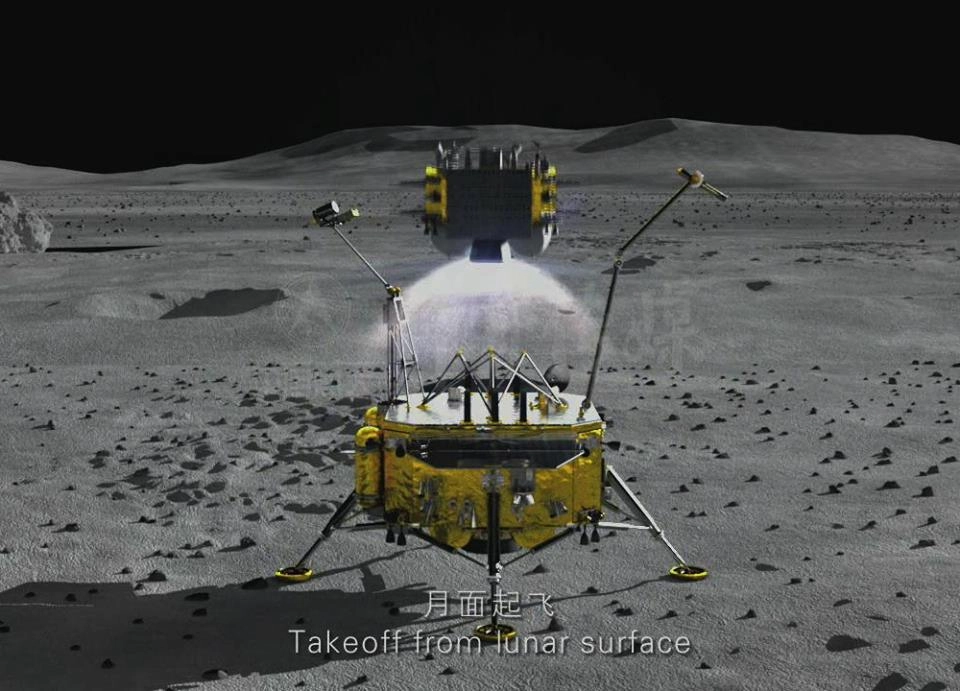
China continues to ramp up its space activities, which include a new launch complex, more powerful boosters and the construction of a large space station, as well as plans for complex robotic missions to the moon and Mars.
For example, China's "little fly" spacecraft looped around the moon and returned to Earth Nov. 1 (Beijing time) after eight days of flight, parachuting safely down in northern China's Inner Mongolia.
The capsule used seven kinds of thermal protection materials, returning data that will be applied to China's Chang'e 5 robotic lunar sample return mission, which is slated to launch in 2017 from the new Wenchang Satellite Launch Center. [Greatest Moon Missions of All Time]

In the human spaceflight arena, China's manned space agency is readying the Tiangong 2 space lab for liftoff around 2016, which will be followed by the crewed Shenzhou 11 spacecraft and a Tianzhou cargo vessel that will rendezvous with the lab.
Chinese officials expect that the core space station module will be launched around 2018, and the orbiting facility is slated to be completed by about 2022.
All of these plans form a comphrehensive space exploration agenda for the coming years.

Incremental steps
The Lunar Exploration Analysis Group (LEAG), an assembly of experts convened by NASA to assist in planning the scientific exploration of the moon, is eyeing China's growing lunar exploration capacity.
"China has had a well developed, focused plan, and they are using incremental steps to lunar exploration," said Jeffrey Plescia, chairman of LEAG. "Each mission has achieved the primary goal — orbiters, landing, rovers — leading up to sample return and then on to humans."
The objective of the recent test of the lunar sample return capsule was to demonstrate gear that can return from the moon and land safely.
"I would guess that, given the pieces they have tested, that they have a high probability of success on the sample return," Plescia told Space.com. "My personal guess, though, is that their lunar exploration, while trying to do some science, is more focused on the geopolitical theater. They are demonstrating that they have the technical capability of doing the most sophisticated deep-space activities. They have a program, and they can keep to the schedule and accomplish mission goals on time." [See photos from China's 1st moon lander and rover]
In comparison, Plescia said, "the United States has been floundering around for decades, trying to figure out what to do."
In the meantime, the U.S. has de-emphasized manned missions into space, instead focusing on a robotic science program that is "myopic at best," as it's narrowly focused on Mars, Plesica said. However, he added that the U.S.' Mars missions have provided a lot of surface detail and made a number of impressive discoveries.
"The real problem [in the U.S.] is the lack of direction and commitment," Plescia said. "I think, like others, that the moon is key to understanding how to live and work in space and explore the solar system."
Expanded access to space
China's space program has been extremely active recently, said Dean Cheng, a research fellow on Chinese political and security affairs at the Heritage Foundation in Washington, D.C.
Several Shijian and Yaogan satellites — two series of spacecraft that are believed to have military functions — have been launched in 2014. The "little fly" probe circumnavigated the moon, performing a vital precursor of any human lunar missions, he said. Also, the Chinese recently displayed a Mars rover at a popular air show, and there are reports that the country could dispatch a robotic Red Planet mission by the end of the decade.
In the interim, Chinese officials have discussed the possibility of even more powerful rockets than the still-under-development Long March 5 booster, Cheng said. In addition, the new Wenchang launch site on Hainan is apparently ready for a public unveiling, he said.
"This new facility will be China's southernmost launch site, with obvious benefits in terms of payload. It will also be China's first launch facility that is located on the coast," Cheng said. "Larger Chinese launch vehicles will now be possible, since they can be shipped to the new launch facility by sea, rather than [be] limited by Chinese railway tunnel widths and track curvature."
"When the Wenchang satellite launch center is officially opened, it will mark a further step in China's efforts to expand its access to space," with the ability to hurl heavier payloads into space, Cheng told Space.com. "These are expected to include a Chinese space station, lunar sample retrieval mission and a Mars rover."

Long-term commitment
China also established new space ties with 4M (the Manfred Memorial Moon Mission), the first private mission to the moon, suggesting an interesting link between China and private space entrepreneurs, Cheng said. There are also reports of cooperation between China and Russia, and one or more joint space ventures may be announced in 2015, he said.
"All of this is a reminder that China's space development efforts are likely to continue sustained interest under the new Chinese leader, Xi Jinping, as it did under his predecessors Hu Jintao, Jiang Zemin and Deng Xiaoping," Cheng said.
"Despite reports of a slowing economy, at this point, there does not seem to be much evidence that the space development effort is suffering any budgetary cutbacks," he added.
Indeed, China's long-term commitment to space development is one of that nation's great strengths, Cheng said, "as it supports sustained development of program[s], rather than a 'feast or famine' approach."

Investment in space
"China is continuing to pursue a number of goals it decided upon decades ago," said Gregory Kulacki, senior analyst and China project manager for the Global Security Program at the Union of Concerned Scientists (UCS), based in Cambridge, Mass.
Like Cheng, Kulacki believes the launch facility on the island of Hainan is a key new capability.
"It has been on the drawing board for quite a long time, and has experienced numerous delays, but is now prepared to serve as the home space port for China's new generation of wider-bodied launch vehicles that can carry larger payloads," Kulacki told Space.com. "These new vehicles have also experienced some delays, but China has no fixed deadlines to meet."
"As these major new pieces of China's space infrastructure come online, including new satellite manufacturing facilities in Tianjin, the pace and scale of its activities in space will continue to grow," Kulacki said. "China already has considerable space assets on orbit, and its investment in space will continue to increase significantly over the next several decades."
People who claim China is pursuing an asymmetric space warfare strategy misread the nation's intentions, Kulacki said. Rather, "the strategic objective of Chinese space policy is not to exploit asymmetry between China and the United States, but to end it," he said.
Leonard David has been reporting on the space industry for more than five decades. He is former director of research for the National Commission on Space and is co-author of Buzz Aldrin's 2013 book "Mission to Mars – My Vision for Space Exploration," published by National Geographic, with a new updated paperback version to be released next year. Follow us @Spacedotcom, Facebook or Google+. Originally published on Space.com.