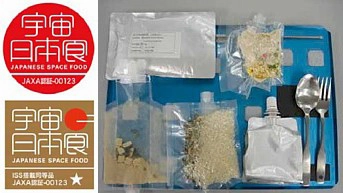
Japanesespace food will soon be available on the International Space Station (ISS). TheJapan Aerospace Exploration Agency (JAXA) has certified 29 Japanese foodproducts for use in space.
Astronauts and cosmonautswill soon enjoy such Japanese take-out standards as ramen, curry, onigiri (riceballs) and green tea (see photo).What took them so long?
- Egg soup
- Rice with red azuki beans and wild greens
- Salmon onigiri (rice balls)
- Mackerel in miso sauce
- Kabayaki saury (broiled with sweet soy sauce)
And fordessert, a little bit of Kuroame (brown sugar candy); hopefully, theInternational Space Station also has stringent standards regarding brushingafter meals.
Science fiction writershave been dreaming of elaborate space cuisine for generations. John W. Campbellanticipated the StarTrek food replicators in his 1934 story Twilight:
The food was three hundred thousand years old, I suppose. Ididn't know, and the machines that served it to me didn't care, for they made thingssynthetically, you see, and perfectly.
(Read more about Campbell's synthetic fooddispenser).
Robert Heinlein seized uponthe newly invented Raytheon microwave oven in his classic 1948 juvenile novel SpaceCadet:
...every ration taken aboard a Patrol vessel is pre-cookedand ready for eating as soon as it is taken out of freeze and subjected to thenumber of seconds...
(Read more about Heinlein's microwavable foodrations).
NASA has also given a greatdeal of thought about how to provide food to astronauts on long voyages; see RoboticTomato Harvester Ready For Space for details. The Chinese space program isalso interested in the effects of space travel on food production; see Chinese'Seed Satellite'. US astronauts, however, are going to want beef; take alook at CulturedMeat Straight From The Vat.
Via Pink Tentacle.
(This Science Fiction inthe News story used with permission from Technovelgy.com - where science meetsfiction.)
Join our Space Forums to keep talking space on the latest missions, night sky and more! And if you have a news tip, correction or comment, let us know at: community@space.com.
