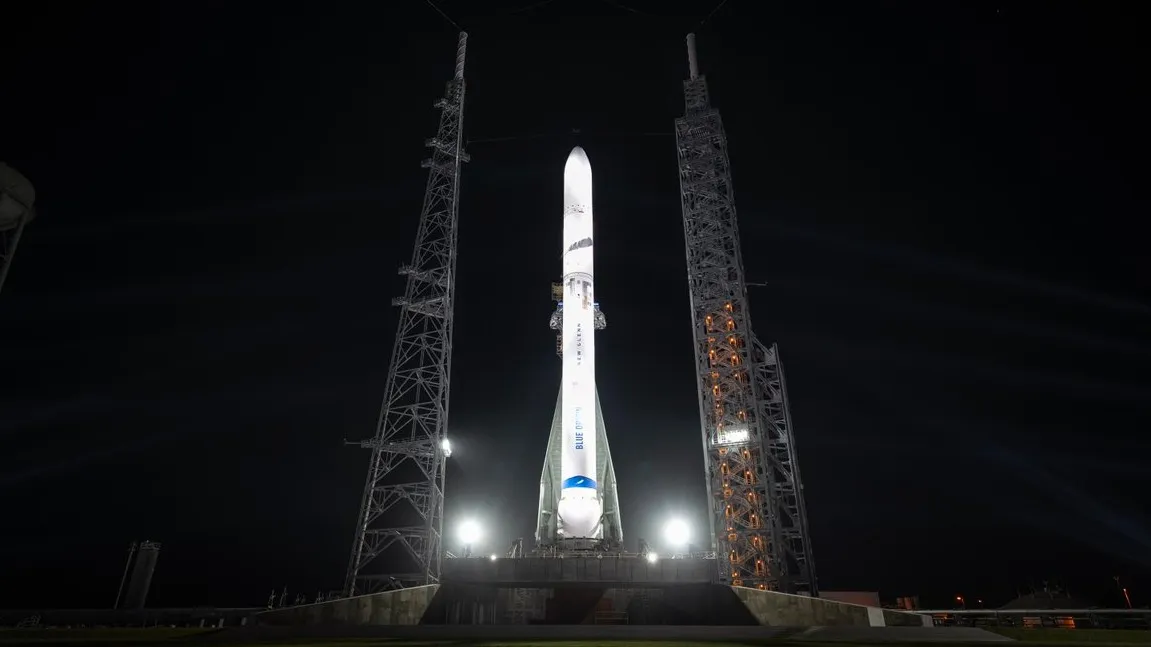
The inaugural flight of Blue Origin's New Glenn heavy-lift rocket, which will send NASA's ESCAPADE mission on its way to Mars, now has a tentative launch date.
NASA announced on Monday (Aug. 26) that the mission will launch no earlier than Oct. 13. Blue Origin's first New Glenn rocket will lift off from Space Launch Complex 36 at Cape Canaveral Space Force Station in Florida, debuting at last after years of delays in its development.
An Oct. 13 launch falls within the window of opportunity for traveling to Mars, which occurs every 26 months, when Earth is properly lined up with the Red Planet to allow efficient travel.
NASA's ESCAPADE (Escape and Plasma Acceleration and Dynamics Explorers) mission consists of two probes built by Rocket Lab to study the effects of the solar wind on Mars' atmosphere. The spacecraft arrived in Florida on Aug. 18 to begin preparations for the New Glenn launch, NASA's Launch Services Program shared recently in a post on X.
"The successful delivery of the spacecraft to Kennedy Space Center marks a significant milestone and the culmination of over three years of dedicated teamwork from individuals across the project, especially our partners at Rocket Lab," Rob Lillis, ESCAPADE principal investigator and associate director for planetary science at the UC Berkeley Space Sciences Laboratory, said in a statement from Rocket Lab.
Related: Facts about Blue Origin, Jeff Bezos' spaceflight company

The twin ESCAPADE spacecraft, named Blue and Gold, are designed to take simultaneous observations from different locations around Mars to identify the planet's real-time response to space weather. Specifically, the two spacecraft will measure plasma and magnetic fields around Mars to identify the processes that strip atoms from the planet's magnetosphere and upper atmosphere, which may help explain how the Red Planet's climate has changed over time, according to the statement.
If all goes according to plan, the ESCAPADE probes will arrive in orbit around Mars in early September 2025. However, if the New Glenn rocket experiences delays that push the launch beyond the coming window, the next opportunity to head toward Mars will come in late 2026.