





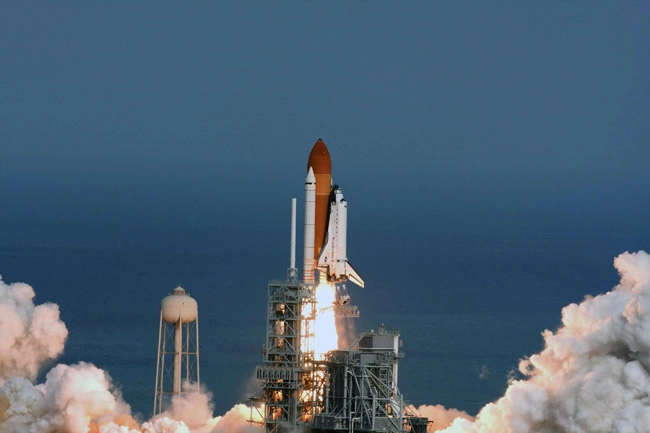
CAPECANAVERAL, Fla. ? After two decades of waiting, Europeans are celebrating the arrival of their first piece of orbital real estate in space.
"It'sa great day for ESA," said Jean-Jacques Dordain, director general for the European Space Agency (ESA),of the Columbus laboratory's launch today aboard the space shuttle Atalantis. "From now on ESA is a visible andconcrete partner of the International Space Station."
Atlantislugged the 13.5-tonpolished cylinder into orbit Thursday along with the seven-astronautcrew of the STS-122 mission commanded by Stephen Frick. NASA expects theorbiter to dock with the orbital outpost on Saturday afternoon and begin operationsto install Columbus on Sunday morning.
BillGerstenmaier, NASA's spaceflight chief, said technicians spotted three small chunksof foam insulation fall from Atlantis' external fuel tank as the spacecraft reached orbit. NASA has kept a close watch on such foam debris since the 2003 Columbia tragedy because they can damage an orbiter's fragile heat shield.
"It'sfairly small foam loss compared to what we've seen in the past,"Gerstenmaier said. "We didn't see anything abnormal."
Europe on orbit
While NASA poresover the launch footage, ESA officials celebrated Columbus' orbital arrivalafter two decades of work and preparation with popping corks and champagne.
NASAadministrator Michael Griffin called Atlantis' space shot today "one ofthe more significant shuttle launches we'll ever have" because ofAtlantis' unique European payload.
"Nolaunch can be any more momentous than the launch of Columbus," Griffin told reporters here at Kennedy Space Center. "It shows ... this is a realpartnership among nations and societies to bring together a capability greaterthan any one nation could bring by itself."
Dordain also noted the importance of the ESA's Automated Transport Vehicle called Jules Verne. The autonomous spacecraft is slatedto launch on March 8 and will ferry crucial supplies to the space station through 2015, including experimental payloads to the Columbus laboratory.
Spacewalksfor science
The new Columbus module harbors 16 phone booth-sized racks and, once attachedto the space station, will consume the energy of about four households whenfully operational.
"Forthe first time, Europe will have this permanent base and will be able toactually experiment in space," astronaut Leopold Eyharts said beforelaunching into space, noting that the ability to experiment will be "a keything for the future of [space] exploration."
SpaceflyersRex Walheim and Hans Schlegel, an ESA astronaut, willventure outside of the space station on Sunday around 9:35 a.m. EST (1435GMT) to prepare Columbus for its attachment to the Harmony module. A third andfinal spacewalk planned for Feb. 14 will outfit the bus-sized lab withtwo external experiments to study the sun and space environment.
?It?s atremendous contribution to the space station,? Frick has said of the Columbus lab. ?It fills half the payload bay and it?s going to take all of our docked timeto try to get it going.?
Atlantis isscheduled to begin wrapping up its 11-daymission on Saturday Feb. 16, when the orbiter will depart from the spacestation with Expedition 16 astronaut Dan Tani. Eyharts will stay behind as hisreplacement. If all goes according to plan, the astronaut crew will return toEarth on Feb. 18.
NASA isbroadcasting Atlantis' STS-122 mission live on NASA TV. Click here for SPACE.com's shuttle mission coverage and NASA TV feed.
- SPACE.com Video Interplayer: NASA's STS-122: Columbus Sets Sail for ISS
- Test Your Smarts: Space Shuttle Countdown Quiz
- VIDEO: ISS Commander Peggy Whitson Takes Charge