
SpaceX's Dragon V2 Manned Spacecraft: How it Works (Infographic)
Breaking space news, the latest updates on rocket launches, skywatching events and more!
You are now subscribed
Your newsletter sign-up was successful
Want to add more newsletters?
Delivered daily
Daily Newsletter
Breaking space news, the latest updates on rocket launches, skywatching events and more!
Once a month
Watch This Space
Sign up to our monthly entertainment newsletter to keep up with all our coverage of the latest sci-fi and space movies, tv shows, games and books.
Once a week
Night Sky This Week
Discover this week's must-see night sky events, moon phases, and stunning astrophotos. Sign up for our skywatching newsletter and explore the universe with us!
Twice a month
Strange New Words
Space.com's Sci-Fi Reader's Club. Read a sci-fi short story every month and join a virtual community of fellow science fiction fans!
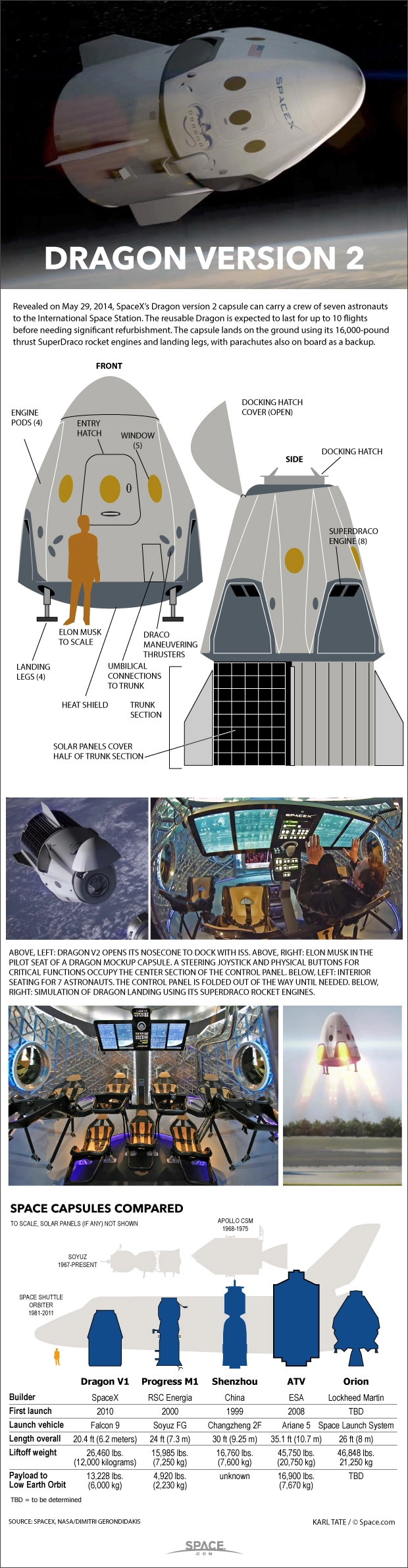
Revealed on May 29, 2014, SpaceX's Dragon Version 2 capsule can carry a crew of seven astronauts to the International Space Station. The reusable Dragon is designed to last for up to 10 flights before needing significant refurbishment. The capsule lands on the ground using its 16,000-pound thrust SuperDraco rocket engines and landing legs, with parachutes also on board as a backup.
Dragon V2 opens its nosecone to reveal its docking hatch for mating with the International Space Station. The capsule seats seven astronauts. A control panel is folded out of the way until needed. A steering joystick and physical buttons for critical functions occupy the center section of the control panel.
For landing, Dragon uses its eight SuperDraco rocket engines to touch down at a designated landing field.
Meet Dragon V2: SpaceX's Manned Space Taxi for Astronaut Trips: Photos
SpaceX Dragon V2 - Manned Spacecraft First Look | Video
SpaceX Unveils Dragon V2 Spaceship, a Manned Space Taxi for Astronauts
Follow us @Spacedotcom, Facebook and Google+.
Breaking space news, the latest updates on rocket launches, skywatching events and more!

Karl's association with Space.com goes back to 2000, when he was hired to produce interactive Flash graphics. From 2010 to 2016, Karl worked as an infographics specialist across all editorial properties of Purch (formerly known as TechMediaNetwork). Before joining Space.com, Karl spent 11 years at the New York headquarters of The Associated Press, creating news graphics for use around the world in newspapers and on the web. He has a degree in graphic design from Louisiana State University and now works as a freelance graphic designer in New York City.
