


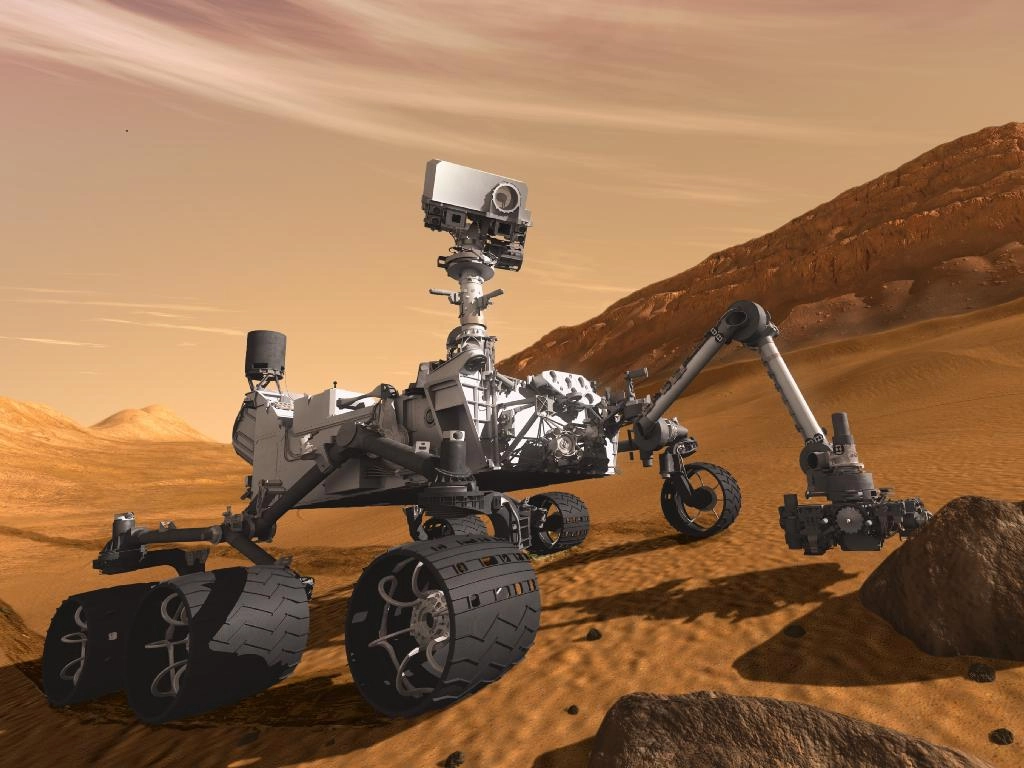
Before astronauts travel through space, they undergo a variety of simulations to prepare for whatever challenges they might meet. It turns out that the scientists involved with a robotic rover do the same thing.
NASA's Mars Science Laboratory rover, called Curiosity, is due to launch Saturday (Nov. 26). If all goes according to plan, it will take about nine months to reach the Red Planet.
During that time, the 240 science team members and collaborators on the ground will gather for several operational-readiness tests to prepare for touchdown.
The team will use a model at NASA's Jet Propulsion Laboratory in Pasadena, Calif., to get a feel for how Curiosity will function on the surface of Mars. [Photos: Last Look at Mars Rover Curiosity Before Launch]
"This is a great time for us to really get familiar with how the command sequence works," project scientist John Grotzinger of the California Institute of Technology told SPACE.com.
Dress rehearsal
While the test rover drives across a surface of loose material, the science team members will sit in a separate area, out of sight of the model, and practice processing the information they receive.
Instruments on Curiosity will provide various readings that the team will need to interpret. So "we will be exploring … how to interpret data at first glance," explained Michael Meyer, program scientist for the Mars Science Laboratory mission.
The instruments might take readings from a fossil, for example. The scientists will attempt to identify it.
"It's a different process to think about, how to explore through a robot," he said.
One that takes some getting used to.
Team-building
Preparing to deploy a rover on another planet requires learning more than how to make the equipment function. The scientists have to learn to work together and how to prioritize.
Curiosity is limited by how much power it can use each day. "You can't drive a hundred meters and do all of your scientific investigations," Meyer said.
The team must work together to determine the goals for the next day and the sequence of commands that must be sent to the distant explorer.
"It's a perfect representation of how we will interact as a team when we are on Mars," Grotzinger said of the model rover tests.
Working the problem
Of course, the mission won't always be smooth sailing. So as in flight simulations for astronauts, there will be planned malfunctions in the scientists' rehearsals. Equipment will stop working properly, and the team will need to figure out the best way to fix the problem or work around it.
By the time Curiosity is ready to start exploring, the scientists should be in top form.
"The idea is to prep the team to deal with whatever situation we're faced with when we get to Mars," Meyer said.
Follow SPACE.com for the latest in space science and exploration news on Twitter @Spacedotcom and on Facebook.
