


NASA's Mars rover Opportunity will get a respite from its bossy human operators on Earth. But the rover won't be able to slack off.
Beginning Thursday (Jan. 27), NASA scientists will stop sending commands to Opportunity for about two weeks, while the Red Planet is almost directly behind the sun from Earth's perspective. Mars rover operators won't resume sending commands until Feb. 11.
During such Mars-sun-Earth alignments, the sun can disrupt radio transmissions between the two planets. A corrupted command signal could potentially harm Opportunity, researchers said.
It will be the fourth time a solar conjunction has precipitated a command suspension since Opportunity landed on Mars in January 2004.
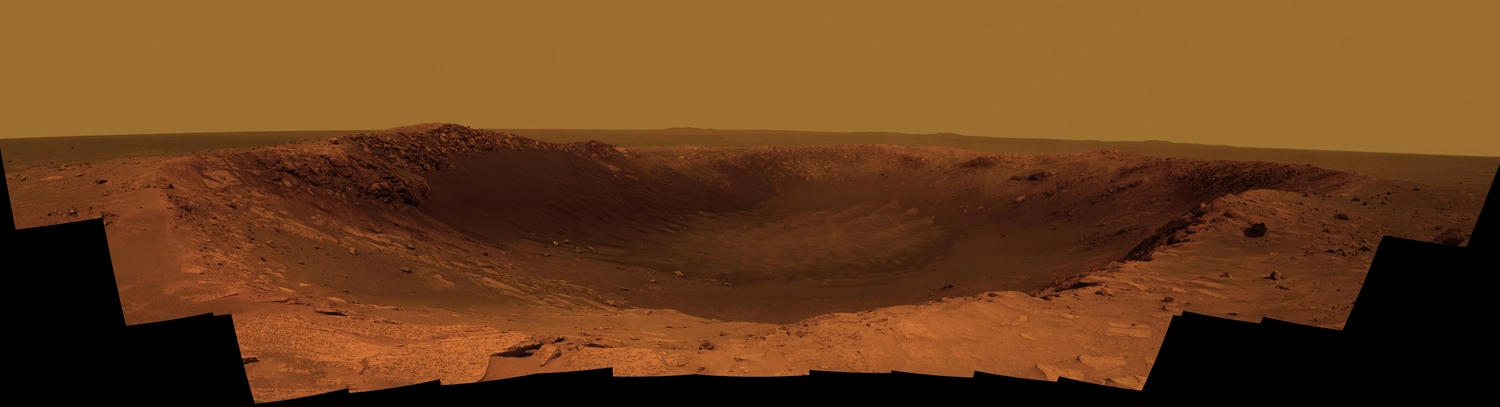
But the rover team has developed a set of commands to send to Opportunity in advance of the conjunction, so the golf-cart-size rover will have plenty to do during the moratorium. Opportunity will spend the time poking around a crater called Santa Maria, looking for new and exciting things, researchers said.
"The goal is to characterize the materials in an area that shows up with a mineralogical signal, as seen from orbit, that's different from anywhere else Opportunity has been," Bruce Banerdt, rover project scientist at NASA's Jet Propulsion Laboratory in Pasadena, Calif., said in a statement.
Sending data home
A similar command moratorium will apply to the NASA spacecraft circling the Red Planet, the Mars Reconnaissance Orbiter (MRO) and Mars Odyssey, researchers said.
These spacecraft will still be able to send data to Earth during the communications suspension, but at a much-reduced rate. Mars-to-Earth communication does not present a risk to spacecraft safety even if transmissions are corrupted by the sun, researchers said.
MRO will scale back its observations during the conjunction, since it has a limited amount of onboard storage space and will not be able to download as much data to Earth.
For its part, Opportunity will continue sending data daily for Odyssey to relay back to Earth.
"Overall, we expect to receive a smaller volume of daily data from Opportunity and none at all during the deepest four days of conjunction," said Alfonso Herrera, a rover mission manager at JPL.
Checking out Santa Maria
Opportunity, which has been on its way to a large crater named Endeavour, reached Santa Maria crater in December, and last week's drives brought the rover to the spot where it will wait out the conjunction. From its position, the rover can use its robotic arm to reach an outcrop target named Luis de Torres, researchers said.
The six-wheeled rover will use its spectrometer for several days to examine the outcrop and assess the types of minerals present. Back in Opportunity's youth, this operation might have taken just a few hours, but the spectrometer uses a small amount of cobalt-57 to glean information, and much of this radioactive stuff has been depleted during the rover's seven years on Mars, so longer readings are necessary.
Opportunity also will take some atmospheric measurements during the conjunction. Once communications resume, the rover will spend a few more days investigating Santa Maria before continuing its long trek toward Endeavour, researchers said.
Endeavour is about 3.7 miles (6 km) away from the rim of Santa Maria. Opportunity has been trudging toward this crater, which is about 14 miles (22 kilometers) wide, since the summer of 2008.
Spirit still sleeping
Opportunity's drive to Santa Maria brought the total distance driven by the rover during its seventh year on Marsto 4.6 miles (7.4 km) – a record for any single year. The rover has logged a total of 16.6 miles (26.7 km) during its time on Mars, researchers said.
Opportunity and its twin, Spirit, which had landed on Mars three weeks earlier, successfully completed their three-month prime missions in April 2004. They then began years of bonus mission time.
Both rovers have made important discoveries about wet environments that may have made ancient Marsfavorable for supporting microbial life, researchers said.
While Opportunity is still chugging along, Spirit has hit some snags. Spirit got mired in soft sand in May 2009 and stopped communicating with Earthin March 2010.
The Martian spring has arrived, and rover scientists remain hopeful that Spirit will warm up, wake up and check in with its operators. Engineers continue to listen for a signal from Spirit, researchers said.
