

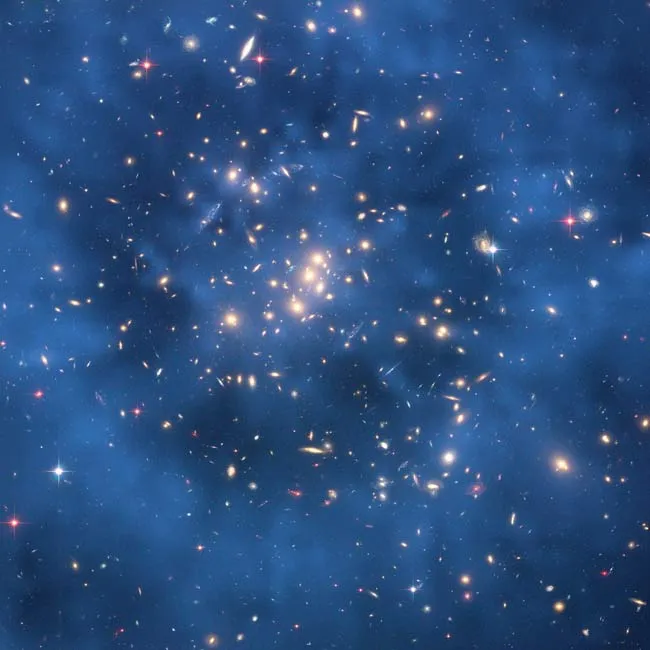
The
universe may be filled with shining stars, but nearly 85 percent of all matter
can't be seen, calculations show. In the hunt for the invisible,
astrophysicists have turned up a small but new hiding place for mysterious dark
matter: "recycled" dwarf galaxies produced from nasty
galactic collisions.
The
discovery, detailed today in the online version of the journal Science,
challenges the notion that dark
matter hangs out in halos around large galaxies. Instead, it might be found
within the galaxies.
Dark matter
acts as gravitational glue, holding millions or billions of stars together in
galactic globs or disks. Without it, "our own galaxy should have fallen apart
by now," said Frederic Bournaud, an astrophysicist with the French Atomic
Energy Commission (Commissariat a l'energie atomique). "So dark matter--this
unseen force--is somewhere keeping it glued together."
Clueless
Scientists
have no firm idea what dark matter actually is. They haven't
even agreed on a single definition for the mysterious stuff, because they can
only guess as to what it's made of. While dark matter is a source of gravity
and reacts with regular matter on large scales, it has no measurable effect on
small scales (like within our solar system), there is no picture of it and
there's no known way to detect it directly.
Conventional
matter, called "baryonic" matter, is the stuff of plants, rocks, stars and
things we can touch or at least see. But some baryonic matter is not easily
seen, because it's in the form of cold gas or faraway, dark, burned-out stars.
Some researchers use the term "dark matter" to refer to this
hard-to-see regular matter.
But the
overwhelming majority of unseen matter is probably the highly unconventional,
yet-to-be-described "non-baryonic" matter, and most scientists limit their
definition of dark matter to this strange form.
Disagreements
aside, so far the bulk of dark matter has only been detected
indirectly. One method, for example, takes a galaxy's visible matter,
calculates how fast it should be moving and then compares that to the actual,
observed speed. For large galaxies, the calculations show visible matter
accounts for only 10 percent of the mass that should be there.
But by
combining telescope images, calculations and computer models, Bournaud thinks
he and his team might be a little closer to finding and identifying more of the
universe's missing mass.
Galactic
hit-and-run
To discover
more clues about dark matter, the astrophysicists aimed the Very Large Array of
radio telescopes in New Mexico at NGC5291, a galaxy cluster about 200 million
light-years away. It resembles a ring, crowned with one large galaxy at the
center and studded with smaller dwarf galaxies in a cloud of cosmic debris.
How does
such a curious group of galaxies form?
"About 360
million years ago a large galaxy collided with NGC5291, which used to be a
spiral galaxy," Bournaud said. Several suspects are in the area, but IC4329 is
the prime candidate--with a lined-up trajectory and six times the mass of
NGC5291, it's remained relatively unchanged from the probable cosmic
collision, much like a car often remains unscathed after hitting a cyclist.
Simulated
help
If dark
matter does hang out at the edges of large galaxies, little or none should be
found in the recycled dwarf galaxies. But Bournaud has discovered that visible
matter makes up only one-third of the mass in the tiny galaxies--so large
galaxies probably contain most dark matter within their galactic boundaries,
not in a halo around them.
Bournaud
thinks about half of the unseen mass in the recycled galaxies is plain old
hydrogen gas. "But that's only a guess," Bournaud said, adding that telescopes
should eventually
be able to detect it. Regardless of whether or not the hidden matter is
regular matter or dark matter, however, current theories about recycled dwarf
galaxies and dark matter location are being put "to the test," according to the
study.
He gives
some of credit for the discovery to dramatic advances in computing. "Even 10
years ago, simulations were far behind telescope observations," he said. Like
police reconstructing accident or crime scenes by combining eyewitness reports
and forensic measurements, "today astrophysicists are combining what they see
with computers models to make discoveries."
The next
step in adding weight to the theory, Bournaud said, is to look at other
recycled dwarf systems. "If we can better understand galaxy formation, we can
find more dark matter," he said.