





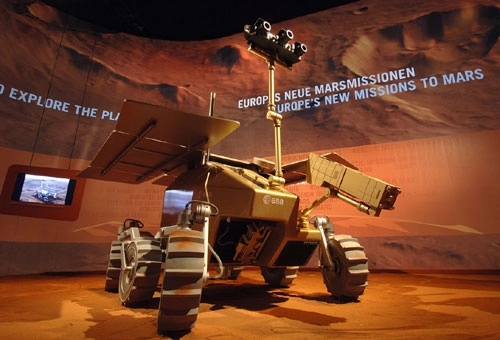
PARIS - Europe's planned lander and rover mission to Mars in 2016 shouldbe substantially cut back to fit within its likely budget constraints, and thedownsizing should occur as soon as possible, officials from the French spaceagency, CNES, said Jan. 28.
They saidthat while the cuts will be painful for everyone, it's better to redesignthe mission now rather than risk cost overruns and possible programdelays later on.
Addressinga press briefing here, CNES's deputy director for science, Richard Bonneville,said French support of the mission, called ExoMars, remains solid. But he saidas currently designed, ExoMars will not fit into the budget likely to beapproved by European Space Agency (ESA) governments when they meet late thisyear to review a fresh program proposal.
"Ifear that it will not be possible" to build ExoMars as itis currently planned, Bonneville said.
Meetinglast November, ESA governments, as expected, refused to endorse a proposal tospend 1.2 billion euros ($1.6 billion) on ExoMars. In an informalsurvey of support, these nations - led by Italy, France, Germany and Britain -said they could spend about 850 million euros.
ESA wasordered to look for ways to reduce the size of ExoMars and, above all, to seekinternational cooperation - from Russia, the United States and elsewhere - inthe amount of about 200 million euros. Key to that international participationwould be a Russian Proton rocket, provided free of charge, to replace the 150million euros or more ESA would need to spend for a European Ariane 5 vehicle.
France isESA's biggest backer of Ariane 5 and in the past has lobbied ESA governments infavor of a rule forbidding the use of non-European rockets for Europeangovernment missions. ESA has stopped short of adopting such a policy, but in2005 its governments agreed that European vehicles should have an automaticpreference.
StephaneJanichewski, CNES deputy director for policy, said in a Jan. 29 interview thatFrance did not rule out the use of Russia's Proton vehicle for ExoMars if the decisionwas part of a broader program of science cooperation with Russia.
ButJanichewski said even with the Proton vehicle and a future U.S. participation,it is doubtful that ESA governments will be able to fund a billion-euroversion of ExoMars. He said it would be more prudent to make theprogram cuts now than to take the risk of missing the 2016 launch window.
- New Video - Spirit on Mars: NASA's Little Rover That Could
- Video - Europe?s Martian Rover ExoMars
- The Future of Mars Exploration: What's Next?
