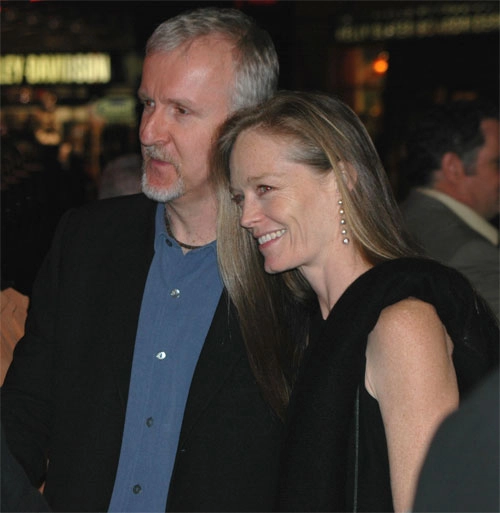
It is not often when a science documentary can play as an adventurefilm. Of course, with someone like director James Cameron at the helm, youexpect the best, and in the case of his new IMAX 3Dfilm, "Aliens of the Deep", hedelivers.
With a title like that, you have to wonder if it is science or science fiction. When you watch the movie unfold, you still have to wonder. Cameron has taken us into the deep ocean previously for IMAX in "Ghosts of the Abyss", however, the new film maypermanently blur the line between reality and speculation. His idea was to makedives to places like the mid-Atlantic trench where bizarre creatures inhabit thescalding and toxic environments surrounding black smokers.
These black smokers are vents in the Earth's crust where it is nearlyimpossible for true volcanism to occur because of the pressure found milesunder the ocean s surface. These vents form, releasing their noxiousby-products into the surrounding water. Common sense tells us that nothingcould live here, yet we found that life actually flourishes under theseconditions. In fact, it may be places like these deep-ocean incubators wherelife first found a foothold billions of years ago on Earth.

We've always known that life probably originated in the oceans, we justnever imagined until recently how deep it occurred and under whatcircumstances. The discovery of these amazing and extreme environments on Earthas an abode for life has led planetary scientists and biologists from placeslike NASA s Jet Propulsion Laboratory to believe that other spots such as thismay also harbor life elsewhere in our own solar system. The prime example isthe vast ocean that exists under the ice of Jupiter s moon, Europa. Callistoand Ganymede may also have these sub-ice oceans, but none are as close to thesurface, and thus as accessible to human exploration, as the Europan ocean.
Cameron's film takes us all on an incredible journey to study thesereal-life environments on Earth, and on a wild ride of exploration that mayhappen in the not-too-distant future when we extend our reach to search for life elsewhere. He enlists the expertise of many scientists,astrobiologists, geophysicists, chemists, andoceanographers.
"Aliens" features scientists as heroes in the quest for knowledge. One of these, Dijanna Figueroa, is a marine biologist specializing inthe physiology and ecology of organisms in extreme conditions such as the deepocean. She told us, " I m glad this movie featuresscientists in the spotlight. Not many scientists get to do this sort of thing.I feel very honored, and if I can inspire just one person, then that means a lot to me. We need to get young kids excited about science."
When asked if there were any surprises during her submersible dives,she said, "There s always something that I've personally never seen before, sothere was awe in every single dive. I hope that comes through in the film. I'vegone to the bottom of the ocean many times, yet every time it is a specialmoment."
Loretta Hidalgo, a biologist from Stanford, is well-known to those ofus in the Orange CountySpace Society as the co-founder of Yuri's Night with National Space Society Executive DirectorGeorge Whitesides. She participated in several dives during the making of the film, including an historic first where four manned submersibles were on the bottom at the same time. We get to see her excitement during these dives, as well as her playfulness when she waves at the camera on a robotic rover that scoots up to her bubble cockpit for a look.
Cameron once stated that humanity's use of technology teeters us between salvation and destruction. As a director, where does he draw that line?
"I don't think you candraw the line", he said. "That line isup to us collectively to draw by the decisions we make. Understand that withtechnology we will either save ourselves or we won't. Look at all the badthings in the world. Almost all of them have a technological origin, except forthe recent tsunami. Even so, science can help us understand that better andsave lives by being able to create a warning system. We reout making a film at these underwater volcano sites where you have all thistectonic activity and the more we learn about how that stuff works, the more wecan predict when they will happen again. "
Several years ago, he started working on a feature film about a possible first expedition to Mars.So far that film remains unmade. When I asked him about it, Cameronsaid that the time was not yet right, but he expects it to happen in the nextthree to four years. He wants to make sure it will truly have an impact on ourfuture goals in space. However, he has started development of specializedequipment needed to film that project, such as high-quality cameras that canwork in very tight spaces and extreme environments. Those Mars-project cameraswere used to film "Aliens of the Deep."
This movie will take you places you never even imagined existed, andyet they are right here on our home planet. It is a movie that draws togetherscience and Hollywoodin a way that is accessible to all.
Teri Hatcher [Lois and Clarke and Desperate Housewives] joined us at the premiere at UniversalCity Walk. She even brought her young daughter. " We don't go to too many movies because I m a pretty conservative mother," Hatcher said, "but this one seemed like a good one that we could watch together. I think we need more things like this movie."
Cameron agrees. "As a parent, Im happy to be doing my part to bring something to the educational communitythat they can use to get kids excited about science and technology, and justabout the wonder of the world. Kids now don t generally have a sense of wonder,certainly not the way I remember having it back in the 1960s, back when JacquesCousteau was on television and we were sending guys to the Moon. It just seemedlike everything was amazing. As a society, science isn't so hip anymore, so Iwant to bring that back. That's the goal for this film."
The expedition that Cameron mounted to film this project is theprecursor to our expeditions to the outer planets and beyond. Dijannaexplained, "I think we cannot effectively search for life somewhere else if wehaven t learned how to do it well here first."
"Jim is an amazing guy," Dijanna continued. "He has an extreme passion for this planetand for exploration and for science. I'm so happy that we have him to puttogether things like this and to be able to share that passion. The wholeexpedition inspired me. I really think that kids should come out and see this,because it s not your average documentary about science. It does a really goodjob about getting people to realize that we, as scientists, are excited aboutwhat we do. We had a great time, and I hope the audience has a great time."
The human species is hard-wired to be explorers. Any time we havedenied that trait, we have faltered and stumbled. When we embrace exploration,it brings out the best humanity has to offer. In Aliens of the Deep, we canfollow the lead that James Cameron has set for us and set our sights on newlife and new worlds.