

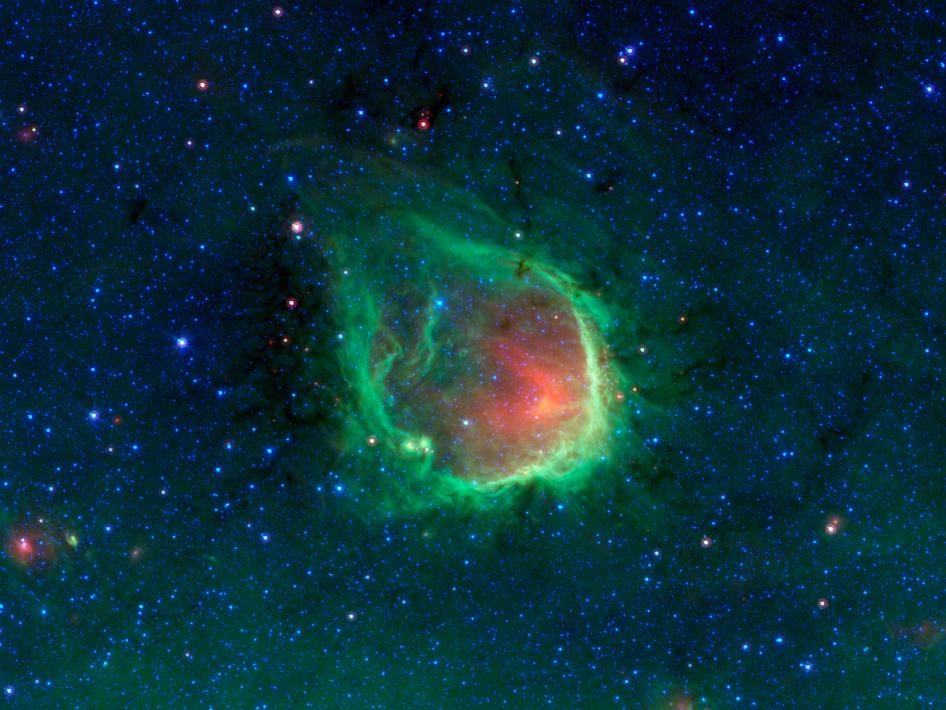
'Green Lantern's Ring' Shines in NASA Space Photo
Breaking space news, the latest updates on rocket launches, skywatching events and more!
You are now subscribed
Your newsletter sign-up was successful
Want to add more newsletters?
Delivered daily
Daily Newsletter
Breaking space news, the latest updates on rocket launches, skywatching events and more!
Once a month
Watch This Space
Sign up to our monthly entertainment newsletter to keep up with all our coverage of the latest sci-fi and space movies, tv shows, games and books.
Once a week
Night Sky This Week
Discover this week's must-see night sky events, moon phases, and stunning astrophotos. Sign up for our skywatching newsletter and explore the universe with us!
Twice a month
Strange New Words
Space.com's Sci-Fi Reader's Club. Read a sci-fi short story every month and join a virtual community of fellow science fiction fans!
A glowing ring spotted in space seems at first more like superhero fiction than science fact. But that's what NASA's Spitzer Space Telescope found in the murky clouds encircled by the tail of the constellation Scorpius.
The new photo of the bright emerald nebula, released Wednesday (June 15), is reminiscent of the glowing ring wielded by the comic book superhero Green Lantern, who derives his strength from the band forged by the diminutive Guardians of the Planet "Oa," according to a NASA description. The film version of "Green Lantern", starring Ryan Reynolds as iconic hero Hal Jordan, on Friday (June 17). [See NASA's photo of a 'Green Lantern' nebula]
In reality, the cosmic ring is a region of hot gas and glowing dust sculpted by the powerful light of giant "O" stars, which are the most massive type of star known to exist.
The ring, named RCW 120, is actually glowing in infrared colors that our eyes cannot see, but show up brightly when viewed by the Spitzer telescope's infrared detectors. At the center of this ring are a couple of giant stars whose intense ultraviolet light carved out the bubble, though they blend in with the other stars when viewed in infrared.
RCW 120 is about 4,300 light-years from Earth and does have a central, massive star at its core that is 2.5 million years old, according to previous studies.
Visit SPACE.com for the latest in space science and exploration news on Twitter @Spacedotcom and on Facebook.

Breaking space news, the latest updates on rocket launches, skywatching events and more!

Space.com is the premier source of space exploration, innovation and astronomy news, chronicling (and celebrating) humanity's ongoing expansion across the final frontier. Originally founded in 1999, Space.com is, and always has been, the passion of writers and editors who are space fans and also trained journalists. Our current news team consists of Editor-in-Chief Tariq Malik; Editor Hanneke Weitering, Senior Space Writer Mike Wall; Senior Writer Meghan Bartels; Senior Writer Chelsea Gohd, Senior Writer Tereza Pultarova and Staff Writer Alexander Cox, focusing on e-commerce. Senior Producer Steve Spaleta oversees our space videos, with Diana Whitcroft as our Social Media Editor.
