





Latest about Galaxies
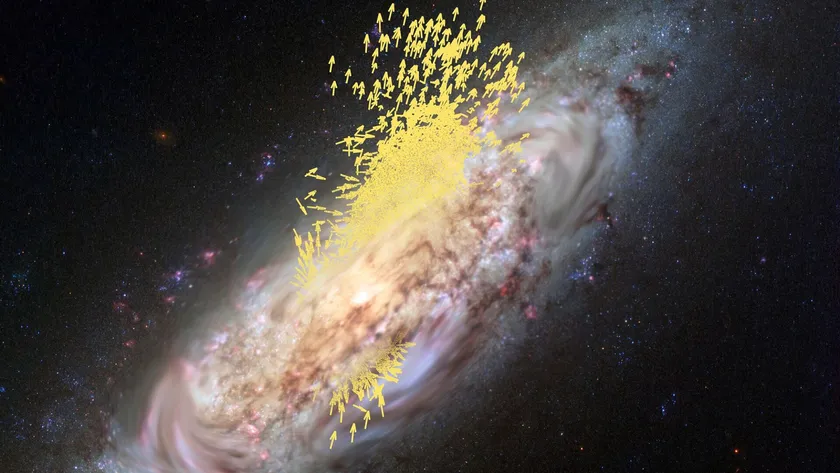
Our Milky Way galaxy appears to have flipped 90 degrees long ago. But why?
A slowly rotating stellar halo was the clue to a major and unknown event in the Milky Way's history that saw the spiral disc flip over by more than 90 degrees.

Galaxy cluster's magnetic field reconstructed for 1st time with record-breaking astronomy map
"We believe that the mechanism that 'turns on' these gigantic radio emissions is linked to the formation process of galaxy clusters."

Infant stars celebrate their independence with cosmic fireworks| Space photo of the day for July 3, 2026
Infant stars celebrate their independence with cosmic fireworks in a stunning new image from the James Webb Space Telescope.

Stunning new NASA space telescope images reveal the universe in red, white and blue for America 250
NASA's Chandra X-ray Observatory has released four stunning images of cosmic wonders, depicted in red, white and blue for the America 250 anniversary on July 4.

The James Webb Space Telescope peered into one of the universe's oldest galaxy clusters, and scientists can't explain what they saw
Using the James Webb Space Telescope, astronomers have spotted a massive and densely packed galaxy cluster at "cosmic noon" before such structures were thought to be possible.

Strange glowing 'bow-and-arrow' structure may be a giant cosmic shock wave created by a supersonic galaxy collision
A bizarre "bow-and-arrow" radio galaxy nearly 1.8 million light-years across could reveal how galaxy clusters sculpt some of the universe's largest structures.

This is the largest and most detailed image of our Milky Way — with over 60 million stars and 50 exoplanet systems
The ESA's dark universe detective spacecraft Euclid, has studied the heart of the Milky Way, creating the largest and most detailed photo of this region ever made.

James Webb Space Telescope discovers 'galaxy-killing' wind that may explain why some early galaxies lived fast and died young
Powerful outflows of gas may explain why so many massive galaxies shut down star formation soon after the Big Bang.

