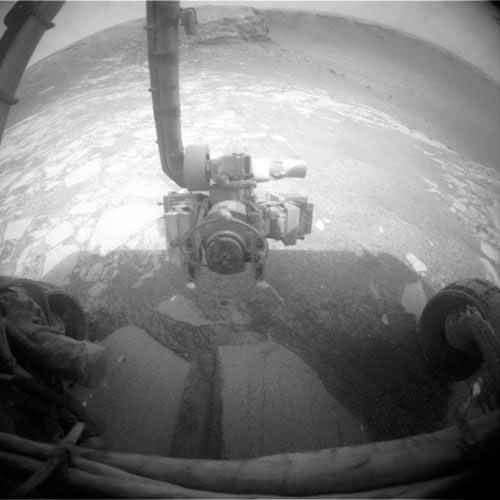
GOLDEN, Colo. – Aftermore than three and a half years of operation, NASA's twin Mars rovers continueto thrive, showing no signs of stopping as they relay a wealth of valuable databack to Earth about that ancient world's past, present and future.
NASA announced Oct. 15that it was extending, for a fifthtime, the activities of the trailblazing robots – Spirit and Opportunity – perhaps through 2009.
The six-wheeled,golf-cart sized dual rovers that make up the Mars Exploration Rover (MER)project, have been, quite literally, on a mechanical and scientific roll sincethey landed on opposite sides of Mars in January 2004. They continue tofunction well, NASA officials said, despite the fact that each one only had anengineering warranty of 90 days of life to carry out their respective missions.
Slow motion science
The solar-powered roverscan reach a top velocity of 5 centimeters per second on flat hard ground. "Whenyou use these vehicles on a day-to-day basis, it just feels excruciatingly slow,"said Steve Squyres, lead scientist for the MER mission at Cornell University inIthaca, N.Y., adding: "It's this wonderful adventure that's unfolding inincredibly slow motion."
The longevity of therovers has translated into unexpected scientific payoff, particularly in thecase of Spirit, Squyres told Space News in an Oct. 18 phone interview.
"Spirit didn't makeits biggest discovery until 1,200-plus sols [a sol is a Martian day] into themission," Squyres said. When Spirit analyzed a patch of Martian soil thatwas very rich in silica, it provided some of the strongest evidence yet thatancient Mars was much wetter than it is now. The processes that could haveproduced such a concentrated deposit of silica require the presence of water.
Spirit is now busy atwork exploring an intriguing site called "Home Plate," said WilliamBruce Banerdt, MER project scientist at the Jet Propulsion Laboratory inPasadena, Calif. "I wouldn't say there's anything like a consensus, butthere is opinion that this is some sort of volcanic feature," he toldSpace News in an Oct. 18 phone interview.
Banerdt said overheadimagery of the area collected by NASA's Mars Reconnaissance Orbiter's HighResolution Imaging Science Experiment showed that other features in thatvicinity have a volcanic look to them. "If the rover grants us enough timefor more observations of these other features, we hope to be able to beginputting together the story of this area and its evolution ? perhaps in a veryactive volcanic environment," he said.
"As the roverscontinue to survive, the story has been getting more and more exciting,"said Larry Crumpler, research curator for volcanology and space sciences at theNew Mexico Museum of Natural History and Science in Albuquerque and a member ofthe MER science team.
Crumpler suggested thatSpirit's current exploration zone within Gusev Crater – in a range of hillsthat were on the distant horizon from its landing site – is an area ripe fornew revelations.
"There is abundantevidence for not only water, but water that may have been present for aconsiderable time, or water that was warm, maybe even hot. All of these factorsbode well for some climactic discoveries," Crumpler explained in an Oct.19 e-mail.
Crumpler said members ofthe MER science team are having the time of their lives. "Look for some ofus to be riding along with the rovers until the bitter end, however far in thefuture that may be. I am sure there will be a major science question stillhanging just around the next ridge," he said.
Mobility on Mars
"Before the MERmission, you would be surprised at how difficult it sometimes was to convincepeople of the value of mobility on the Martian surface," Squyres added. "Butit took a very capable set of rovers and a couple of very interesting places onMars to try and convince the world of that."
For instance, theOpportunity rover is now perched inside the rim of VictoriaCrater, a feature 800 meters across and well over 70 meters deep that wasexcavated by a meteor impact millions of years ago. To get to that site withinMeridiani Planum, the robot slogged roughly 6 kilometers from its landing site.
"The longevity ofthe mission has allowed us to examine Victoria Crater both from the rim and nowin-place within the inner rim of the crater," said William Farrand, aresearch scientist at the Space Science Institute in neighboring Boulder and a member of the MER science team.
"We are just gettingstarted with our examinations of Victoria's stratigraphy ? so it is too earlyyet to say what those investigations will yield," Farrand said in an Oct.18 e-mail. "But we would never have had this opportunity if the rovers hadnot lasted as long as they have."
Farrand said that,potentially, Mars scientists will gain a better understanding of how thesedimentary rocks at Meridiani Planum formed. "We know that water played ahuge role here," he said, but added that a lot of the details have yet tobe worked out, with the investigations at Victoria Crater providing additionalinformation to better work out that sedimentary history.
Squyres said a decisionis forthcoming about just how far down into Victoria Crater Opportunity willventure. The decision will be driven both by science and safety considerations,he said. "If we lose a wheel down inside the crater, I'm not sure we'llever get out," Squyres said. "There's a lot of motivation for us towrap up the science quickly and get back out on the plains," he said.
The Spirit rover is strugglingnow due to a breakdown in its right-front wheel, Squyres pointed out.
Remote maintenance
Squyres says thelongevity of the rovers is due to several factors.
"The first is thatwe built really good hardware. The components were selected extremely carefullyand everything was tested very, very rigorously." Furthermore, thevehicles were designed for remote maintenance, imbued with the ability forground controllers to troubleshoot and maintain the robots from a distance, hesaid, such as utilizing heaters on every single actuator to counter thetemperature swings on Mars.
Mars rover operators alsohave received lucky breaks. In particular, little gusts of wind have repeatedlyswept away sheens of dust that collect on rover solar panels, Squyres said. "That'sbeen just good fortune."
Another reason for thelong-term survivability of the rovers has been the ability to drive and parkthe vehicles on steep terrain, thereby tilting solar arrays significantlytowards the Sun. "We've survived two winters on the planet that way ? andthe third one is coming ? and we're going to try and survive that one too,"Squyres said.
Squeezing out morescience
Last July, Spirit and Opportunity were subjected to global martian duststorms that reduced sunlight reaching the solar-powered rovers. Thatsituation elevated concern regarding survival of electrical and mechanicalcomponents on board the robots. Ground controllers put in place low-powerprocedures that enabled the machines to survive the severe dust storms. Withclearing skies, the rovers were put back on line to continue their datagathering.
But, in the end, therovers are not immortal, Squyres said. "If Mars doesn't kill them, we'regoing to wear them out. We have driven them so hard," he said.
The key now, Squyresadded, is to continue each day and find that balance between safety andaggressiveness, as well as squeezing as much science out of the rovers aspossible.
"When I sit down andlook at the traverses that Opportunity and Spirit have followed, the data thatwe've collected, the discoveries that we've made and the papers that we'vewritten ? I sleep pretty well at night," Squyres said. "I'm going tobe the last guy to turn out the lights when the last rover dies. I've got tosee this through the end."
- VIDEO:Mars Rover Team Ponders Mission's End
- VIDEO:Red Dust Dangers
- Mars Rover Special Report