The Apollo 11 crew, from left: Commander Neil A. Armstrong, Command Module Pilot Michael Collins, and Lunar Module Pilot Edwin E. "Buzz" Aldrin Jr. On July 20th 1969 at 4:18 PM, EDT the Lunar Module "Eagle" landed in a region of the moon called the Mare Tranquillitatis, also known as the Sea of Tranquility.
The Apollo 11 crew leaves Kennedy Space Center's Manned Spacecraft Operations Building during the pre-launch countdown. Mission commander Neil Armstrong, command module pilot Michael Collins, and lunar module pilot Buzz Aldrin prepare to ride the special transport van to Launch Complex 39A where their spacecraft awaited them. Liftoff occurred at 9:32 a.m. EDT, July 16, 1969.
The Apollo 11 mission launched from the Kennedy Space Center, Florida on July 16, 1969, bearing the first humans to walk on the moon.
A Saturn V rocket launches the Apollo 11 crew on the first moon landing mission on July 16, 1969 in this image framed by an American flag. Four days later, Apollo 11 astronauts Neil Armstrong and Buzz Aldrin landed on the moon while crewmate Michael Collins orbited above.
The Apollo 11 Saturn V space vehicle climbs toward orbit on July 16, 1969, bearing astronauts Neil A. Armstrong, Michael Collins and Edwin E. Aldrin, Jr. Armstrong and Aldrin would make history as the first men on the moon.
Apollo 11 astronaut Buzz Aldrin poses for a snapshot while inside the Lunar Module in this July 1969 NASA image. Aldrin and astronaut Neil Armstrong were the first humans to land and walk on the moon on July 20, 1969.
Clad in his spacesuit, Command Module (CM) pilot Michael Collins does a final check of his communications system before the boarding of the Apollo 11 mission on July 16, 1969.
Tranquility Base, the Apollo 11 mission's Eagle lunar lander touchdown site as seen in July 1969.
Sunlight and shadows are cast on the Apollo 11 lunar lander Eagle and lunar module pilot Buzz Aldrin in this image by mission commander Neil Armstrong during the first manned moon landing on July 20, 1969.
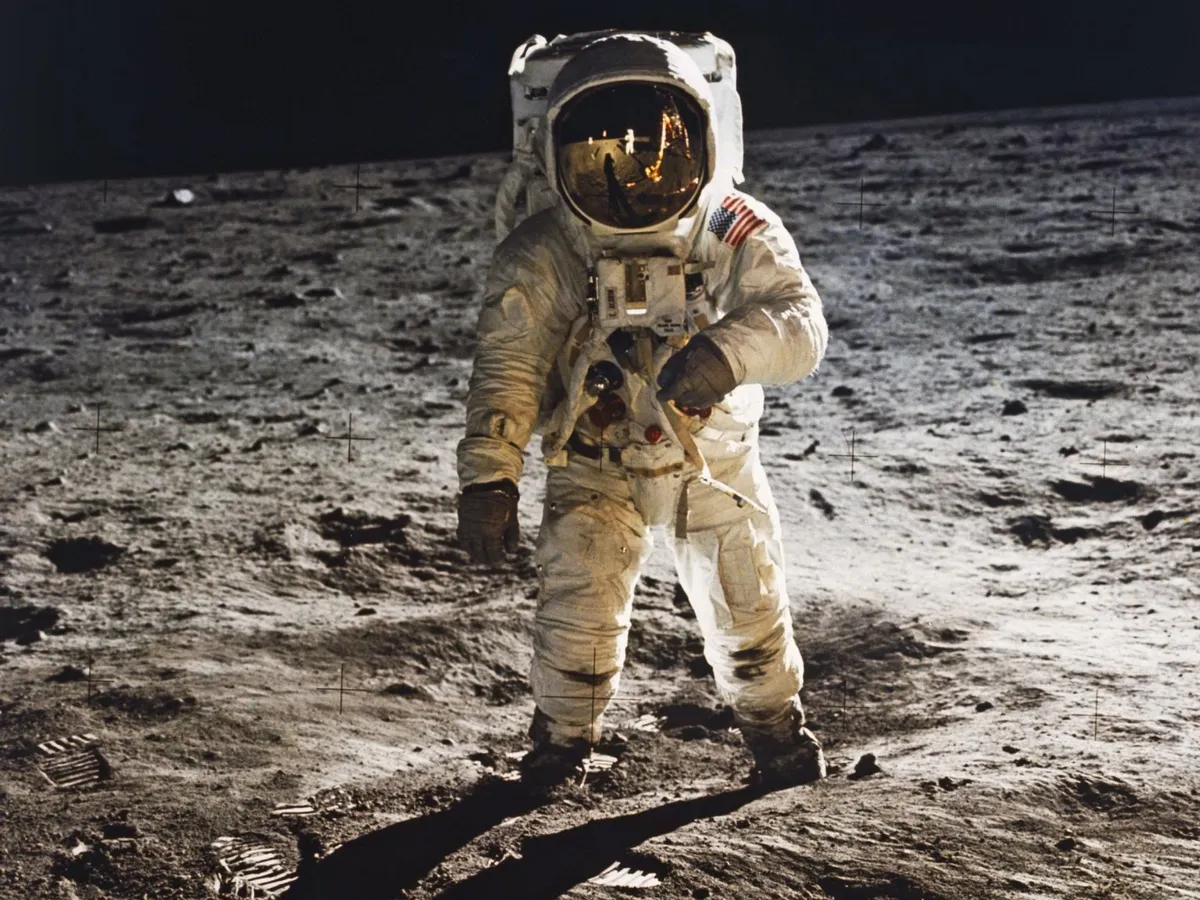
Apollo 11 astronaut Buzz Aldrin walks on the moon in July 1969 in this photo snapped by Neil Armstrong.

Astronaut Edwin E. "Buzz" Aldrin, Jr., lunar module pilot of the first lunar landing mission, is beside the U.S. flag during an Apollo 11 moon walk. The Lunar Module (LM) is on the left, and the footprints of the astronauts are clearly visible in the soil of the moon. Astronaut Neil A. Armstrong, commander, took this picture with a 70mm Hasselblad lunar surface camera.
On July 20, 1969, Apollo 11 astronaut Neil Armstrong became the first man to walk on the moon. Armstrong is pictured here, shortly after collecting a sample of lunar dust and rocks. At his feet is the handle for the sample collection tool.
Apollo 11 astronaut Edwin Aldrin photographed this iconic photo, a view of his footprint in the lunar soil, as part of an experiment to study the nature of lunar dust and the effects of pressure on the surface during the historic first manned moon landing in July 1969.
Destination Moon. Space tourists are guaranteed a window view like no other from a lunar distance. Shown here is photo from Apollo 11 mission in 1969.
Composite photo of President Richard M. Nixon as he telephoned "Tranquility Base" and astronauts Neil Armstrong and Edwin "Buzz" Aldrin after their historic Apollo 11 moon landing on July 20, 1969.
Apollo 11 mission officials relax in the Launch Control Center following the successful Apollo 11 liftoff on July 16, 1969. Second from left (with binoculars) stands Dr. Wernher von Braun, Director of the Marshall Space Flight Center.
Dr. Wernher von Braun, director of the Marshall Space Flight Center, Huntsville, Alabama, relaxes after the successful launch of Apollo 11 astronauts Neil A. Armstrong, Michael Collins and Edwin Aldrin Jr. Their historic lunar landing mission began at 9:32 a.m. EDT, July 16, 1969, when an Apollo/Saturn V space vehicle lifted off from the spaceport's Launch Complex 39A.
Slow-scan Polaroid taken at Goldstone tracking station reveals far more detail than publicly broadcast TV during Apollo 11 moonwalk. Search is underway to locate old Apollo tapes and freshen them up with new digital technologies.
Apollo 11 astronauts trained on Earth to take individual photographs in succession in order to create a series of frames that could be assembled into panoramic images. This frame from Aldrin's panorama of the Apollo 11 landing site is the only good picture of mission commander Neil Armstrong on the lunar surface.
President Richard M. Nixon was in the central Pacific recovery area to welcome the Apollo 11 astronauts aboard the USS Hornet, prime recovery ship for the historic Apollo 11 lunar landing mission. Already confined to the Mobile Quarantine Facility (MQF) are (left to right) Neil A. Armstrong, commander; Michael Collins, command module pilot; and Edwin E. Aldrin Jr., lunar module pilot. Apollo 11 splashed down at 11:49 a.m. (CDT), July 24, 1969, about 812 nautical miles southwest of Hawaii and only 12 nautical miles from the USS Hornet.
http://www.space.com/17299-photos-neil-armstrong-first-moonwalker-icon.html
A copy of the U.S. Customs form filled out by Apollo 11 astronauts Neil Armstrong, Buzz Aldrin and Michael Collins after their return to Earth on July 24, 1969.
A close-up view of Apollo 11 lunar sample no. 10046.
In this image, the Apollo 11 lunar lander and it shadow can be seen in a view from NASA's new Lunar Reconnaissance Orbiter, which is scouting the moon for new landing sites for future astronauts.
President Barack Obama poses with Apollo 11 astronauts, from left, Buzz Aldrin, Michael Collins, and Neil Armstrong, Monday, July 20, 2009, in the Oval Office of the White House in Washington, on the 40th anniversary of the Apollo 11 lunar landing.
Stowed aboard Discovery during the STS-119 launch on March 15, 2009, the moon rock inside its case was in turn packaged inside a padded container labeled "Apollo 11 sample".
A moon rock brought to Earth by Apollo 11, humans' first landing on the moon in July 1969, is shown as it floats aboard the International Space Station. Part of Earth can be seen through the window. The 3.6 billion year-old lunar sample was flown to the station in honor of the July 2009 40th anniversary of the historic first moon landing. It was returned on shuttle mission STS-128 to be publicly displayed.
Enlargements of the New Frontier Congressional Gold Medal being on display in the Capitol Rotunda. The smaller, actual-size medals were awarded to astronauts Neil Armstrong, Buzz Aldrin, Michael Collins and John Glenn on Nov. 16, 2011.
A statue of a young Neil Armstrong sits outside the engineering building that bears his name at Purdue University.
This photo from the historic Apollo 11 moon mission, shows astronaut Neil A. Armstrong, mission commander standing on the moon, July 20, 2012. Armstrong was using a clothesline device to transport a contingency lunar sample into the Lunar Module (LM), nicknamed "Eagle," on the surface of the moon. Astronaut Edwin E. "Buzz" Aldrin, Jr. was in the Eagle to receive the sample. Armstrong, the first person to set foot on the moon, passed away on August 25, 2012, at the age of 82.
This American flag patch is from the left arm on Neil Armstrong's Apollo 11 suit. This image was taken in April 2006 at the National Air and Space Museum's Garber Facility in Suitland, MD.