


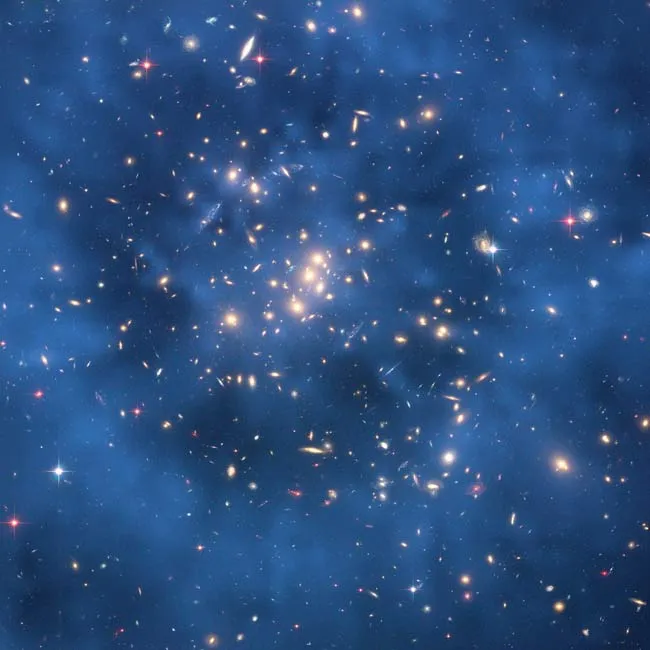
Roughly 80 percent of the mass of the universe appears to be dark matter: an invisible material that seems to interact with ordinary matter only through gravity, without emitting light or energy. Scientists cannot detect dark matter directly and don't yet know what it's made of, but they track its influence based on the motions of stars and galaxies. The presence of dark matter is necessary to explain the universe's current structure.
Related Topics: The Big Bang Theory, Black Holes, The Theory of Relativity in Space, Gravitational Waves
Latest about dark matter

'It's very humbling to get to work with so many smart people who are all trying to execute your vision.'

Neil deGrasse Tyson discusses his latest book, "Lost in Space," a gorgeously illustrated 400-page odyssey around the heavens.

Though their origins may be shrouded in mystery, fast radio bursts could be used to probe some of the universe's biggest puzzles, including the nature of dark matter and dark energy.

Astronomers have used the MeerKAT radio telescope to detect hydrogen gas located billions of light-years away, from a period when the cosmos was billions of years younger.

Using the LUX-ZEPLIN experiment, scientists may have detected the first direct evidence of dark matter, in the form of a rare interaction between a WIMP particle and ordinary matter.

NASA's Nancy Grace Roman Space Telescope has left Earth, but it'll be a while before it starts its highly anticipated science mission. Here are the next steps for the observatory.

SpaceX will launch the Nancy Grace Roman Space Telescope, NASA's next great observatory, atop a Falcon Heavy rocket on Aug. 30. Here's what time it flies.

A SpaceX Falcon Heavy rocket is poised to lift off with the Nancy Grace Roman Space Telescope on Aug. 30. This observatory is on a mission to usher in a new wave of astronomical discovery.

