






See Uranus and Moon in Night Sky Sunday
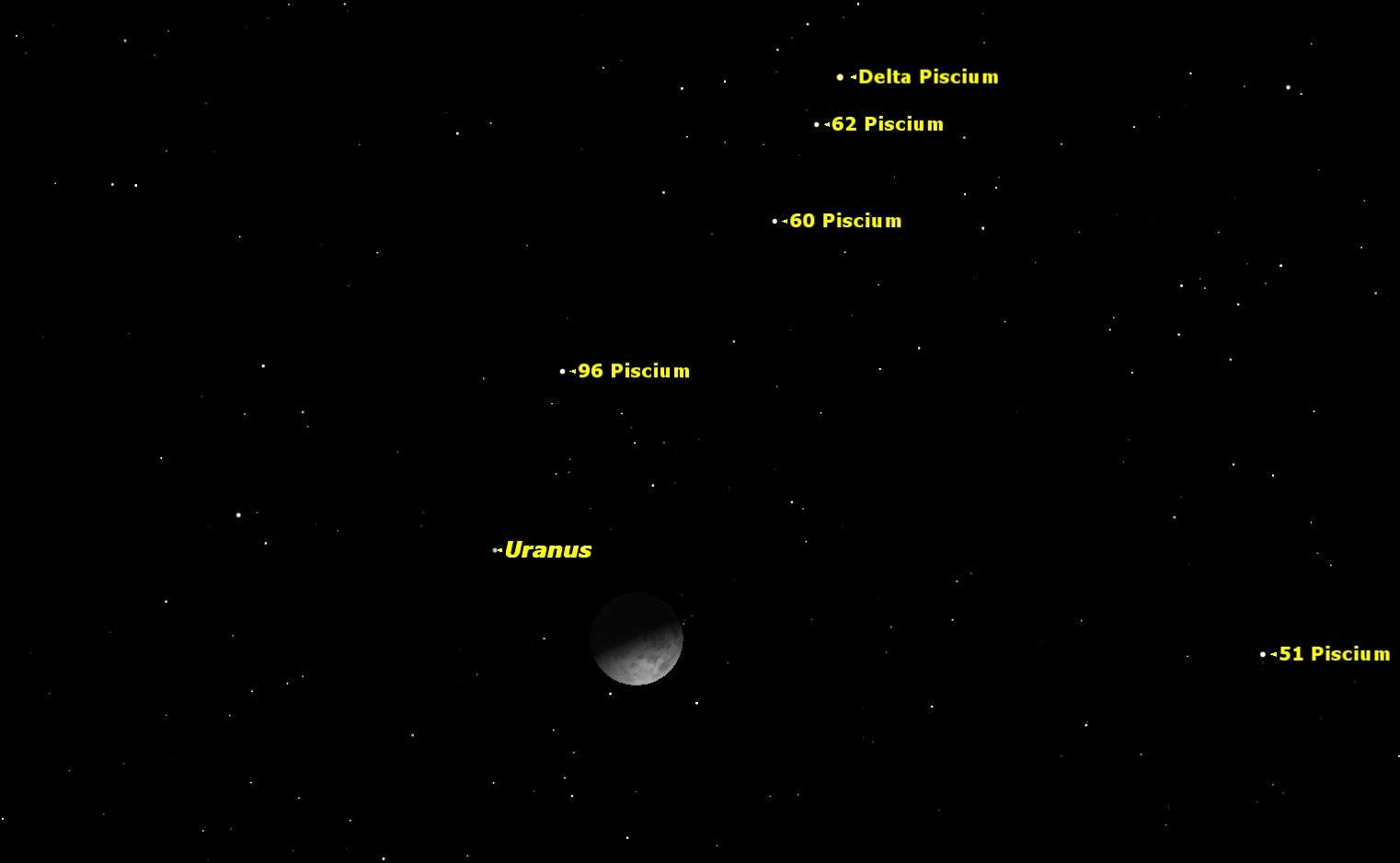
Look to the sky Sunday (Dec. 28) to see the moon in a close encounter with the planet Uranus.
Uranus is theoretically visible with the unaided eye, but realistically most of us need binoculars to see it. Look just above and to the left of the Moon to spot Uranus, which should have an odd blue-green color unlike any star. Only a very large telescope will show distant Uranus as anything other than a star.
Skywatchers in the eastern part of North America might have some difficulty seeing the conjunction due to the early setting of the moon. The best time to look will be around 11:30 p.m. EST, when the setting moon is still high enough that Uranus will be visible. Observers on the West Coast of the United States will have a much better view. The best time to look should be around 10 p.m. PST, when the moon will be closest to Uranus. [See images of Uranus]
Observers should take notice of the stars around Uranus and the moon, faint stars in the constellation Pisces. In particular, look for 96 Piscium, just above the moon. Because of the rotation of the Earth, the moon, Uranus and the background stars all seem to be moving towards the western horizon. The mon is also moving, but in the opposite direction.
Try to follow the moon as it moves against the background stars. If you’re in the right location, you may see the moon actually pass in front of 96 Piscium in what is called a lunar occultation. In Los Angeles, this should occur at 10:53 p.m. local time.
Usually when the moon passes in front of a star, the star winks out instantaneously, like someone turned it off with a switch. That’s because the moon has no significant atmosphere to dim the star gradually. On rare occasions the star may disappear briefly behind a mountain on the edge of the Moon and then reappear a second later.
Exactly which stars will disappear behind the moon depends on your exact location on Earth. The Moon is close enough to the Earth that it exhibits parallax, the same thing you see if you hold a finger up close to your eyes while observing something in the distance.
For observers across the United States and southern Canada, the moon will pass comfortably north of Uranus. But observers in northern Canada, Alaska, and northeastern Asia will actually see the moon pass directly in front of Uranus, occulting the planet.
The lucky people in the city of Yellowknife in Canada’s Northwest Territories, will see the moon occult Uranus for the second time this month, having witnessed a similar occultation on Dec. 1.
Editor's note: If you have an amazing skywatching photo you'd like to share for a possible story or image gallery, please contact managing editor Tariq Malik at spacephotos@space.com.
This article was provided to Space.com by Simulation Curriculum, the leader in space science curriculum solutions and the makers of Starry Night and SkySafari. Follow Starry Night on Twitter @StarryNightEdu. Follow us @Spacedotcom, Facebookand Google+. Original article on Space.com.
