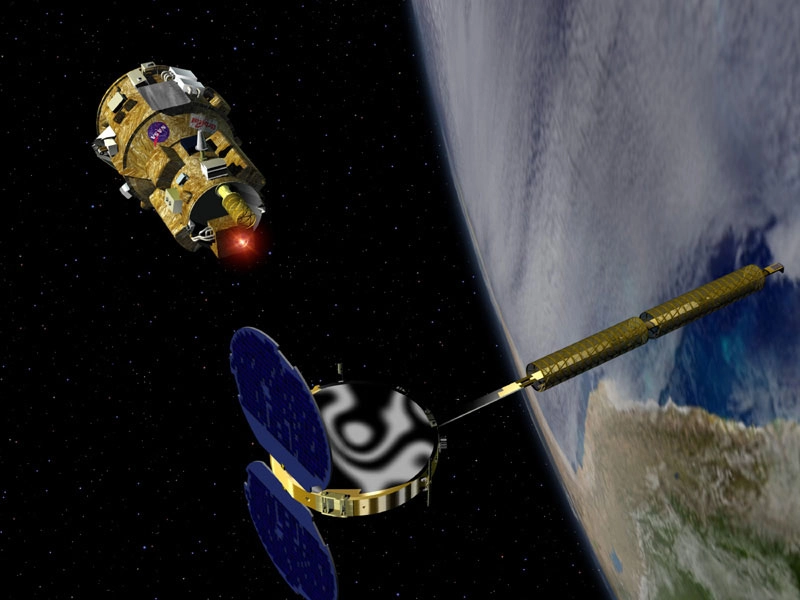
With lessthan a day remaining before the launch of their autonomous spacecraft, NASAresearchers find themselves in an all-too-familiar position. But hopefully thistime it will be different.
Six months ago,a series of glitches prevented NASA from launch its robotic DART spacecraft ona mission to hunt down and rendezvous with an orbiting satellite. The spaceagency, however, is ready to try again.
"Theexcitement is back up to a fever pitch," said Jim Snoddy,NASA's DART project manager, during a press conference held Thursday at themission's Vandenberg Air Force Base launch site in California. "Space weatheris about the only thing we're looking at for tomorrow's launch."

Researchersattempted to launch DART, short for Demonstration of Autonomous RendezvousTechnology, twice in late October 2004. But several problems, including poorweather,a contaminatedpayload fairing and a communications glitch with DART'starget satellite, forced launch scrubs.
The missionis now set to launch on April 15 between 1:21:49 and 1:28:49 p.m. EDT (1721:49to 1728:49 GMT).
U.S. AirForce Maj. Richard Benz, launch weather officer for the DART space shot, saidweather conditions are favorable for tomorrow's spaceflight, though anotherlaunch window will be available on Sunday if needed.
Robot at the helm
DART hasbeen hailed as the first U.S.-built spacecraft designed to fly itself toward an in-orbit rendezvous with another space vehicle, though Russia has used thetechnology for years to control its autonomous Progress cargo shipments to theInternational Space Station (ISS).
TheEuropean Space Agency (ESA) is developing its own unmanned autonomousspacecraft - dubbed the Automated Transfer Vehicle - to loft cargo to the ISS,as is the Japanese Aerospace Exploration Agency (JAXA). Earlier this week, theU.S. Air Force also launched a small satellite, called XSS-11,to demonstrate autonomous rendezvous functions.
Accordingto its flight plan, DART will spent about seven hours flying itself to theMultiple Paths Beyond Line-of-Site Communications (MUBLCOM) satellite, whichhas been in orbit since 1999. About 21 hours into the mission, DART should havecompleted its rendezvous maneuvers and cast itself into a deorbittrajectory that will destroy the autonomous spacecraft. The entire missionshould be over 25 hours after launch.
Instead oflifting off from the ground, DART will get a boost before the engines of itsOrbital Sciences-built Pegasus XL rocket ever ignite. The spacecraft and itsfour-stage rocket will be carried into launch position by the former passengerjet Stargazer L-1011, which will fly to an altitude of about 40,000 feet(12,192 meters) before unleashing its payload above the Pacific Ocean.
"We're looking forward to an uneventfullaunch," said Bryan Baldwin, Pegasus launch vehicle program director forOrbital Sciences, during the press briefing.
Ifsuccessful, DART's launch will be the second spaceshot in two days for NASA.
The nextcrew of the International Space Station (ISS), Expedition11 commander Sergei Krikalevand flight engineer John Phillips, is set to launch spaceward tonightaboard a Soyuz rocket. The flight will also carry visiting astronaut Roberto Vittori,who represents the European Space Agency. That launch is currently scheduled forabout 8:46 p.m. EDT (0046 April 15 GMT) this evening.
