


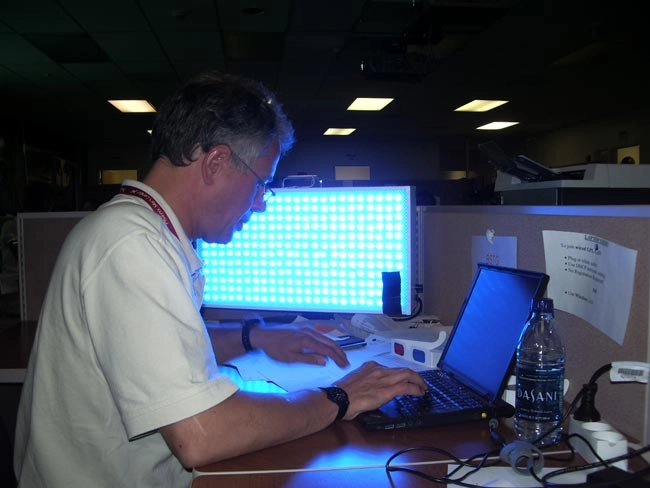
The mission controllers overseeing NASA's Mars rover Curiosity face a constant battle with jet lag.
A day on the Red Planet is 40 minutes longer than days on Earth, meaning the start of the Martian day — and the start of the scientists' workday — is always changing, relative to Earth time. Living on a constantly shifting schedule mirrors chronic jet lag and can wreak havoc on an Earthling's 24-hour internal body clock. Previous research has shown that it also can drag on alertness and job performance.
But the results of a new study conducted on a previous Mars lander team show that certain measures, including naps and light boxes, can get mission controllers on a 24.65-hour Martian clock. Researchers say a regimen to reset the body clock could help the Curiosity team and scientists working on future Mars missions fight fatigue.
"Our study, which was conducted during the Phoenix Mars Lander mission, investigated the effectiveness of a pilot program to educate the mission personnel on how to reset their body clocks more quickly and how to improve their sleep, alertness and performance," Steven W. Lockley, a neuroscientist at Brigham and Women's Hospital (BWH), said in a statement.
When the Phoenix lander arrived in the Martian arctic in 2008, mission controllers had to adjust to its schedule. The solar-powered spacecraft went to sleep during the Martian night while the scientists and technicians were up analyzing data it collected and making operational decisions for the lander's next day ahead.
Nineteen of the Phoenix ground crew members volunteered for the study. Over the course of 11 weeks, they kept a sleep and work diary and wore an "actigraph" watch, a sensor that helped determine their sleep patterns. They also took regular tests to check on their memory, mood and alertness while on duty.
The researchers found that most of the participants were able to synchronize to a Martian day with the help of strategies like taking naps and using blue light boxes at their workstations to help reset their internal body clocks. The regimen also included drinking small cups of coffee throughout a shift (instead of one giant cup at the start) and staying on Martian time even on days off.
"While adapting the human sleep-wake and performance cycle to a 24.65 hour day is a substantial challenge, our study has provided the foundation to develop comprehensive fatigue management programs for future missions, which may eventually include manned missions to Mars," said physiologist Laura Barger, of Harvard Medical School and BWH.
The study was published online today (Sept. 28) in the journal SLEEP.
Follow SPACE.com on Twitter @Spacedotcom. We're also on Facebook and Google+.
