





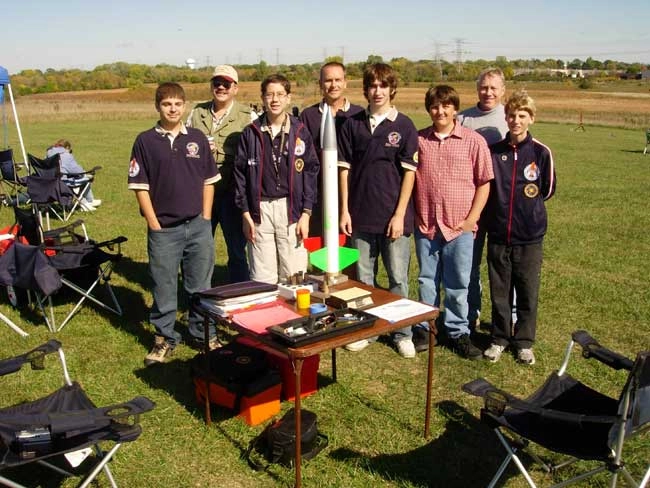
We are a group of six students who became heavily involvedwith model rocketry two years ago. A science teacher at one of the local highschools had told us about a national model rocketry competition called the"Team America Rocketry Challenge" or TARC for short.
This competition is the world's largest model rocketcontest. Last year over 10,000 middle and high school students competed for thecoveted National Championship ranking. The whole idea was initiated by the(A.I.A) Aerospace Industries Association and NASA for two reasons.
The first year of the contest was to celebrate the WrightBrother's Century-of-Flight on December 17, 2003. Secondly, it was a way toinspire younger generations to seriously get involved and consider educatingthemselves in the areas of engineering, science and math to prepare for careersin Aerospace and Aviation. Several participating A.I.A members have contributedup to $60,000 in prize money for the top 10 teams. The top 25 teams have anopportunity to submit a proposal to NASA in the student launch initiative. Ifselected, each team would be flown to Huntsville, Alabama and work with NASArocket scientists to construct and launch a high powered rocket that would flyup to a mile high while conducting its experiments onboard.
Our team consists of students from various backgrounds instudies and previous rocket skills. A few members had never even built orlaunched a rocket before. This is what is so great about the competition; thatanybody can form a team and participate.
The St. Andrews team assigned each member to research andcomplete a specific task. Kenny Johnson had very strong hands-on building; sohe was in charge of rocket assembly. Mike Cinquinohad a strong background in electronics; so he designed and assembled ourignition system. AJ Witzke and Mike Williamsonassisted with back-up assignments, pre-flight checks and launch control. Eachyear the rocketry challenge has a different set of rules and specificationsthat each team must follow. Last year's goal was to launch a rocket forduration. The rocket had to be in the air for 60 seconds from take-off untiltouchdown and carry two raw eggs that had to survive the flight withoutbreaking or cracking. Each rocket could be designed as a single or multi-stage vehicle.
For TARC 2006, the goal is a combination of duration andaltitude with the payload of one raw egg surviving touchdown. The teams mustdesign their rockets to achieve maximum altitude of 800 feet and do it all in45 seconds from lift-off until the rocket touches down. A series of computersoftware programs are used by the students to design their rockets to meetthese goals and launch them on the computer for data analysis. After the teamis confident that their rocket design will meet the TARC-2006 rules; they begin constructing the real thing, making sure ofairworthiness, stability and safety. This year St. Andrews has added two morestudents who are somewhat rookies to this challenge. They are Monica Johnsonand Eric Ludwig. St. Andrews also has split into two teams this year for abetter chance to be twice as successful. Each team also consists of a teamsupervisor. The St. Andrews teams are as follows:
Team Leader: Leonard Johnson
Team # 4020
Supervisor: Nick Cinquino
Captain: Kenny Johnson, Mike Cinquino, Monica Johnson
Team #4284
Supervisor: Arnie Witzke
Captain: AJ Witzke,Michael Williamson, Eric Ludwig
This year our teams have a few new added features withlaunching and electrical system checks. All the students have had hands-oninstructional welding class to create their personally designed launch towergantry.
Team meetings on a regular basis have brought the studentstogether to study, discuss and refine their creations for quality productioncontrol of the rockets. The students have designed and made their selections ofvarious sized nylon parachutes. These parachutes will control therate-of-descent to achieve the 45 second flight profile time and eggsurvivability.
Many calculations and design techniques go into theirresearch and development for a successful rocket launch. The team's creativityalso plays heavily in having a great season. An onboard miniature electronicaltimeter is carried on the upper payload bay to measure air pressuredifferences and calculate the rocket's peak altitude.
When the rocket is recovered after its flight thealtimeter's audible alarm beeps out the altitude in a set rate of beeps. Thestudents then remove the altimeter from the rocket and connect it to a laptopcomputer to download all the flight data results.
This information is critical in determining rocket weight,parachute size and class of rocket motor(s) to be used in conjunction withtotal timed flight. Each TARC team has two chances to make a qualificationattempt and if they are good enough, receive an invitation to attend theNational Finals! Designing team mission patches, decals, logos, and flyers helpthe teams generate a successful fundraising strategy that attracts potentialcharity for sponsorship and donations. They also provide DVD, VHS, digitalcamera and 35mm visual aids for studying their performances and promoting thecompetition of sport model rocketry.
The St. Andrews TARC Teams accomplishments:
1) National Finalists at TARC 2005
2) Chicago Adler Planetarium's 75th anniversary guest VIP's
3) Appearance in Sept./Oct. 2005 issue: SportRocketry
4) Appearance in June issue of "STARCHASER" British X-Prizemagazine
5) Honored by Park Ridge Mayor and City Council
6) Recognized by: Illinois State Senator Sullivan
7) Recognized by: United States Senator BarackObama
8) Recognized by: Illinois Governor Rod Blagojevich
9) Congratulated by: NASA administrator: Michael Griffin
10)SpecialMention Award for Rocket design: Flis Kits ModelRocket Company
11)Congratulations letter from Mr.Vern Estes
The St. Andrews TARC Teams major Sponsors:
1) Bigelow Aerospace
2) Elon Musk: Space X
3) Space Dev: Designer of the winning SpaceShipOnerocket engine
4) Numerical Precision
In conclusion, the sport of model rocketry can be a veryrewarding experience. This includes groups of all ages. Learning basic modelrocketry theory and applying it to constructing a simple level 1 kit that canbe purchased at your local hobby shop is a beginning for any curious potential rocketeer.
Important issues to remember are that practicing modelrocketry safety codes is a must in this very statistically safe sport. Onceyour rocket clears the launch rod in an exhilarating cloud of smoke you are offto an exciting start. This may create an interest to eventually register andparticipate in the world's largest model rocketry contest as we at St. Andrewshave done.
Our team has successfully accomplished so many goals that wenever could have dreamed of. And so far; at least half the team has decided togo on to college and earn science and engineering degrees for future careers inAerospace. Now that's what we call "The American Dream".
NOTE: The views of this article are theauthor's and do not reflect the policies of the National Space Society.
Visit SPACE.com/Ad AstraOnline for more news, views and scientific inquiry from the National SpaceSociety.