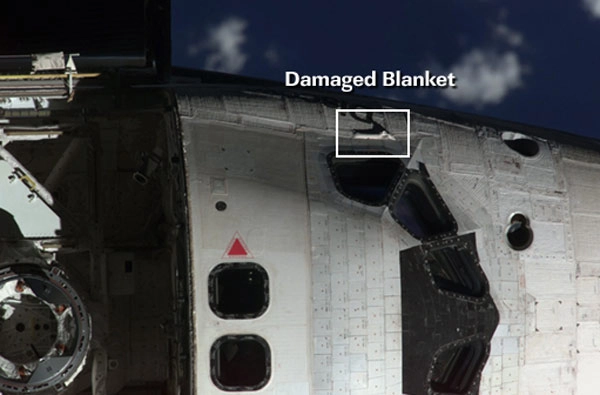
HOUSTON--Thespace shuttle Discovery was given a clean bill of health to return home Mondayafter mission managers declared a fourth spacewalk would not be needed torepair a damaged thermal blanket on the orbiter's hull.
"We have clearedDiscovery to reenter," said Wayne Hale, NASA's deputy shuttle program manager,during a briefing here Thursday at Johnson Space Center (JSC). "We believe thechances of anything untoward happening with this piece of fabric is remote."
Theannouncement came after a night of wind tunnel tests which proved that sizeablechunks of the small thermal blanket--damaged on launch and puffing out from justbelow the orbiter's leftmost flight deck window--would likely not rip off andsmash into a vulnerable section of Discovery. The blanket clearance was thelast piece needed to clear Discovery for landing. Its heat-resistant tiles andreinforced carbon carbon (RCC) panels were clearedduring earlier inspections, shuttle officials said.

Hale saidthat after wind tunnel tests of three concluded this morning, engineersbelieved there was only a 1.5 percent chance a piece of the blanket coulddetach from its mooring at time it could cause the worst damage--while theDiscovery was locked in supersonic flight between Mach 6 and Mach 1, about 10minutes before landing. In that worst case scenario, a piece of the blanketabout eight-tenths of an inch long could pull free and hit a critical area,such as the orbiter's tail.
"I will nottell you that there is zero risk," Hale said. "Even if this blanket were inpristine shape, there is not zero risk."
However, therisk of landing with the damaged blanket was much less than the risk of oncemore suiting up Discovery's two spacewalkers, STS-114 mission specialistsStephen Robinson and Soichi Noguchi, and sending themon a repair job.
This couldhave potentially created more debris that could harm the orbiter or astronauts'spacesuits, Hale said. Similarly, deciding to leave Discovery's crew on orbitto be retrieved by a rescue shuttle--a remote case that would call for thelaunch of Atlantis orbiter--also carries more risk than landing as there arestill concerns about external tank foam shedding during liftoff, Hale said.
Thedamaged blanketmeasures about 20 inches (50 centimeters) long and 3.8 inches wide (9.6 centimeter), though only about an eight-inch (20-centimeter) section puffedup during launch.
Flightcontrollers alerted Discovery's astronaut crew of the good news before missionmanagers had concluded their daily meeting Thursday, NASA officials said.
"Soichi we have good news," astronaut Julie Payette, servingas Discovery's CAPCOM. "The blanket is safe for return...so no EVA four."
"That's, Iwould say, good news," Noguchi replied.
Noguchi andRobinson have successfully conducted three spacewalks during their STS-114mission, the latest including a first-ever repair of the orbiter's tile-linedbelly. During that repair, Robinson pulled two space-filling strips ofceramic-lined cloth jutting out from between the heat tiles underneath theorbiter's nose.
Meanwhile,the entire STS-114 crew has completed their primary cargo transfer work,loading tons of fresh supplies into the International Space Station (ISS) andtransferring still more tons into a cargo pod for return to Earth, shuttleofficials said.
The shuttleis scheduled to land at NASA's Kennedy Space Center on Aug. 8.
"Thisflight has been conducted flawlessly," Hale said. "It is a thing of beauty."
- Fixing NASA: Complete Coverage of Space Shuttle Return to Flight
