
Mapping Rain & Snow: How the Global Precipitation Measurement Satellite Works (Infographic)
Breaking space news, the latest updates on rocket launches, skywatching events and more!
You are now subscribed
Your newsletter sign-up was successful
Want to add more newsletters?
Delivered daily
Daily Newsletter
Breaking space news, the latest updates on rocket launches, skywatching events and more!
Once a month
Watch This Space
Sign up to our monthly entertainment newsletter to keep up with all our coverage of the latest sci-fi and space movies, tv shows, games and books.
Once a week
Night Sky This Week
Discover this week's must-see night sky events, moon phases, and stunning astrophotos. Sign up for our skywatching newsletter and explore the universe with us!
Twice a month
Strange New Words
Space.com's Sci-Fi Reader's Club. Read a sci-fi short story every month and join a virtual community of fellow science fiction fans!
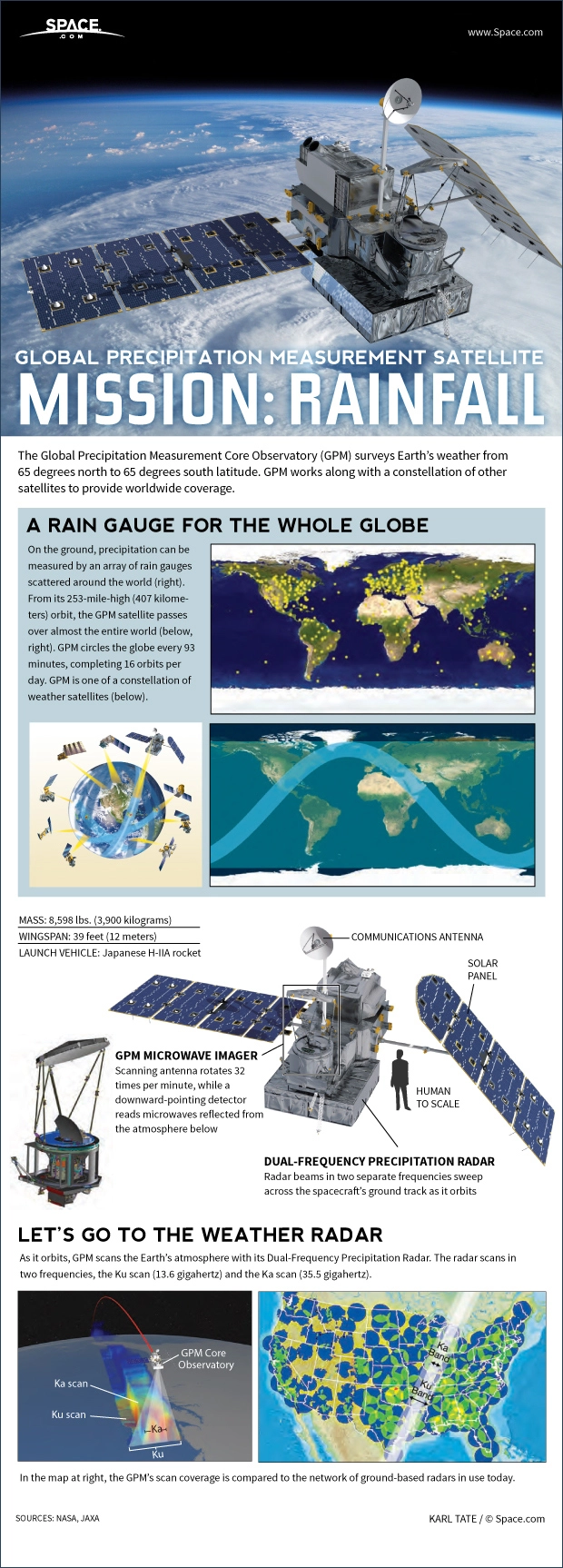
The Global Precipitation Measurement Core Observatory (GPM) surveys Earth’s weather from 65 degrees north to 65 degrees south latitude. GPM works along with a constellation of other satellites to provide worldwide coverage.
On the ground, precipitation can be measured by an array of rain gauges scattered around the world. From its 253-mile-high (407 kilometers) orbit, the GPM satellite passes over almost the entire world. GPM circles the globe every 93 minutes, completing 16 orbits per day. GPM is one of a constellation of weather satellites.
GPM has a mass of 8,598 lbs. (3,900 kilograms). Its wingspan across the solar panels is 39 feet (12 meters). It is launched on a Japanese H-IIA rocket.
The satellite carries a microwave imager. Its ccanning antenna rotates 32 times per minute, while a downward pointing detector reads microwaves reflected from the atmosphere below.
Breaking space news, the latest updates on rocket launches, skywatching events and more!
As it orbits, GPM scans the Earth’s atmosphere with its Dual-Frequency Precipitation Radar. The radar scans in two frequencies, the Ku scan (13.6 gigahertz) and the Ka scan (35.5 gigahertz).

Karl's association with Space.com goes back to 2000, when he was hired to produce interactive Flash graphics. From 2010 to 2016, Karl worked as an infographics specialist across all editorial properties of Purch (formerly known as TechMediaNetwork). Before joining Space.com, Karl spent 11 years at the New York headquarters of The Associated Press, creating news graphics for use around the world in newspapers and on the web. He has a degree in graphic design from Louisiana State University and now works as a freelance graphic designer in New York City.
