The Yuletide evening sky is especially rewarding now. The eastern sky is filled with brilliant stars - sort of a celestial Christmas tree.
Distinctive groupings of stars forming part of the recognized constellation outlines, or lying within their boundaries, are known as asterisms. Ranging in size from sprawling figures visible to the naked eye to minute stellar settings, they are found in every quarter of the sky and at all seasons of the year.
The larger asterisms - ones like the Big Dipper in Ursa Major and the Great Square of Pegasus - are often better known than their host constellations. One of the most famous is in the northwest these frosty evenings.

The Northern Cross
Originally known simply as the "Bird" in ancient times, without any indication of what sort of bird it was supposed to represent, it later became the constellation Cygnus, the Swan. But the brightest six stars of Cygnus compose an asterism more popularly called the Northern Cross.
Bright Deneb decorates the top of the Cross. Albereo, at the foot of the Cross, is really a pair of stars of beautifully contrasting colors: a third magnitude orange star and its fifth magnitude blue companion are clearly visible in even a low power telescope. While usually regarded as a summertime pattern, the Cross is best oriented for viewing now, appearing to stand majestically upright on the northwest horizon at around 8:30 p.m. local time, forming an apt Christmas symbol.
Furthermore, just before dawn on Easter morning that cross lies on its side in the eastern sky.
The Christmas package
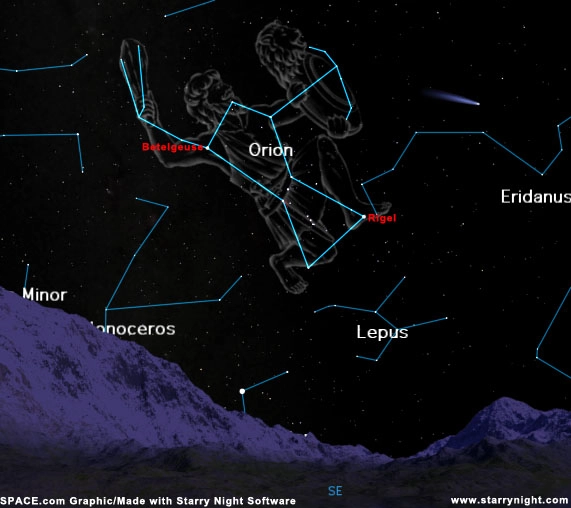
Look over toward the southeast part of the sky at around the same time. Can you see a large package in the sky, tied with a pretty bow across the middle? Four bright stars outline the package, while three close together and in a straight line, form the decorative bow.
Now you can see how our modern imagination might work, but tradition tells us that those seven stars formed a mighty hunter called Orion, the most brilliant of the constellations and visible from every inhabited part of the Earth. Two stars mark his shoulders, two more his knees and three his belt.
As is also the case with the mighty Hercules, the figure of Orion has been associated in virtually all-ancient cultures with great national heroes, warriors, or demigods. Yet, in contrast to Hercules, who was credited with a detailed series of exploits, Orion seems to us a vague and shadowy figure. The ancient mythological stories of Orion are so many and so confused that it is almost impossible to choose among all of them. Even the origin of the name Orion is obscure, though some scholars have suggested a connection with the Greek "Arion," meaning simply warrior. All, however, agree that he was the mightiest hunter in the world and he is always pictured in the stars with his club upraised in his right hand.
Hanging from his upraised left hand is the skin of a great lion he has killed and which he is brandishing in the face of Taurus, the Bull, who is charging down upon him.
The heavenly manger
The legendary French astronomer Nicolas Camille Flammarion (1842-1925) referred to the three belt stars of Orion as "The Three Kings." And if we were to consider these three stars as representing the Magi, then not too far away, to the east, within the faint zodiacal constellation of Cancer, is the star cluster known as Preasepe, the Manger.
A manger is defined as a trough or open box in which feed for horses or cattle is placed. But the Book of St. Luke also tells us that the baby Jesus, wrapped in swaddling clothes was set down in a manger because there was no room at the Inn. In our current Christmas week evening sky, Preasepe represents the manger where Christ was born.
In the sky, the constellation of Cancer is practically an empty space in the sky, positioned between the Twin Stars (Pollux and Castor) of Gemini and the Sickle of Leo. It's completely devoid of any bright stars and would probably not even be considered a constellation at all were not for the fact that there had to be a sign of the Zodiac between Gemini and Leo.
In the middle of Cancer are two stars called the Aselli ("donkeys") that are feeding from the manger; Asselus Borealis and Asselus Australis bracket Preasepe to the north and south, respectively. To the unaided eye the manger appears as a soft, fuzzy patch or dim glow. But in good binoculars and low-power telescopes, it is a beautiful object to behold, appearing to contain a splattering of several dozen stars. Using his crude telescope, Galileo wrote in 1610 of seeing Preasepe not as one fuzzy star, but as " . . . a mass of more than 40 small stars."
Unfortunately, for this year, the Moon will be passing through full phase on December 26, which means that it will be lighting up the evening sky and making it quite difficult-to-near impossible see the faint stars of Cancer or sky objects like Praesepe. This will be especially true on the night of December 28, when the Moon will lie just above it. It will be better to wait until after the first of the New Year, when the Moon rises later in the night, and leaving the evening sky dark.
The Shepherd's Star
Lastly, if you are up before sunrise, look low toward the east-southeast horizon to get a glimpse of what Flammarion described as "The Shepherd's Star," the planet Venus. He wrote:
"She shines in the east in the morning, with a splendid brightness which eclipses that of all the stars. She is, without comparison, the most magnificent star of our sky; the star of sweet confidences. It reigns sovereign of the skies, then plunges into the solar fires and disappears."
And that is exactly what is happening now.
Venus stands low in the southeast as dawn brightens; it has been a brilliant morning "star" for the last five months, but it also has been getting lower in the dawn for the past three months and continues to get a little lower with each passing week. We might even call it the forgotten planet - even though it is more than six times brighter than Jupiter! In another few more weeks, it will disappear into the glare of the Sun, not to reappear again until next spring in the evening sky.
Basic Sky Guides
- Full Moon Fever
- Astrophotography 101
- Sky Calendar & Moon Phases
- 10 Steps to Rewarding Stargazing
- Understanding the Ecliptic and the Zodiac
- False Dawn: All about the Zodiacal Light
- Reading Weather in the Sun, Moon and Stars
- How and Why the Night Sky Changes with the Seasons
- Night Sky Main Page: More Skywatching News & Features

Starry Night software brings the universe to your desktop. Map the sky from your location, or just sit back and let the cosmos come to you.

| DEFINITIONS |
Degrees measure apparent sizes of objects or distances in the sky, as seen from our vantage point. The Moon is one-half degree in width. The width of your fist held at arm's length is about 10 degrees. 1 AU, or astronomical unit, is the distance from the Sun to Earth, or about 93 million miles. Magnitude is the standard by which astronomers measure the apparent brightness of objects that appear in the sky. The lower the number, the brighter the object. The brightest stars in the sky are categorized as zero or first magnitude. Negative magnitudes are reserved for the most brilliant objects: the brightest star is Sirius (-1.4); the full Moon is -12.7; the Sun is -26.7. The faintest stars visible under dark skies are around +6. |