
Bezos and Blue Origin Reportedly Pitch 'Amazon-like' Delivery for the Moon
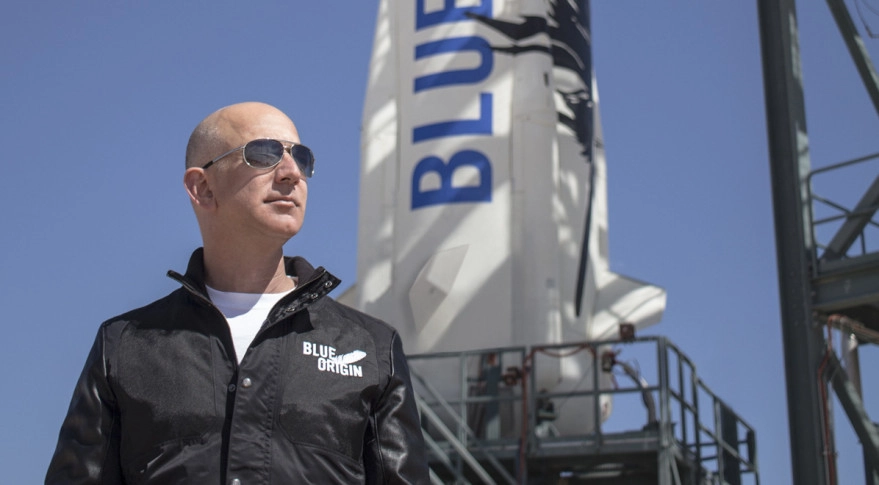
In a January white paper circulated within NASA and the Trump transition team, Blue Origin proposed developing a cargo lander called Blue Moon that could support a future lunar base at the south pole, where there are both deposits of water ice and regions in almost constant sunlight.
The Blue Moon spacecraft could fly on a number of launch vehicles, including Blue Origin's New Glenn vehicle under development. [Washington Post]

More News
China launched a new version of its Kaituozhe small launch vehicle late Thursday. The Kaituozhe-2 rocket lifted off from the Jiuquan Satellite Launch Centre at 6:53 p.m. Eastern and placed a satellite called Tiankun-1 into orbit. The solid-fueled Kaituozhe-2 rocket, likely based on an ICBM, is capable of placing payloads of up to 350 kilograms into orbit. Tiankun-1 will be used for remote sensing and telecommunications experiments. [gbtimes]
At least five companies have filed proposals for V-band satellite constellations in response to a concept from Boeing. Those companies met a March 1 deadline set by the FCC to respond to a Boeing proposal last year for a constellation of up to 2,956 satellites in low Earth orbit that would provide broadband communications in the little-used V-band part of the spectrum. The proposals submitted include a 7,518-satellite system by SpaceX as well as concepts from OneWeb, Telesat, O3b and Theia Holdings. [SpaceNews]
NASA's MAVEN Mars spacecraft performed a maneuver this week to avoid a potential collision with the Martian moon Phobos. MAVEN adjusted its orbit Tuesday to avoid the "high probability" it would collide with Phobos on March 6. The orbits of the spacecraft and the moon intersect, and on that day the two would have passed through the same point just seven seconds apart. The incident is the first time MAVEN has had to maneuver to avoid a potential collision with a moon or another spacecraft. [SpaceNews]
The Air Force is reviewing the orbit-raising propulsion system used on Lockheed Martin military satellites. The Air Force started the review of the propulsion system after an undisclosed problem on a recent spacecraft. The propulsion system is part of the A2100 bus, which is used on several Lockheed military and commercial satellite programs. The review has delayed the Air Force's acceptance of the first GPS 3 satellite, although the spacecraft is still scheduled for launch in the spring of next year. [Bloomberg]
A company best known for building cameras for planetary missions has won a contract for a satellite servicing program. Malin Space Science Systems won a $10.9 million contract from the Naval Research Lab to provide the camera for DARPA's Robotic Servicing of Geosynchrous Satellites program. DARPA announced an agreement last month with Space Systems Loral to develop the spacecraft, but Orbital ATK filed suit in a bid to block the deal. DARPA, citing the suit, declined to comment on the camera contract. [SpaceNews]
Astro Digital has raised $16.65 million to further development of its Earth imaging satellites and analytics platform. The company said Thursday the Series A round would go towards initial launches of its Landmapper smallsats that will provide medium-resolution Earth imagery, as well as development of a complementary high-resolution satellite system. The company is also developing a software platform that converts the images into industry-specific data for customers. [SpaceNews]
China plans to launch the core module of its space station next year. The module, named Tianhe-1, will launch on a Long March 5 heavy-lift rocket next year and be followed by other components, including two modules that will serve as space labs. China expects to complete the station in 2022 and operate it for "dozens of years." [Xinhua]
This story was provided by SpaceNews, dedicated to covering all aspects of the space industry.
