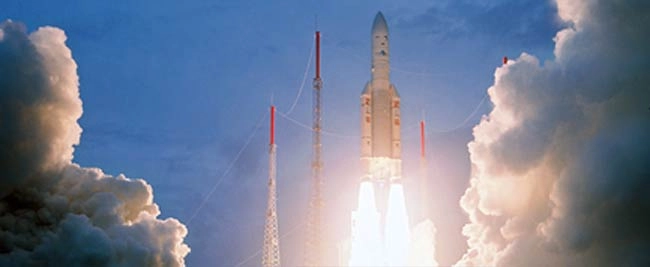
For this second time this month, the workhorse Ariane 5rocket carried out a double satellite deployment mission just like clockwork onThursday and set the stage to break its record for flights in a single year.
The hydrogen-fueled main engine roared to life at theappointed moment of 2000 GMT (4:00 p.m. EDT), followed seven seconds later byignition of the twin solid rocket boosters to begin thundering out of theGuiana Space Center in Kourou on the northeastern coast of South America.
The booster climbed steeply through the late afternoonclouds and headed downrange for a half-hour trek into geosynchronous transferorbit to deliver the NSS 12 and Thor 6 commercial communications satellites.

"This latest success confirms that Ariane 5 isthe commercial market's only operational launcher capable of simultaneouslylaunching two large direct television broadcast satellites," saidJean-Yves Le Gall, chairman and CEO of Arianespace. "It also confirms thatArianespace is the only launch services company capable of orbiting fourcommercial satellites in four weeks - which I also think is a new record."
The Ariane achieved a highly elliptical orbit stretching22,346 miles at its farthest point from Earth and 155 miles at the nearest. Thesatellites will use their onboard engines to circularize the orbit and reachgeostationary slots.
Riding atop the dual payload stack was NSS 12, a powerfulspacecraft to be operated by SES World Skies to cover most of the EasternHemisphere for commercial and government customers stretching from Europe to theMiddle East, Africa, Asia and Australia.
The satellite was built to replace the NSS 8 craft destroyedin the catastrophic liftoffexplosion by a Sea Launch Zenit 3SL rocket in early 2007.
"NSS 12 represents a special commitment that our CEO,Robert Bednarek, made on January 30, 2007, when we lost the NSS 8 satellite.Less than three years later, we are here in Kourou to mark the launch of NSS12," said Scott Sprague, senior vice president of global sales SES WorldSkies.
The company invited some of its customers to the Ariane baseto watch the critical and long-awaited launch.
"It's great to see so many of our customers here today.They are in the audience, they are here to witness its beginning," saidSteve Collar, senior vice president for market development, SES World Skies.
Manufactured by Space Systems/Loral with a 15-year designlife, the 12,400-pound satellite carries 48 Ku-band and 40 C-band transponders.
It will be parked in geostationary orbit over the equator at57 degrees East longitude to take the place of the aging NSS 703 satellite,which was launched aboard an Atlas 2AS rocket from Cape Canaveral in 1994.
"NSS 12 will be going to a really important slot forSES World Skies," Collar said. "It will be replacing NSS 703, whichhas been a really key satellite for us. But NSS 12 provides substantialexpansion from that orbital slot."
Sharing the ride to orbit aboard the Ariane 5rocket Thursday was Thor 6, a communications satellite to serve the Nordiccountries by operator Telenor Satellite Broadcasting.
The satellite will replace the Thor 3 spacecraft launchedaboard a Delta 2 rocket from Cape Canaveral in 1998.
Built by Thales Alenia Space and weighing 6,725 pounds atlaunch, Thor 6 is bound for a geostationary orbital slot at 1 degree Westlongitude.
"Thor 6 will be very important for our business as itwill be the largest satellite in the Thor fleet with its 36 transponders. SoThor 6 will have nearly three times as many transponders as Thor 3 satellitehas, which it is set to replace," said Peter Olsen, satellite missiondirector from Telenor.
"Not only will Thor 6 provide this replacementcapacity, it also provides additional capacity and capability to expand intothe Central and Eastern European market and also will enable the ongoingtransition from standard definition to high definition television."
For Arianespace, the launch Thursday represented the 48thflight for the Ariane 5 and the sixth in 2009. A record-setting seventh missionof the year is scheduled for early December to haul the French militaryreconnaissance satellite Helios 2B into orbit.
"We set the goal of increasing our launch rate, and areon track to meet this challenge," Le Gall said Thursday. "Wheneveryou take up a challenge, there are people who doubt. Being able to win overthese doubters is great satisfaction."
- All About Satellites
- Ariane 5 Rocket Launch Scrubbed Due to Technical Glitch
- How to Spot Satellites
Copyright 2009 SpaceflightNow.com,all rights reserved.