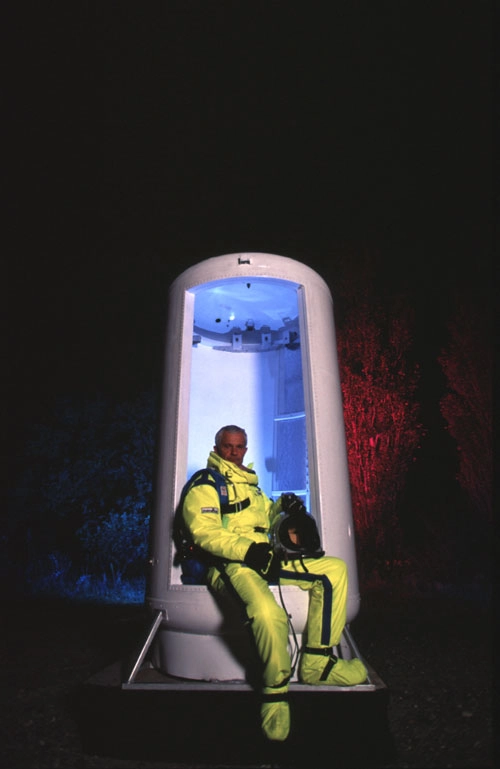
NORTH BATTLEFORD,Saskatchewan (AP) - A French skydiver's hope to set a new free-fall recordmight have come to an end on Tuesday when his ride to the sky left without him.
The helium balloon MichelFournier, a former army paratrooper, was going to use to soar to thestratosphere detached from the capsule he was going to use to jump from40,000 meters (130,000 feet).
It happened after theballoon was inflated on the ground at the airport in North Battleford,Saskatchewan. The balloon drifted away into the sky without the capsule.

Fournier appeareddisappointed as left the capsule and walked to the hanger. He was hugged bymembers of his entourage.
The balloon was reported tohave cost at least US$200,000 (euro127,000) and Fournier was said to havealready exhausted his finances. His handlers planned a media briefing for laterTuesday.
Fournier, 64, had plannedto make the attempt Monday, but had to postpone his plans because of weatherconditions.
Attempts in 2002 and 2003ended when wind gusts shredded his balloon before it even became airborne.
Fournier hoped to break the recordfor the fastest and longest free fall, the highest parachute jump and thehighest balloon flight. He also hopes to bring back data that will helpastronauts and others survive in the highest of altitudes.
An army of technicians,data crunchers, balloon and weather specialists arrived recently in NorthBattleford, a city of 14,000 near the Saskatchewan-Alberta boundary, for theattempt.
Fournier had planned tomake the jump in his native France, but the government denied him permissionbecause it believed the project was too dangerous. He then came to NorthBattleford, an agricultural and transportation hub northwest of Saskatoon.
Spokeswoman FrancineLecompte-Gittens said Monday's postponement was due to unfavorable weather.
Fournier, who has more than8,000 jumps under his belt, planned to be three-times higher than a commercialjetliner. A mountain climber would have to ascend the equivalent of four MountEverests stacked one on top of the other.
It is expected to takeFournier 15 minutes just to come down, screaming through thin air at 1,500kilometers per hour (932 mph) - 1.7 times the speed of sound - smashing throughthe sound barrier, shock waves buffeting his body, before finally deploying hischute about 6,000 meters (yards) above the prairie wheat fields.
- Image Gallery: The Fun of Ballooning
- Image Gallery: Extreme Adventures
- Future of Flight: Space Tourism, Investment and Technology
